
Plan around $40–$100 per m² installed; buy UV-protected sheet from reputable brands and treat the warranty period as the real quality signal; pick tinted or twin-wall product over living spaces to manage heat; and insist on oversized fixing holes — thermal movement is what kills badly installed polycarbonate.
| Topic | What the post says |
|---|---|
| Installed price | Roughly $40–$100 per square metre as a general guide — corrugate at the budget end, twin-wall and multi-wall with glazing bars at the top |
| Small projects | A pergola or single carport often lands around $1,500–$5,000 installed |
| Service life | Quality UV-protected sheet commonly serves 10–20 years in NZ; unprotected cheap sheet fails much sooner |
| Best uses | Pergolas and outdoor rooms (twin-wall, tinted), carports and lean-tos (corrugate), light panels in metal roofs, walkway covers |
| Poor uses | Primary house roofs and anywhere foot traffic is expected — the sheet is non-trafficable and dangerous to walk on |
| Installation details | Oversized fixing holes, correct purlin spacing, compatible tapes and closures, and adequate fall |
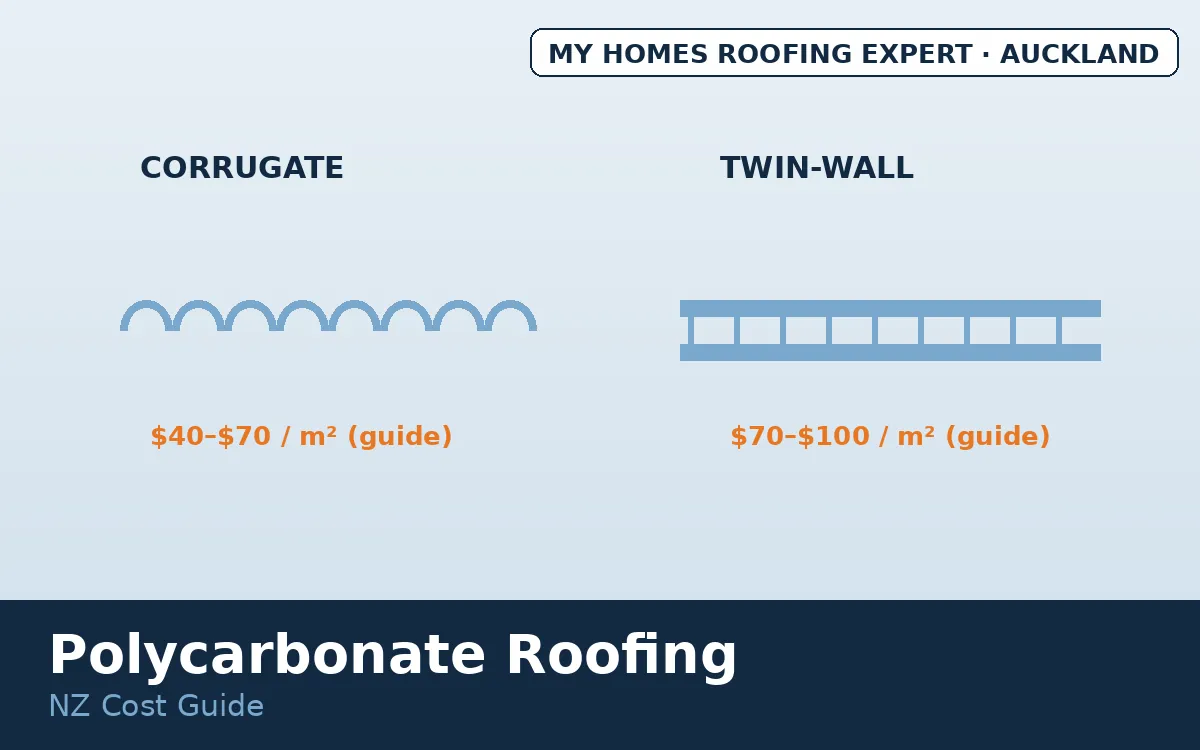
Polycarbonate roofing cost in NZ is friendly by roofing standards. As a general guide, expect installed pricing in the region of $40–$100 per square metre — standard corrugate profiles at the budget end, premium twin-wall and multi-wall systems with proper glazing bars at the top. Typical small projects like a pergola or single carport often land around $1,500–$5,000 installed.
Clear roofing earns its place wherever light matters: pergolas and outdoor rooms, carports beside kitchen windows, walkway covers, and the light strips that brighten dark lean-tos on older Auckland homes. The product has also genuinely improved — modern UV-co-extruded sheets bear little resemblance to the yellowed, brittle fibreglass of the 1980s.
How much does polycarbonate roofing cost in NZ?
Direct answer: roughly $40–$100 per m² installed as a general guide. What sets your number: sheet type — corrugate profiles are economical and fix like roofing iron, while twin-wall and multi-wall sheets cost more and need end closures and glazing bars; tint — clear, opal, bronze, and grey price similarly, so choose on heat and light rather than cost; structure — sheets need correctly spaced purlins, and adding or fixing framing is often part of a quote on older pergolas; span and pitch — low-pitch installations need careful lap and sealing detail to stay weathertight; and access — most polycarbonate lives at easy single-storey height, which keeps labour reasonable. For the structures these roofs usually sit on, see our pergola roofing guide and garage and carport re-roofing service.
Where does polycarbonate work best — and where should it not go?
Best uses: pergolas and outdoor rooms (twin-wall, tinted), carports and lean-tos (corrugate), light panels within metal roofs, and walkway or clothesline covers. Poor uses: primary house roofs — polycarbonate is not a substitute for long-run or tile over living spaces — and anywhere regular foot traffic is expected, because the sheet is non-trafficable and genuinely dangerous to walk on. That last point deserves emphasis for safety: brittle or even new clear sheeting will not reliably hold a person, and falls through fragile roofing cause serious injuries every year in NZ. Roof work over or beside clear sheeting is strictly for trained workers using planks and proper protection.
What separates a good installation from a short-lived one?
Four details: oversized fixing holes with the manufacturer's screws and washers, so sheets can move with temperature; correct purlin spacing for the profile and wind zone — under-supported sheet flexes, leaks, and fails in storms; end and lap sealing done with compatible tapes and closures, since the wrong sealant attacks polycarbonate; and adequate fall so water sheds rather than ponds against laps. Quotes that mention these details are quoting the same job you think you are buying; quotes that just count metres often are not.
What Cost, Risk and Maintenance Factors Apply?
Maintenance is gentle: soft wash with mild detergent, never solvents or abrasive pads, and keep overhanging debris cleared so leaf piles do not stain or hold moisture against laps. Watch fixings after major storms — from the ground. And when an old clear roof has yellowed and crazed, replace rather than patch: UV damage runs through the sheet, and new fixings in brittle material just create new cracks.
How Do You Get a clear roofing quote in Auckland?
My Homes Roofing Expert supplies and installs polycarbonate roofing on pergolas, carports, and lean-tos across Auckland — honest advice on corrugate versus twin-wall and a free, no-obligation quote. Call 022 501 9921 or get in touch.
What Questions Do Auckland Homeowners Ask?
How much does polycarbonate roofing cost in NZ?
Roughly $40–$100 per m² installed as a general guide; small pergola and carport jobs often land at $1,500–$5,000.
How long does it last?
Quality UV-protected sheet commonly serves 10–20 years in NZ; unprotected cheap sheet fails much sooner.
Is twin-wall worth it over corrugate?
Over living spaces, usually yes — better heat, noise, and looks. For simple carports, quality corrugate is fine.
Does it get hot underneath?
Clear sheet can — tinted and twin-wall options cut heat gain while keeping light.
Why do these roofs crack at screws?
Thermal movement against tight fixings — oversized holes and correct washers prevent it.
What else should you know?
What makes a polycarbonate roof installation last?
Four details decide it: oversized fixing holes with the manufacturer’s screws and washers so sheets can move with temperature; correct purlin spacing for the profile and wind zone; end and lap sealing with compatible tapes and closures, since the wrong sealant attacks polycarbonate; and adequate fall so water sheds rather than ponds against laps.
Topics covered
- clear roofing price
- twin wall polycarbonate cost
- pergola roof sheets cost
- corrugate polycarbonate NZ
- carport clear roofing