
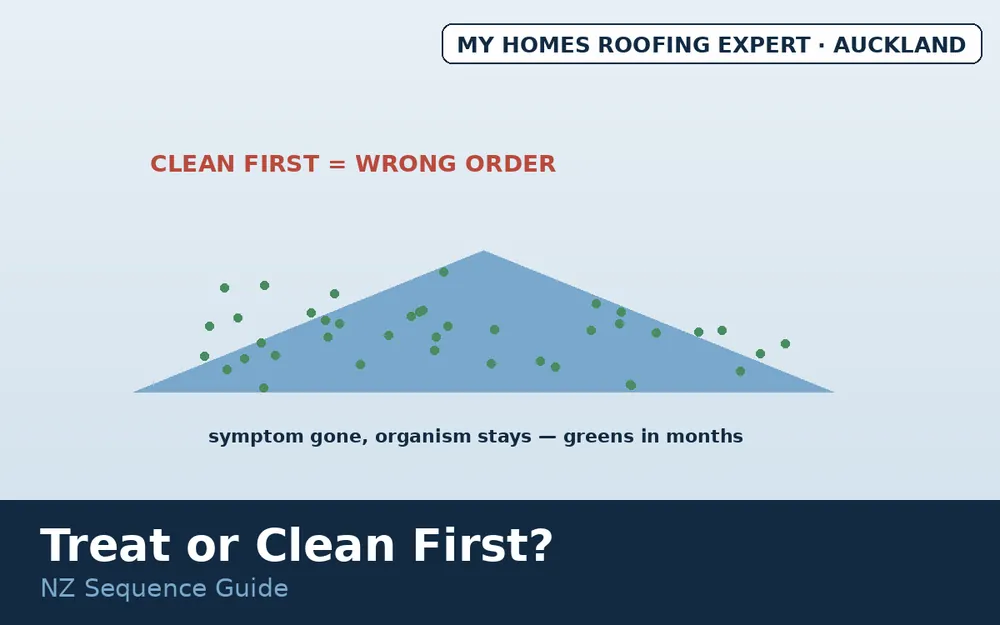
Treat, wait, clean — that order. Treatment kills at the root; the wait lets the biocide finish its work; cleaning removes the dead growth faster than weather alone. Clean-first removes the symptom and leaves the organism, which regrows within months — the wrong order's expensive lesson.
Roof cleaning or moss treatment first is the sequencing question that decides whether moss work lasts months or years, and the answer is clear: treat first, then clean. Treatment kills the moss, lichen, and algae at the root; the dead growth then weathers off or is cleaned away. Do it the other way — clean off the visible green without killing the organism — and the roots, spores, and fragments left behind recolonise fast in Auckland's damp, turning an expensive clean into a brief cosmetic pause.
It is a small piece of knowledge that saves real money, and this guide settles it with the reasoning behind the order.
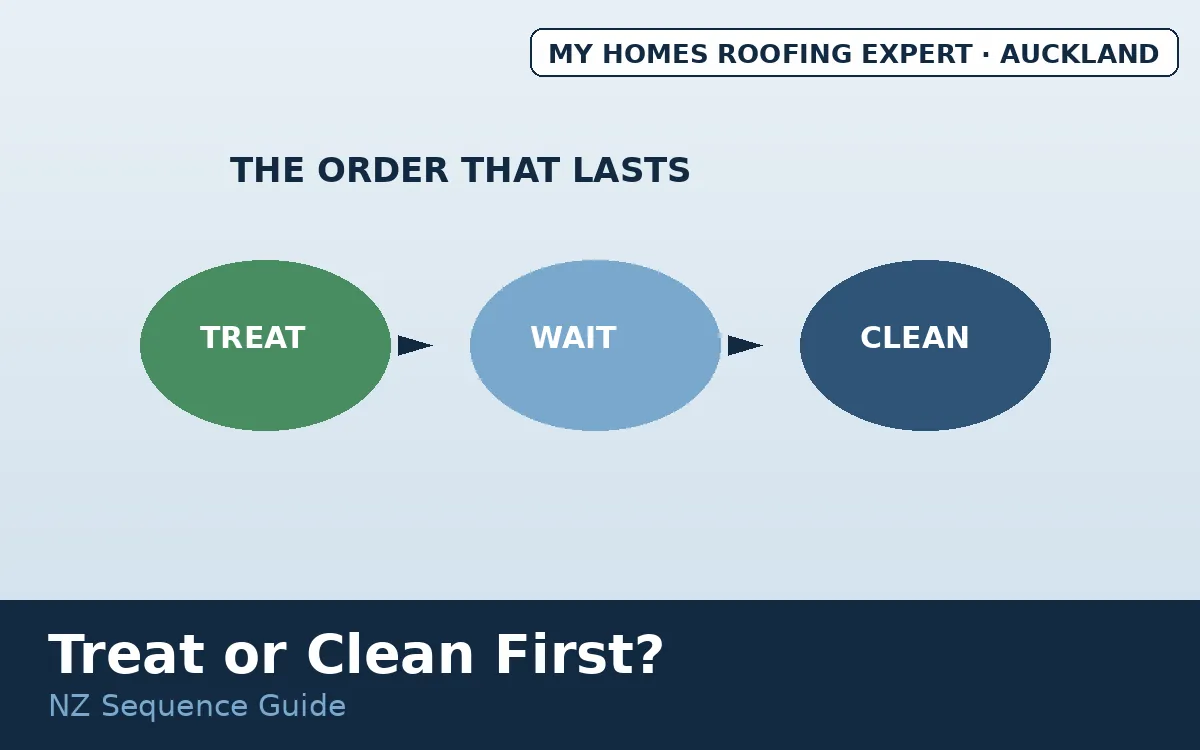
Should moss treatment come before or after cleaning?
Direct answer: treatment first, cleaning second. The reasoning: treatment kills the organism — biocides applied at low pressure penetrate and kill the moss, lichen, and algae at the root, the soft-wash chemistry our washing methods guide details and the aftercare guide tracks through its kill-brown-shed timeline; the dead growth then leaves — weathering off with rain over weeks, or cleaned away faster where a finished look is wanted sooner; and the result lasts.
Because the root structure is dead, regrowth runs on the multi-year cycle our regrowth guide maps rather than the multi-month one. The work itself splits across our moss treatment and roof cleaning services — and the relationship between them is exactly this sequence, treatment as the foundation and cleaning as the finish.
What the wrong order costs
Cleaning first is the intuitive mistake, and it fails three ways: fast regrowth — removing visible moss without killing it leaves roots, spores, and viable fragments that recolonise quickly in Auckland's damp shade, so the roof greens again within months and the cleaning money is spent twice; fragment spread — aggressive cleaning of live growth can scatter viable fragments across the roof, seeding new colonies in places the moss had not yet reached, the opposite of progress; and surface damage.
The pressure that strips live moss is the pressure that strips coatings and granules from the wrong surfaces, the damage our washing guide catalogues, here doubled by being both damaging and ineffective. The combined result is the disappointed owner who paid for a clean roof and watched it green within a season — not because cleaning failed, but because cleaning was asked to do treatment's job. The fix is simply the right order, which costs no more and lasts far longer.
The sequence before painting — where order matters most
The pre-paint sequence raises the stakes of getting the order right, because paint over unkilled growth fails: the correct order is treat, let it work, clean and prepare, then paint — the moss and lichen killed and removed before any coating goes on, so the new paint adheres to clean dead surface rather than living growth. Skipping the treatment step — cleaning visible moss and painting over what remains.
Is a classic cause of early coating failure, the growth continuing to work under the new film, lifting it from beneath, the failure our peeling guide and pre-paint repairs guide trace. The dwell-time discipline matters here too: treatment needs weeks to kill at the root, and rushing to clean-and-paint immediately removes growth before the biocide has finished, undercutting the whole sequence. Proper paint system preparation builds the wait in.
Which is one more reason the cheap quote that skips it costs more across the decade. The painting itself sits in our roof painting service, with treatment and cleaning as its non-negotiable first chapters.
What Cost, Risk and Timing Factors Apply?
The sequence costs nothing extra to get right — it is the same treatment and the same cleaning, ordered correctly — and saves the cost of doing either twice. The timing discipline is the dwell wait: weeks between treating and cleaning, longer before painting, so the biocide finishes its work. Risks are entirely the wrong-order ones: regrowth, fragment spread, surface damage, and coating failure — all avoided by the simple sequence. The work is height work on surfaces the treatment makes slippery.
Professional throughout, with the patience for the dwell period the owner's easy contribution.
How Do You Get the sequence right in Auckland?
My Homes Roofing Expert treats then cleans across Auckland — the order that lasts, the dwell time respected, and the pre-paint sequence done properly when painting follows. Call 022 501 9921 or visit moss treatment Auckland.
What Questions Do Auckland Homeowners Ask?
Treatment before or after cleaning?
Before — treatment kills at the root, then the dead growth weathers off or is cleaned away.
Why does cleaning first not work?
It removes the symptom, not the organism — roots and spores recolonise fast in the damp.
Do I need both?
Where moss is established, treatment is non-negotiable first; cleaning is the optional finish.
How does it fit before painting?
Treat, let it work, clean and prepare, then paint — painting over unkilled growth fails.
How long between treatment and cleaning?
Commonly weeks — the biocide needs dwell time to kill at the root before removal.
Topics covered
- order of roof maintenance
- treat then wash roof
- moss before cleaning NZ
- roof maintenance sequence
- moss treatment timing