
Map the internal point, trace uphill (water travels), check penetrations, laps, flashings, and internal gutters in order, and water-test by zone where the eye cannot confirm. The grid approach turns an overwhelming roof into a methodical sequence — and planned inspection beats reactive chasing by finding faults before they leak.
Warehouse roof leak detection is a different discipline from house-roof leak finding, because scale and water-travel defeat intuition. On a large commercial roof, the entry point is often a small fault in a vast field, water runs along purlins and structure far from where it entered, and the drip inside rarely sits below the fault outside. Random searching burns days; the professional approach is systematic — mapping, tracing uphill, checking suspects in order, and water testing where needed.
Auckland's warehouses, factories, and distribution buildings make this a routine commercial-roofing task, and the method is what separates a found leak from a week of guessing.
How are leaks found on large warehouse roofs?
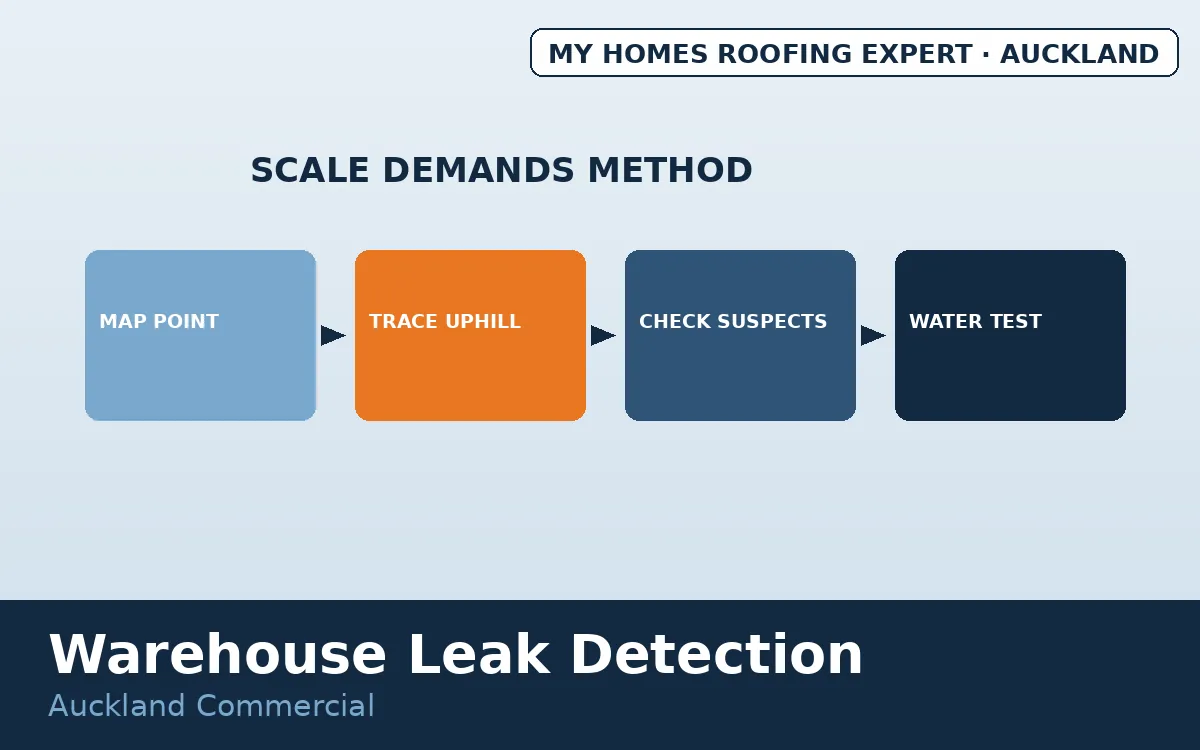
Direct answer: systematically — map, trace uphill, check the usual suspects, then water-test if needed. The method: map the internal point — the drip, stain, or wet patch located precisely against a roof plan, the anchor for everything after; trace uphill — because water travels along structure before dropping, the search starts at and above the internal point and works up-slope, not directly overhead (the water-travel principle our leak detection guide applies at house scale and warehouses amplify); check the suspects in order.
Penetrations and their boots (the penetration mortality that leads commercial leak lists), laps and fixings, flashings, and especially internal gutters (the high-consequence box gutters that discharge inside); and water-test where visual fails — controlled flooding or hosing of defined zones in sequence to reproduce the leak under observation, isolating the source by elimination. The scale and the method are core commercial roofing work; for context beyond the detection, our warehouse painting and factory membrane guides cover the surfaces involved.
The roof-plan grid — turning area into sequence
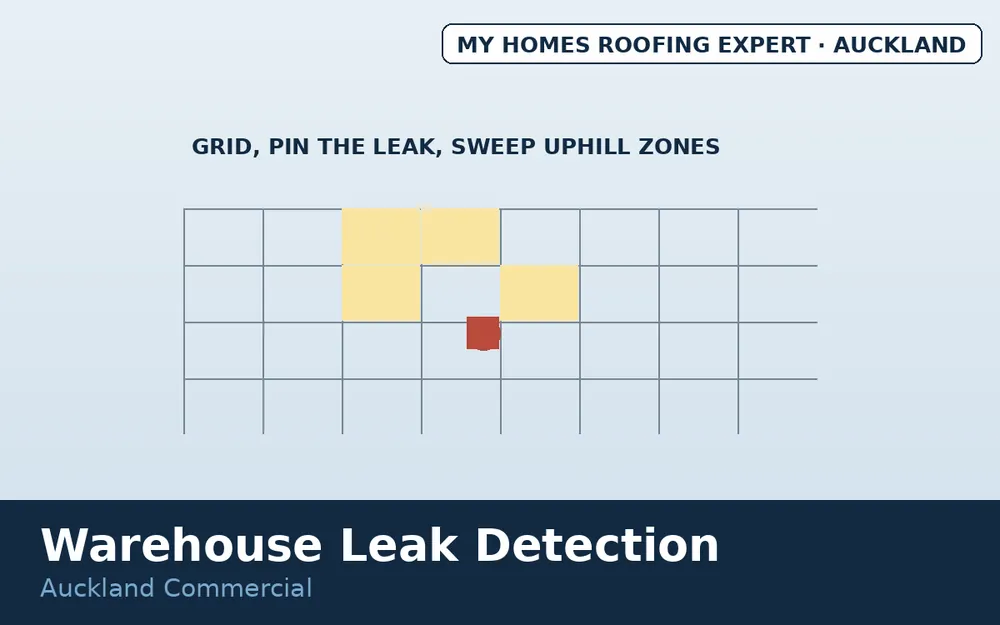
The grid approach is what makes a vast roof searchable: the map — the roof drawn or referenced as a grid of zones, each identifiable, the framework that replaces wandering with system; the location — the internal leak pinned to its grid position, then the zones above and uphill of it prioritised; the systematic sweep — each priority zone inspected for its suspects (penetrations, laps, flashings, gutters), findings recorded against the grid so what has been checked is documented and what remains is clear.
And the elimination logic — water testing applied zone by zone where visual inspection cannot confirm, each test ruling areas in or out until the source is isolated. The grid does three things random searching cannot: it makes the search complete (no zone forgotten), documentable (the record that feeds the maintenance contract and the insurer), and efficient (effort concentrated where water-travel logic points).
On a roof measured in thousands of square metres, the difference between grid method and guesswork is the difference between hours and days — and between a found leak and a recurring one.
Planned beats reactive — detection as routine
The deeper lesson warehouse leaks teach is that the best detection is the inspection that finds the fault before it leaks: reactive detection — chasing a leak already dripping on stock — happens under pressure, often in the weather that exposed the fault, with damage already accruing; planned detection.
The scheduled inspection rounds of a maintenance contract, walking the grid, checking the penetrations and gutters and flashings against their aging clocks, and catching the developing fault while it is still a maintenance item — turns leak detection from emergency into routine. The economics mirror the residential maintenance-plan maths at commercial scale: one prevented stock-damage event against years of programme inspection, with the documented condition history doubling as the insurer's and the building-sale's evidence. The fragile-panel and access disciplines apply throughout.
Translucent panels per the fragility rules, access per the access guide — because warehouse roofs concentrate every height-work hazard.
What Cost, Risk and Approach Factors Apply?
Reactive detection prices as commercial callout plus the tracing time the leak's difficulty demands — open-ended on a roof that defeats quick location, which is the reactive penalty. Planned detection prices inside the maintenance programme, where the grid is already mapped and the suspects already known. Risks are the method shortcuts (random searching, ignoring water-travel) and the access hazards (fragile panels, height) — the former wasting money, the latter wasting nothing worth risking. The systematic approach is the cost control, and the planned programme is the deeper one.
How Do You Get warehouse leaks found systematically in Auckland?
My Homes Roofing Expert detects and repairs leaks across Auckland's commercial roofs — gridded, traced uphill, water-tested where needed, and best caught on programme. Call 022 501 9921 or email info@roofingexpert.co.nz.
What Questions Do Auckland Homeowners Ask?
How are warehouse leaks found?
Systematically — map the internal point, trace uphill, check suspects in order, water-test by zone where needed.
Why are they hard to find?
Scale and water-travel — a small fault in a vast field, with water running far along structure before it drops.
What is the grid approach?
Mapping the roof as zones, pinning the leak, and sweeping uphill zones systematically — complete and documented.
What is water testing?
Controlled flooding or hosing of zones in sequence to reproduce the leak and isolate its source by elimination.
Planned or reactive?
Planned beats reactive — scheduled inspection finds faults before they leak, turning detection into routine.
Topics covered
- commercial leak tracing
- factory roof leak
- flood testing roof NZ
- large roof leak detection
- industrial roof leak