
Boots for pipes, rated kits for flues, engineered mounts for hardware, matched closures for redundant holes — and sealant only ever inside those systems. The boot clock runs 10–20 years; the smear clock runs two or three; and the binocular check reads both from the lawn.
Roof penetration sealing governs the most repetitive leak source in Auckland roofing: every pipe, flue, aerial, and solar foot is a designed hole in a weathertight surface, and each is only as good as the system sealing it — the boot, the flashing assembly, the engineered mount. The recurring villain is the smear: sealant beaded from pipe to roofing, carrying all the movement with none of the stretch, cracking on its UV schedule, and teaching the same leak lesson roofline after roofline.
This guide catalogues the penetration families, their aging clocks, and the sealing that actually lasts.
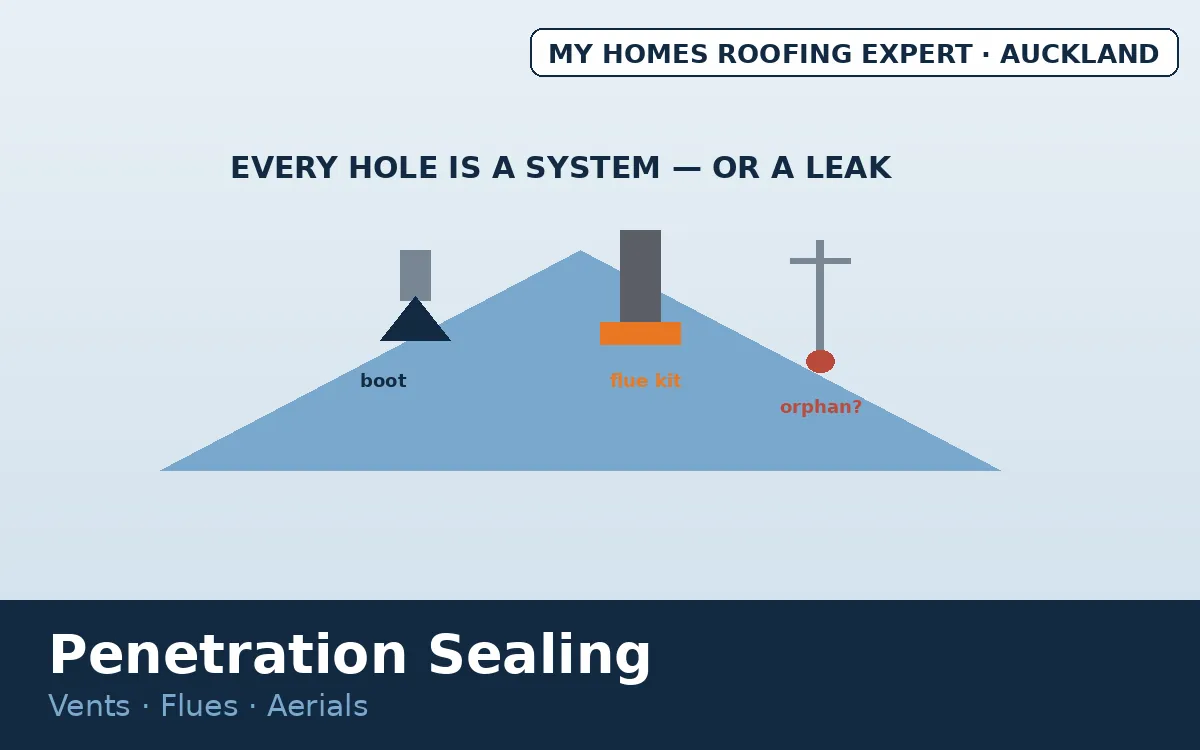
How should roof penetrations be sealed?
Direct answer: by the family's system — boots for pipes, rated assemblies for flues, engineered mounts for hardware — with sealant as gasket, never as structure. The families: pipes and vents — EPDM or silicone boot flashings, cone-sized to the pipe, base dressed to the roof profile, the standardised brilliance whose mortality the next section clocks; flues — high-temperature flashing assemblies rated for the appliance, with clearances and storm collars to specification, never an ordinary boot on a hot flue.
Aerials, dishes, and cables — the responsibility orphan: mounted by trades who are not roofers, their lag bolts and cable entries rank high among the mystery leaks our leak detection guide chases, and the rule is simple — any trade penetrating the roof flashes to roofing standard or brings someone who will; and solar mounts — engineered feet with their own flashing details, specified into the array per our solar prep guide, where the panel decades and the roof decades have to agree.
The material chemistry throughout follows the flashing families guide — compatible metals, compatible sealants, manufacturer tables over van stock.
The boot clock — penetration maintenance's headline item
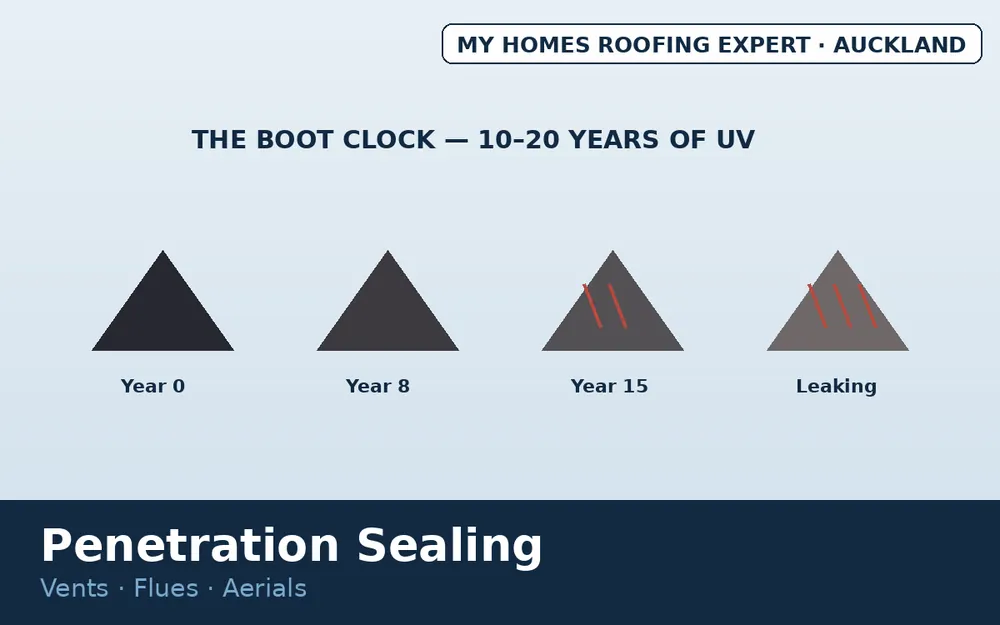
Pipe boots earn their own section because their failure is so common, so predictable, and so cheap to pre-empt: the aging arc — UV stiffens the rubber, surface crazing appears, cracks open at the cone's stretch lines, and the leak begins drip-small at the pipe's downhill side; the clock — 10–20 years by material and exposure, silicone outlasting EPDM under NZ sun, north-facing boots leading south; the read.
Crazing and cracking visible through binoculars, and boot age inferable from the roof's or the last repair's; and the renewal — boots replace routinely (retrofit split-boot designs avoid disturbing the pipe), priced as minor repair callouts and bundled naturally into the inspection-and-maintenance rhythm of the maintenance plan. The boot is a consumable component on a durable roof — replacing it on schedule is the system working, and finding it cracked in a ceiling-stain investigation is the schedule missed.
Penetration discipline across the roof's life
The management habits that keep holes honest: the register — know your penetrations (count them from the lawn), because each is a maintenance address and the inspection checklist our inspection guide walks treats them as first-class items; the trade rule — every new installation crossing the roofline (heat pump lines, EV cabling, dishes, flues) carries the flash-properly requirement into its contract, pre-empting the orphan-penetration pattern; the redundancy purge.
Dead aerial mounts, abandoned flues, and orphaned pipe stubs closed properly with matched sheet or fitted blanks at the next roof visit, since unused holes are pure liability; and the re-roof reset — strip-and-replace per our strip-off guide renews every penetration's flashing in one pass, which is one more line in the strip's value column.
What Cost, Risk and Timing Factors Apply?
Penetration economics are the trade's friendliest: boots and reseals as minor callouts, flue kits and mount reflashings as contained repairs, all dwarfed by the ceiling and cavity costs of the leaks they prevent. Risks are the smear and the orphan — both visible, both cheap to fix early. The standing rule holds: penetration work is height work around holes, professional territory, with the homeowner's register-and-binoculars routine the ground-level half of the system.
How Do You Get every hole on the register in Auckland?
My Homes Roofing Expert seals, renews, and closes penetrations across Auckland — boots on clock, flues to rating, orphans flashed or purged. Call 022 501 9921 or book a free inspection.
What Questions Do Auckland Homeowners Ask?
How are penetrations sealed properly?
By system — boots, rated flue kits, engineered mounts — with sealant only as the gasket within.
How long do boots last?
10–20 years on the UV clock, silicone outlasting EPDM — a consumable replaced routinely.
Why does sealant alone fail?
Movement and UV — a bridging bead carries the movement with none of a boot's stretch.
Aerial and dish penetrations?
Whoever mounts them must flash to roofing standard — the orphan penetration is a classic mystery leak.
Remove unused penetrations?
Yes — closed properly with matched sheet or blanks, not smeared over.
Topics covered
- pipe boot replacement
- flue flashing leak
- aerial mount sealing
- vent pipe roof seal
- solar mount flashing