
Expect a few days, a provisional sum for rafter-end repairs, fascia strung straight, gutters continuous and falled to outlets, and downpipes proven with a hose. The assembly renews together because it failed together — and the drainage specialists at Gutter Expert work this exact sequence across Auckland alongside our spouting and guttering team.
Fascia gutter replacement process questions usually arrive after the symptoms have linked up: gutters weeping at rusted seams, fascia paint bubbling behind them, and the soft-timber probe confirming what the overflow years were doing in the dark. The remedy is the combined renewal — strip the assembly, repair the revealed timber, refit fascia straight, hang continuous spouting to true fall — and walking the sequence in advance is the best inoculation against both surprise and shortcut.
The pairing logic leads everything: gutters and fascia fail each other, mount to each other, and renew properly only together.
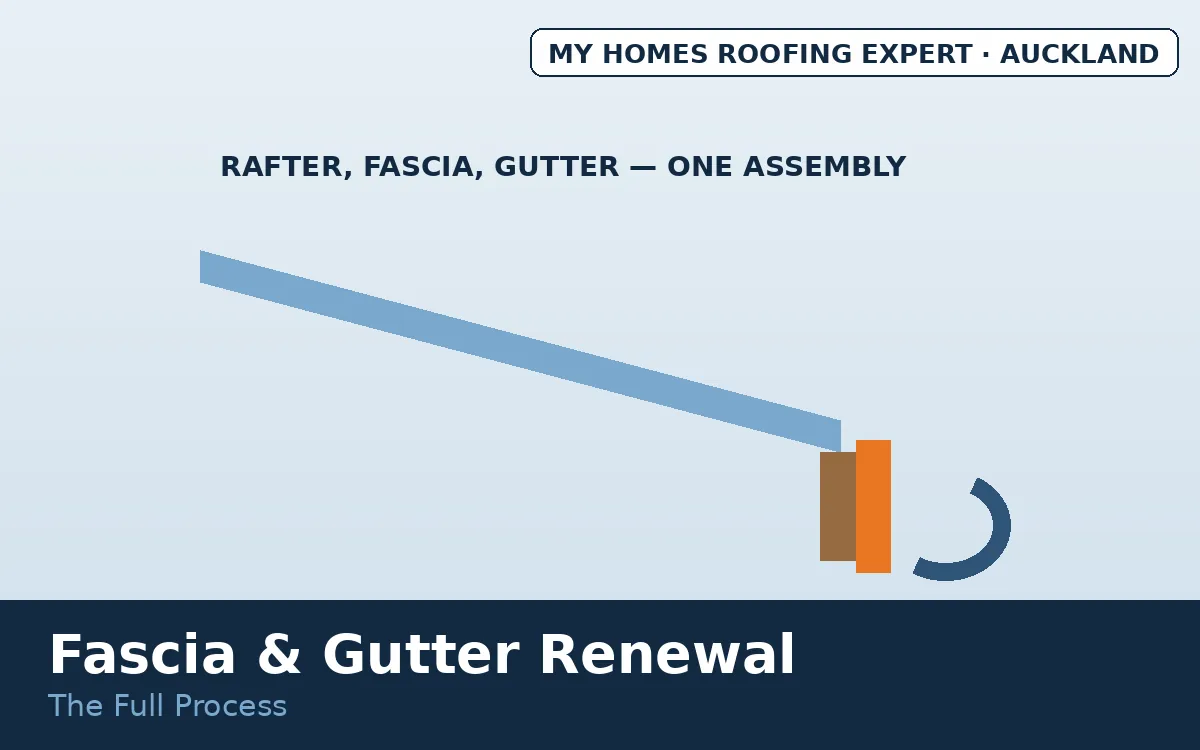
What does the replacement process involve?
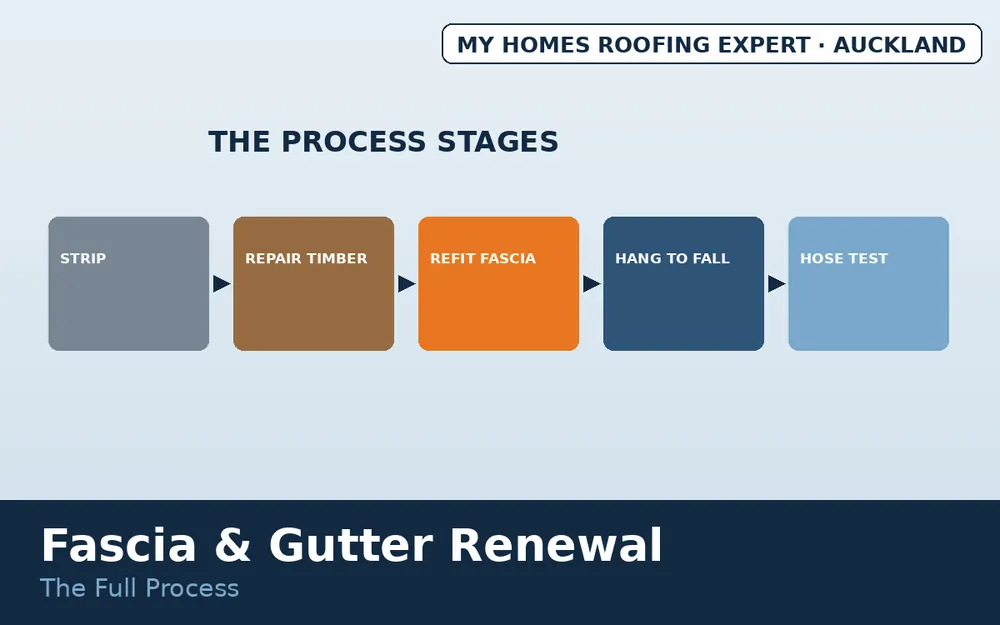
Direct answer: strip, assess, repair, refit, hang, connect, finish — typically a few days on an average home. The stages: strip — old spouting off (its rust line and joint history confirming the replacement call), then fascia boards off, the careful demolition that protects the soffit and roofing edge above; assess — the revealed rafter ends and soffit edges read honestly, the hidden-condition stage the next section details; repair.
Rot cut back to sound timber, rafter ends sistered or capped, soffit edges renewed, the carpentry that everything after mounts to; refit — new fascia fitted straight and true (a string-line discipline, since the fascia line is the streetscape line), in the material matched to house and system; hang.
Continuous spouting roll-formed on site and hung to the correct fall per the gradient logic of our fall guide, brackets at proper spacing, profile and capacity sized to the roof per the materials guide; connect — downpipes positioned, joined, and discharge-checked; and finish — drip edges dressed, paint or touch-ups where timber fascia wants them, site cleared.
The hidden-condition stage — what the strip reveals
Fascia removal is the eaves line's diagnostic window, and the findings catalogue is consistent: rafter end rot — the headline, where decades of gutter overflow wicked into the concealed timber, ranging from surface softness (treated and capped) through structural loss (ends sistered with new timber) — the repair scope our fascia cost guide carries as the honest provisional sum; soffit edge decay — the board edges sharing the moisture history, renewed in section while open; past improvisations.
The doubled boards, odd packers, and legacy repairs that older eaves lines accumulate, rationalised now; and the dry surprise — plenty of strips reveal sound timber throughout, the provisional sum returning unspent, which is exactly how provisional sums should work. The stage's discipline is photographic: revealed conditions pictured before repair, the documentation habit every honest contractor carries and every quote comparison should expect.
The decisions inside the job
Four choices shape the result: fascia material — primed timber for heritage fidelity and paintability, pre-finished metal systems for integration and low maintenance, composites between, matched to era and appetite; gutter system — material per the four-family logic (steel default, aluminium coastal), profile per the house's era, capacity per the roof's catchment — replacement being the once-a-generation moment to fix undersizing rather than inherit it; downpipe rationalisation.
Positions and counts reviewed against the overflow history rather than copied, the capacity thinking of the overflow guide; and scope pairing — roof edge details renewed while the line is open, and the whole job sequenced into re-roofing where both are due, since the eaves assembly and the roof edge meet at exactly this line. Access per the access guide leans platform — this is edge work by definition.
What Cost, Risk and Timing Factors Apply?
Pricing assembles from the fascia and spouting guides' ranges — per-metre rates, the rafter-end provisional, access by height — with the combined job beating the sum of separate ones on shared access and labour. Risks are the pairing shortcuts: new gutters screwed to rotten fascia, new fascia behind dying gutters, both restarting the clock the combined job exists to stop. Timing favours the dry seasons for the open-eaves days, and the work is scaffold-line work end to end — professional territory, with the homeowner's contribution the hose test at handover.
Renew the eaves line properly in Auckland
My Homes Roofing Expert replaces fascia and spouting as one system across Auckland — strips photographed, rafter ends repaired honestly, gutters hung to proven fall. Call 022 501 9921 or request a free quote.
What Questions Do Auckland Homeowners Ask?
What does the process involve?
Strip, assess revealed timber, repair, refit fascia straight, hang continuous spouting to fall, connect downpipes, finish.
Why replace both together?
One assembly — they fail each other, mount to each other, and renew properly only together.
What does the strip reveal?
Rafter end rot most commonly — carried as a provisional sum, photographed, sometimes happily unspent.
What fascia materials?
Primed timber, pre-finished metal systems, and composites — matched to era and maintenance appetite.
Roof edge at the same time?
Sensibly yes where tired — and the whole job pairs into re-roofing when both are due.
Topics covered
- fascia board replacement steps
- new spouting installation
- fascia and gutter renewal
- replace fascia gutters together
- eaves line replacement