
Why gutters pool and overflow when the fall fails — reading standing water, the realignment process, and when correction beats replacement.
Gutter fall correction fixes the failure nobody sees happen: spouting that left the installer with a clean gradient to the outlet and has spent the years since sagging, settling, and losing its slope — until water stands in the channel, silt and moss move in, and mid-run overflow appears in rain that the system once handled easily. The fix is realignment: brackets reset, the line restored, the gradient water-tested — contained work with outsized drainage returns.
The diagnostic gift is that standing water testifies for days after every shower, making this one of the most readable faults in the whole drainage system.
How is incorrect gutter fall fixed?
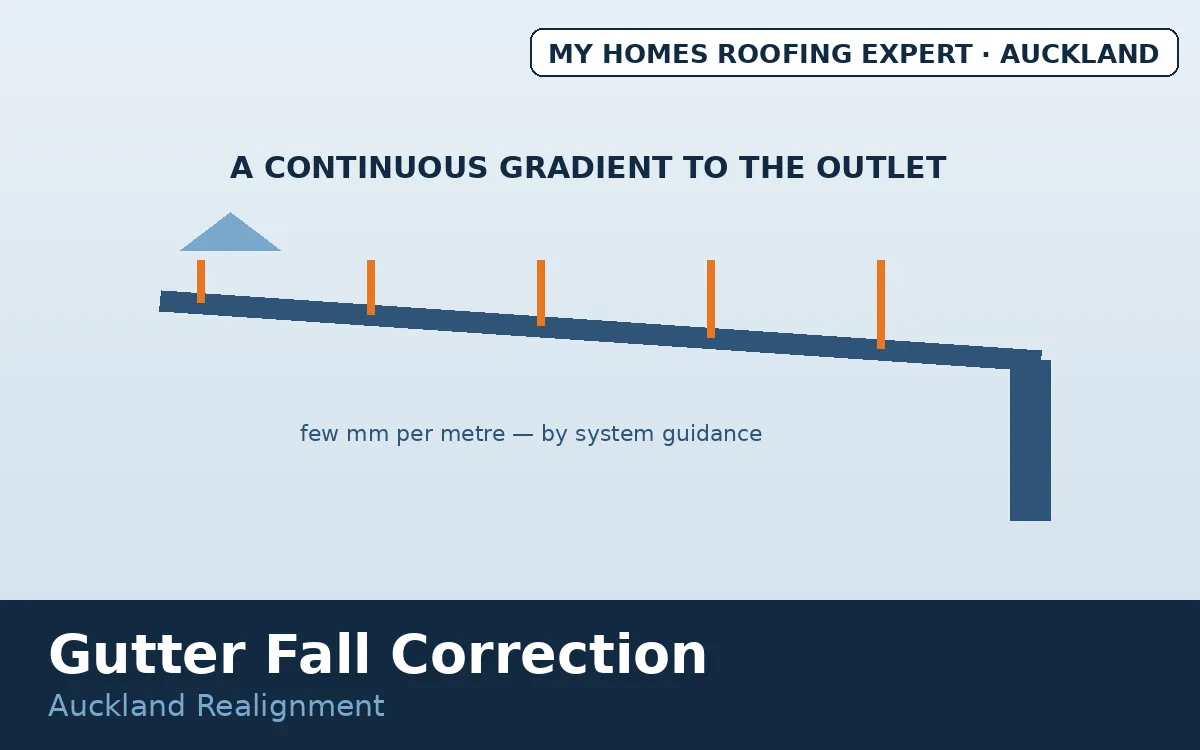
Direct answer: support first, line second, water-test third. The process: cause reading — sagged fall has a reason, and the realignment that lasts addresses it: brackets loosened in tired fascia (refastened or repositioned), fascia itself soft or moving (the fascia conversation arriving before any line work, since corrected fall on rotting timber is geometry on borrowed time), spans bowing between too-few supports (brackets added to proper spacing, the support arithmetic our sagging spouting guide covers), and local kinks pressed by ladders or branches (dressed or sectioned out); the line reset — a string line or level run from high point to outlet, brackets adjusted along it to restore continuous gradient, with long runs occasionally wanting an added downpipe rather than an impossible slope (the capacity thinking the overflow guide brings); and the water test — hose at the high end, drainage watched to empty, the proof the job ends on.
In short
Standing water means lost fall; lost fall means realignment over sound support — brackets reset to a string-line gradient, causes fixed first, result water-tested. On dying metal or soft fascia, the correction question yields to the replacement one before any brackets move.
Reading the fall from the ground — the owner's evidence kit
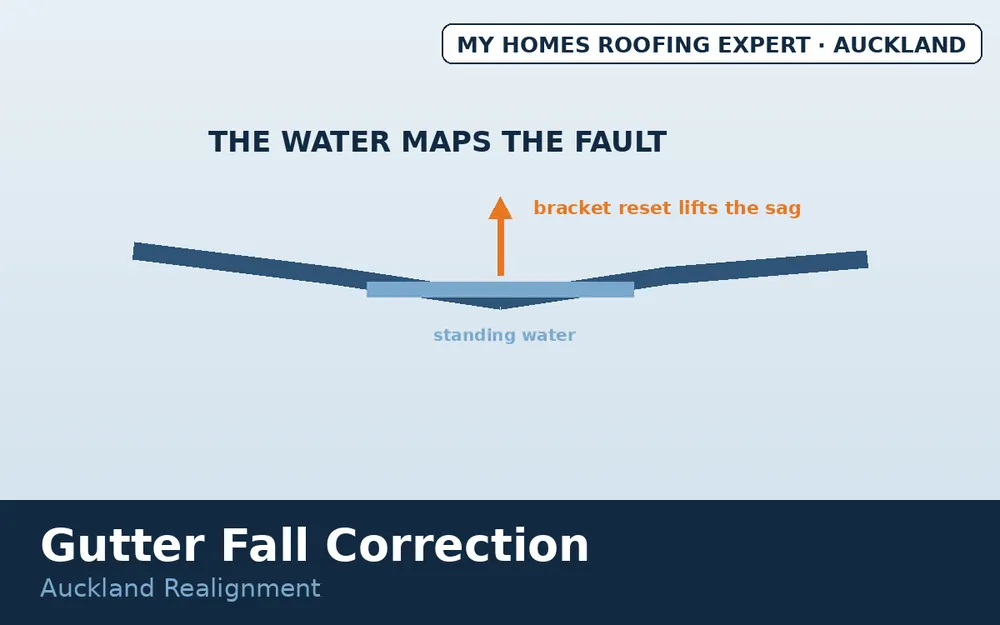
The fault testifies generously: the post-rain check — a dry day after weather, and any gutter still holding water has told you everything; tide marks — silt lines and staining inside the channel mapping where water habitually stands, visible from a stepladder's safe height or the upstairs window; resident moss — growth in the gutter itself is a wetland declaration, distinct from the roof-shed debris the cleaning guides handle; mid-run overflow — spilling between outlets in moderate rain, where blockage-driven overflow concentrates at the blockage; and summer mosquitoes — standing gutter water is breeding habitat, an under-appreciated tell. The pattern distinguishes fall failure from its cousins — blockage (clears with cleaning), capacity (overflows everywhere in heavy rain only), and joint leakage (drips at specific points) — the triage a free inspection formalises.
Why fall matters more than it looks
The costs of the flat gutter compound quietly: corrosion acceleration — steel spouting holding water rusts along its standing line years ahead of schedule, the internal water-line story that the repair-vs-replace guide reads as the retirement signal; blockage amplification — standing water catches and binds debris that flowing water would carry to the outlet, multiplying cleaning frequency; overflow geometry — pooled sections crest first in heavy rain, wetting fascia at the run's weakest points; and the load spiral — standing water is weight, weight deepens the sag, and the sag holds more water, the feedback loop that turns millimetres of lost fall into visible droop. Correction interrupts the spiral early; the drainage specialists at Gutter Expert see its late stages across Auckland weekly, and the early intervention is always the cheap one.
Cost, risk, and timing factors
Correction pricing is contained — assessment, bracket work, and testing inside the spot-repair ranges, scaling with run length and access height, and pairing economically with cleaning visits since the empty gutter is the adjustable one. Risks are sequencing risks: lines reset on failing fascia, and corrections sold onto retired metal — both caught by the support-first, condition-first discipline. The work itself is gutter-line height work, professional as ever, with the post-rain glance the owner's standing contribution.
Get the fall read and reset in Auckland
My Homes Roofing Expert reads, corrects, and water-tests gutter fall across Auckland — causes first, lines true, on spouting that deserves it. Call 022 501 9921 or visit spouting and guttering Auckland.
Frequently asked questions
How is bad fall fixed?
Brackets reset to a string-line gradient toward the outlet, support causes fixed first, result water-tested.
How do I know fall has failed?
Standing water days after rain — plus tide marks, resident moss, and mid-run overflow.
Why does fall fail?
Loosening brackets, sagging fascia, bowing spans, and local kinks — millimetres lost across long runs.
How much fall is right?
A continuous gentle gradient to the outlet per system guidance — dead-level drains poorly.
When is correction not worth it?
On water-line rust and soft fascia — the replacement test comes before the brackets move.
Topics covered
- gutter slope fix
- water pooling in gutters
- gutter realignment NZ
- spouting fall problems
- standing water gutters