
What scheduled commercial roof care includes — inspection cycles, reporting, minor-works inclusions, and the asset-management case.
Commercial roof maintenance contract decisions are asset-management decisions wearing high-vis: a large roof is a six-or-seven-figure asset protecting everything beneath it, and the contract converts its care from reactive emergency pricing to scheduled, documented, budgetable programme — inspections on cycle, minor faults dying on the spot, condition reported in board-ready evidence, and the forward works forecast feeding capital planning instead of ambushing it.
Auckland's commercial stock — warehouses, body corporates, processing plants — is adopting the model at pace, pushed equally by insurer expectations and by the arithmetic of one prevented stock-damage event.
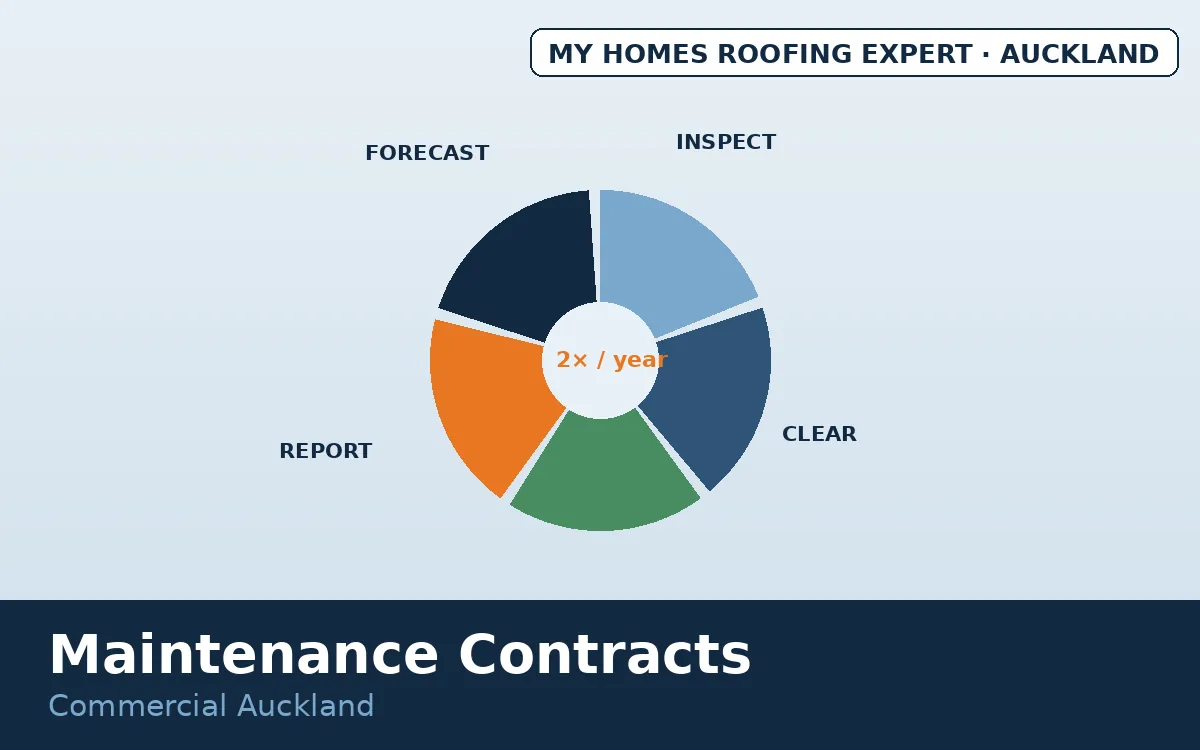
What does a commercial maintenance contract include?
Direct answer: the five-part architecture — inspect, clear, fix small, report, stand by. The parts: scheduled inspections — commonly twice yearly anchored around storm season, plus post-event checks, walking every zone with the fragile-panel disciplines our translucent guide makes non-negotiable on commercial roofs; drainage clearing — gutters, internal gutters, outlets, and overflow provisions, the consequential plumbing whose failure modes the box gutter and overflow guides map, cleared on every visit because blocked outlets over stock are the sector's classic loss; minor works inclusion — an agreed per-visit value covering the fixings, sealant renewals, and boot replacements (the penetration mortality every plant-heavy roof carries) that die cheaply on the day; photo-documented reporting — the condition evidence below; and priority standing — the callout position that storm weeks make valuable.
What Is the Short Answer?
Twice-yearly cycles, drainage cleared every visit, small faults included, condition photographed into board evidence, callout priority standing — programme pricing by roof scale against emergency pricing by event. One prevented loss generally settles the comparison.
The condition report — where the contract earns its board seat
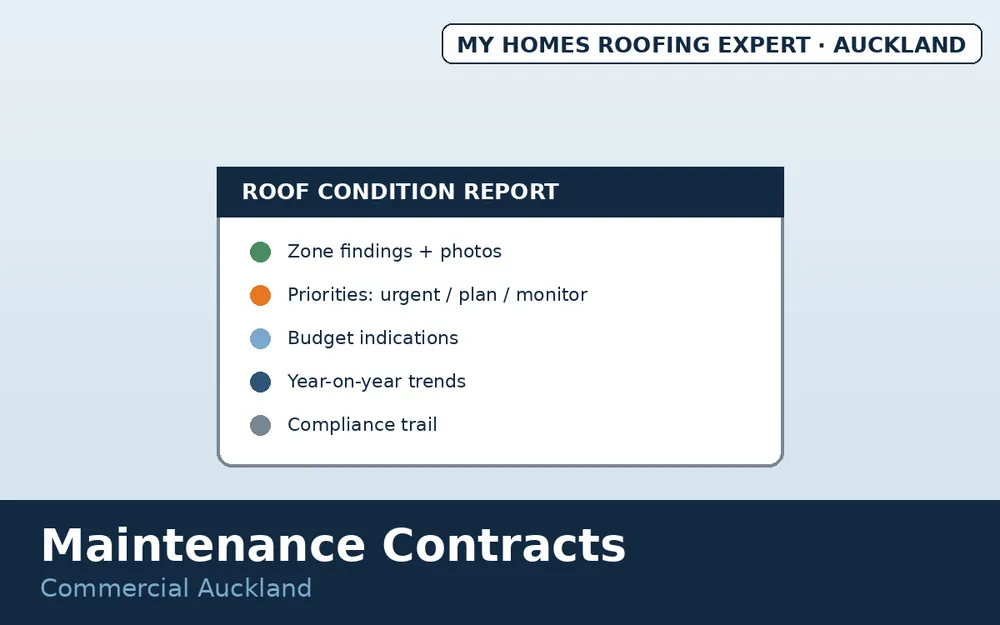
The report converts roof state into management language: zone-by-zone findings — surface and coating staging (the rust ladder of our rust guide applied at warehouse scale), fixings and flashings, penetrations and their boot ages, drainage condition, and the fragile-panel register every contractor on the roof thereafter works from; prioritised actions — urgent, planned, and monitor categories with budget indications, the triage that separates this quarter's spend from next year's; trend lines — year-on-year photographic comparison turning condition into trajectory, the early-warning system for the coating and replacement decisions our commercial replacement guide prices; and the compliance trail — documented care for insurers, lease obligations, and the due-diligence files building sales open. For body corporates and tenanted buildings, the report doubles as the shared-facts document that pre-empts responsibility disputes — the governance value our body corporate guide expands.
What separates a programme from a subscription
The quality markers procurement should require: named scope — zones, drainage assets, and inclusions itemised, not "roof maintenance" in the abstract; minor-works transparency — the included value stated, with overruns quoted before work, the discipline that keeps programmes from becoming open invoices; reporting samples — see a real report before signing, since the document is half the product; access and safety systems — the edge protection, panel covers, and permit disciplines the access guide frames, owned by the contractor and described in the contract; escalation honesty — programmes exist to maintain, and a provider whose every report recommends major works is selling, not maintaining; and exit-friendly records — your roof's documentation belongs to the building, portable if the relationship ends. Whole-building maintenance beyond the roofline pairs naturally with the construction management at our parent brand My Homes Construct.
What Cost, Risk and Procurement Factors Apply?
Programme pricing scales with roof area, complexity, and drainage burden — warehouses pricing differently from plant-dense process roofs — and the procurement comparison is scope-for-scope, the like-for-like discipline that governs all commercial roofing buying. Risks are contract risks: vague scopes, invisible reporting, and the subscription that maintains invoices better than roofs — all filtered at the sample-report stage.
Put your roof on programme in Auckland
My Homes Roofing Expert runs maintenance programmes across Auckland's commercial stock — scopes named, reports board-ready, small faults dying on schedule. Call 022 501 9921 or email info@roofingexpert.co.nz.
What Questions Do Auckland Homeowners Ask?
What does a contract include?
Scheduled inspections, drainage clearing, included minor works, photo reporting, and callout priority.
Why contracted maintenance?
Scale and stakes — small faults become stock events, and insurers expect documented care.
What is in the report?
Zoned findings with photos, prioritised actions with budgets, trends, and the compliance trail.
Tenanted and body corporate buildings?
Access protocols, lease-aligned responsibilities, and shared documentation that pre-empts disputes.
Programme vs ad-hoc cost?
Predictable fees against emergency pricing — one prevented event settles it.
Topics covered
- scheduled commercial roof care
- body corporate roof plan
- preventive roofing programme
- roof asset management
- warehouse roof maintenance