
Translucent roofing sheets compared for NZ — polycarbonate, fibreglass, and profile-matched light panels, where each works, and specification basics.
Translucent roofing sheets do one job — move daylight through a roofline — and NZ uses them everywhere: light strips in warehouse steel, pergola and carport covers, walkway canopies, and the bright panel above many a laundry lean-to. The market splits into two material families, polycarbonate and fibreglass (GRP), whose strengths divide the work between them more cleanly than most owners expect.
And one rule towers over the whole category before any comparison starts: translucent sheets are fragile underfoot — never walked, always guarded during roof work, responsible for serious fall-through injuries every year. Every paragraph below sits under that one.
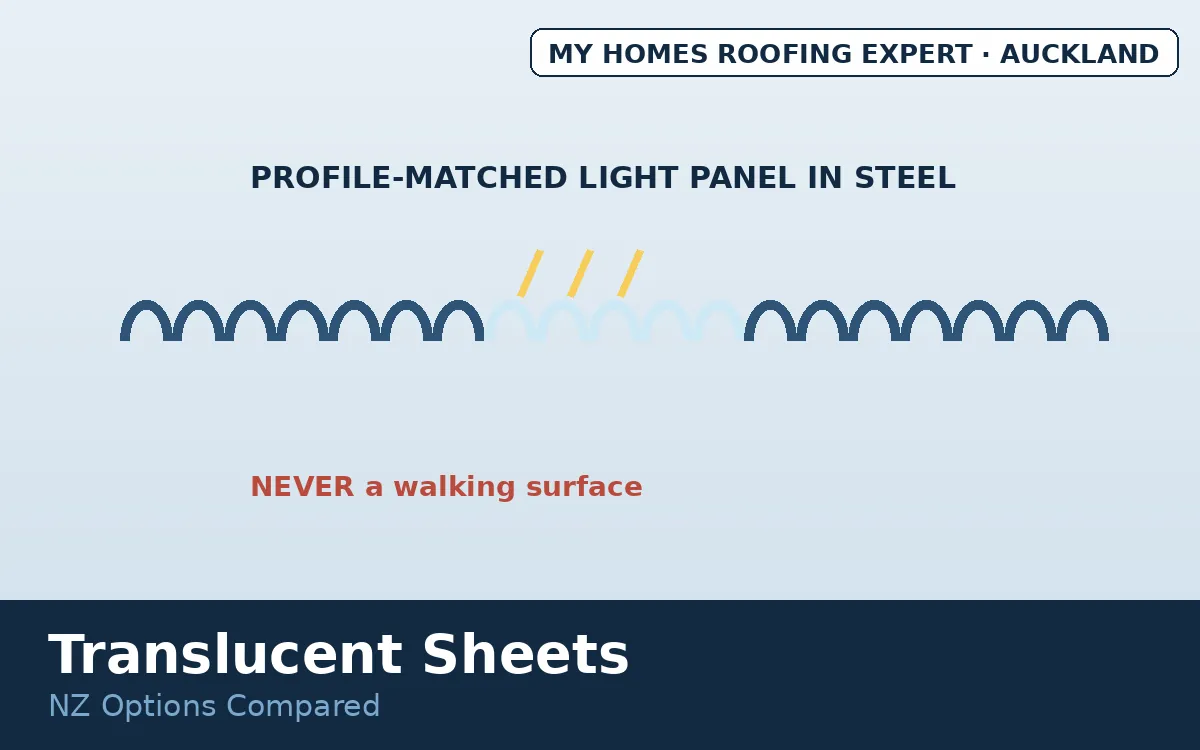
Which translucent sheet is best for your job?
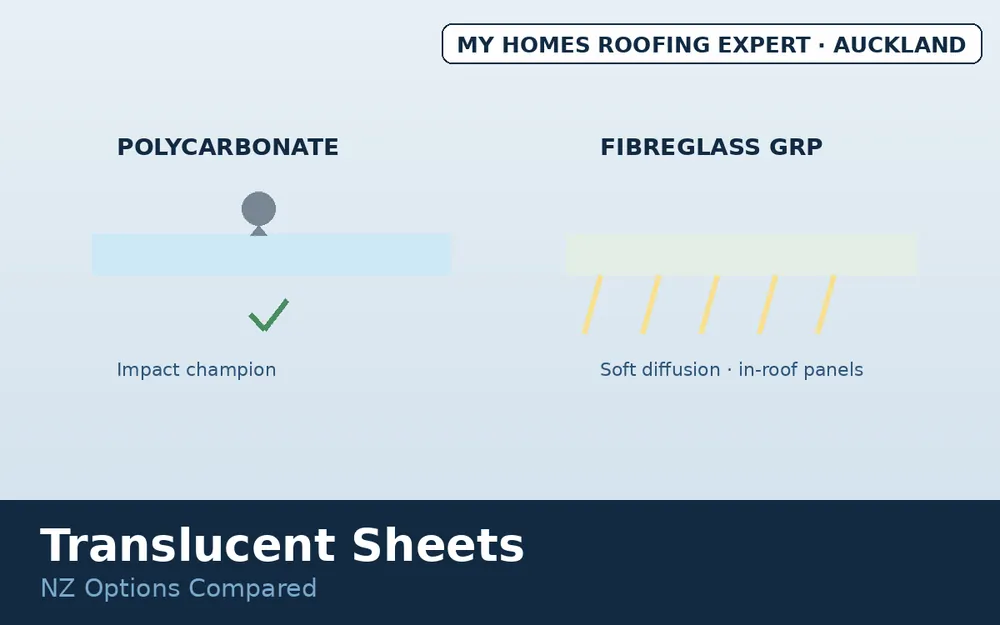
Direct answer: polycarbonate for impact duty and standalone clear roofs; GRP for profile-matched panels and diffusion. Polycarbonate's territory: pergolas, carports, and lean-tos — its impact resistance shrugs off hail and branches that crack lesser sheets; twin-wall variants adding insulation and glare control over living spaces; and the whole standalone clear-roof world our polycarbonate cost guide prices. GRP's territory: profile-matched light panels within steel roofs — moulded to corrugate and trapezoidal geometry, lapping like the steel around them, the default daylight strip in commercial roofing; diffusion — GRP's fibre structure spreads light softly where polycarbonate transmits harder; and specifications where its fire behaviour suits requirements. Overlap exists — polycarbonate profile panels are made too — but the division above covers most NZ decisions.
In short
Polycarbonate for impact and standalone covers; GRP for in-roof light panels and soft diffusion. Buy UV-protected product from named brands, fix with oversized holes for thermal movement, and treat every translucent panel as the fragile, never-walk surface it is.
Specification details that decide service life
UV protection is the purchase: co-extruded UV layers on polycarbonate and gel-coat or film surfaces on GRP separate decade-class sheets from the yellowed, brittle failures of cheap product — warranty length is the honest quality proxy. Fixing for movement: both materials expand more than steel, demanding oversized holes, correct washers, and manufacturer screws — tight fixing is the number-one installation fault, cracking sheets within seasons. Purlin spacing to the sheet's span tables, because under-supported panels flex, leak, and fail in wind. Lap and seal compatibility — wrong sealants attack both materials chemically; use what the maker specifies. And profile fidelity on in-roof panels, where a near-match profile is a leak by design. The fixing logic shares ground with our fixings guide; the carport application with our carport guide.
The fragility rule — why it cannot be said too often
Falls through fragile roofing are among NZ's recurring serious workplace and home injuries, and translucent panels are the classic culprit: aged sheet looks load-bearing and is not; even new sheet is not a walking surface; and panels weathered grey can disappear into a dirty steel roof until a foot finds one. The professional disciplines — identifying and marking panels before work, covers or walkboards over them, exclusion zones beneath — exist because the failure is sudden and the drop is total. For homeowners the translation is simple: never walk a roof containing translucent panels, never assume an old clear sheet will hold anything, and brief any trade going up there about every panel you know of. Aging panels — yellowed, crazed, fibre-blooming — are replacement candidates precisely because brittleness and invisibility grow together.
Cost, risk, and maintenance factors
Costs sit in the polycarbonate guide's ranges for standalone work, with in-roof GRP panels priced per sheet within steel roofing jobs. Maintenance is gentle washing only — soft brush, mild detergent, no solvents, no waterblasting brittle aged sheet — and replacement when yellowing or crazing announces UV retirement. The risk ledger is the fragility rule plus thermal-movement fixing, both solved by specification and professional installation.
Get daylight panels done right in Auckland
My Homes Roofing Expert supplies and installs translucent sheets across Auckland — profile-matched commercial panels, pergola and carport covers, and honest replacement advice on aged sheet. Call 022 501 9921 or get in touch.
Frequently asked questions
Which sheet is best?
Polycarbonate for impact and standalone covers; GRP for in-roof profile panels and diffusion.
What are warehouse light panels?
Profile-matched translucent sheets — usually GRP — lapped within the steel runs.
Safe to walk on?
Never — fragile surfaces requiring covers, walkboards, or exclusion during any roof work.
How long do they last?
Quality UV-protected product commonly 10–20 years; cheap sheet yellows and embrittles early.
Clear, opal, or tint?
Clear for maximum light, opal for soft glare-free diffusion, tint for heat control over living spaces.
Topics covered
- clearlite roofing
- fibreglass roof sheets
- natural light roofing NZ
- GRP roof panels
- light panels steel roof