
Corrugate vs trapezoidal roofing is decided by pitch and architecture. Corrugate, the traditional sine-wave profile, suits villas, bungalows and character homes at conventional pitches. Trapezoidal profiles, with angular ribs and wide flat pans, carry more water, reach lower pitches and suit contemporary builds. Costs are broadly level in the same grade, and mixing profiles on one house is normal.
| Feature | Corrugate | Trapezoidal |
|---|---|---|
| Look | Sine-wave profile; the heritage default for villas and bungalows | Angular ribs and wide flat pans; contemporary |
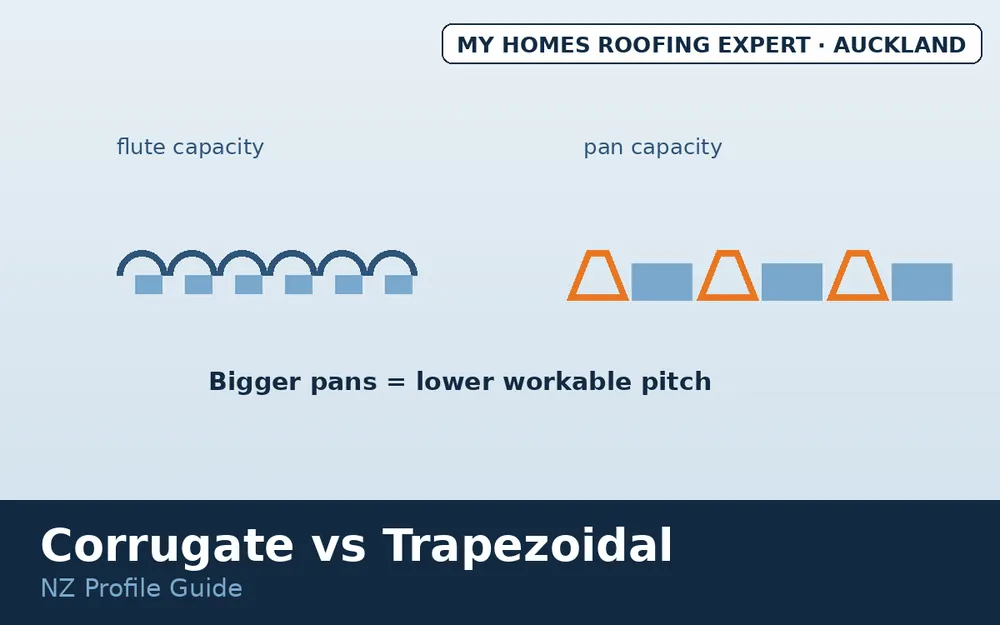
| Water capacity | Flutes carry less per width, so they want steeper fall | Pans move real volume even at shallow angles |
| Pitch | Minimums are profile-specific manufacturer specifications | Reaches lower pitches; minimums are profile-specific |
| Stiffness and walking | Needs more careful foot placement | Ribs stiffen sheets and flat pans give honest landing zones |
| Cost | Broadly similar in the same grade | Broadly similar in the same grade |
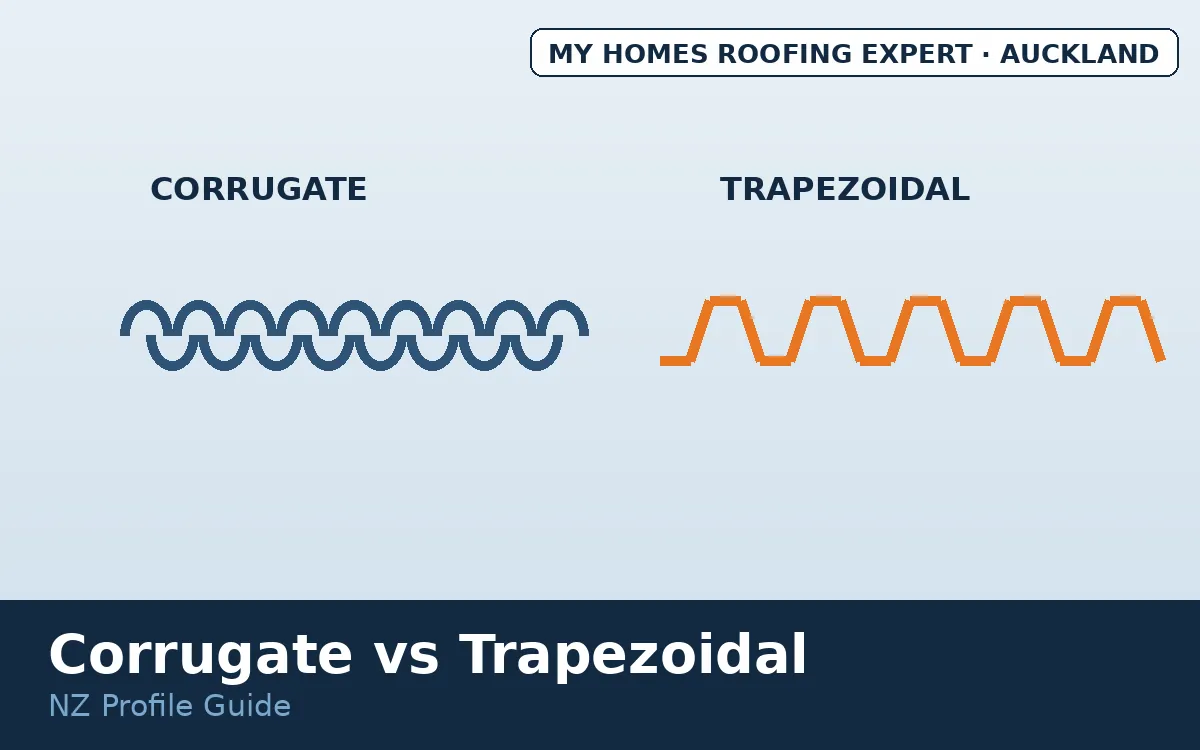
Corrugate vs trapezoidal roofing is the first fork in most NZ long-run decisions, and the good news is that the roof usually decides for you. Corrugate — the sine-wave profile on a century of New Zealand buildings — is the character choice and the heritage default. Trapezoidal profiles — angular ribs with wide flat pans, the five-rib family and its relatives — carry more water, reach lower pitches, and speak contemporary. Same steel, same colours, different geometry doing different jobs.
Auckland uses both at scale: corrugate across the villa and bungalow belts where streetscape matters, trapezoidal on modern builds, low-slope extensions, and commercial roofs where capacity rules.
Should you choose corrugate or trapezoidal?
Direct answer: let pitch and architecture decide. Choose corrugate when: the house is a villa, bungalow, or character home where the traditional profile belongs; you sit in a special character area where like-for-like is the comfortable path (our villa re-roof guide covers that territory); or you simply want the classic NZ look. Choose trapezoidal when: pitch is low — taller ribs and wider pans shed water that corrugate cannot at the same angle; spans are long or foot traffic likely — rib stiffness earns its keep; the architecture is contemporary; or the roof is commercial-scale, where rib profiles dominate for capacity and coverage speed. Pitch limits are profile-specific manufacturer specifications, and matching profile to measured pitch is core metal roofing work — a profile below its minimum pitch is a leak on a schedule.
What Is the Short Answer on Corrugate vs Trapezoidal?
Corrugate for character and conventional pitches; trapezoidal for low pitch, long spans, and modern lines. Costs are broadly similar in the same grade, mixing profiles across one house is normal practice, and the minimum-pitch check is non-negotiable either way.
How do the profiles actually differ in service?
Water capacity: trapezoidal pans are small channels, moving real volume even at shallow angles — the heart of their low-pitch advantage; corrugate flutes carry less per width, wanting steeper fall to compensate. Stiffness and walking: ribs stiffen sheets for purlin spanning, and the flat pans give trained feet honest landing zones; corrugate asks for more careful foot placement — one of many reasons roof walking belongs to professionals, per our walking damage guide. Wind and fixings: both profiles perform well correctly fixed for the wind zone — fixing pattern and screw spec matter more than profile shape, as our fixings guide explains. Weathering and washing: both shed dirt well at pitch; low-slope trapezoidal holds marginally more debris in pans, wanting the occasional clear that any low roof does.
How Much Does the Profile Change the Look and the Streetscape?
Profile reads from the street more than most owners expect: corrugate throws soft repeating shadows that older architecture was designed around; trapezoidal draws crisp parallel lines that suit modern forms. On character streets, corrugate keeps faith with the neighbourhood — and inside special character areas, visible profile changes deserve a council check first, since rules can vary by property. On contemporary homes, rib profiles look intentional where corrugate can look borrowed. Mixed solutions are everyday practice: corrugate on the street-facing main roof, trapezoidal on the low-pitch rear extension — junction flashings handle the meeting, and our project gallery shows both profiles living well on Auckland homes.
What Cost, Risk and Decision Factors Matter?
Pricing between common profiles in the same grade is broadly level — gauge, grade, and job complexity move quotes more than geometry does. The real risks are specification ones: profile below minimum pitch, fixings under wind-zone requirements, or character-area changes made without checking. All three are quote-stage questions, which is the point of asking them early. Bring your pitch, your address, and your streetscape; the right profile usually announces itself.
How Do You Get a profile-matched roofing quote in Auckland?
My Homes Roofing Expert measures pitch, checks wind zone and exposure, and recommends profile honestly on every Auckland long-run quote. Call 022 501 9921 or get a free, no-obligation quote.
What Do Auckland Homeowners Ask About Corrugate vs Trapezoidal?
Corrugate or trapezoidal?
Corrugate for character homes and standard pitches; trapezoidal for low pitch, long spans, and contemporary builds.
What about minimum pitch?
Trapezoidal reaches lower pitches than corrugate — exact minimums are profile-specific specifications your roofer must match.
Is one stronger?
Ribs add stiffness for spanning and foot traffic; correctly specified corrugate is proven too.
Do they cost differently?
Broadly similar in the same grade — gauge and complexity move price more than shape.
Can profiles mix on one house?
Yes — common and sensible, with proper junction flashings.
Topics covered
- roof profile comparison NZ
- five rib roofing
- longrun profiles Auckland
- trapezoidal roof NZ
- corrugated iron profile