
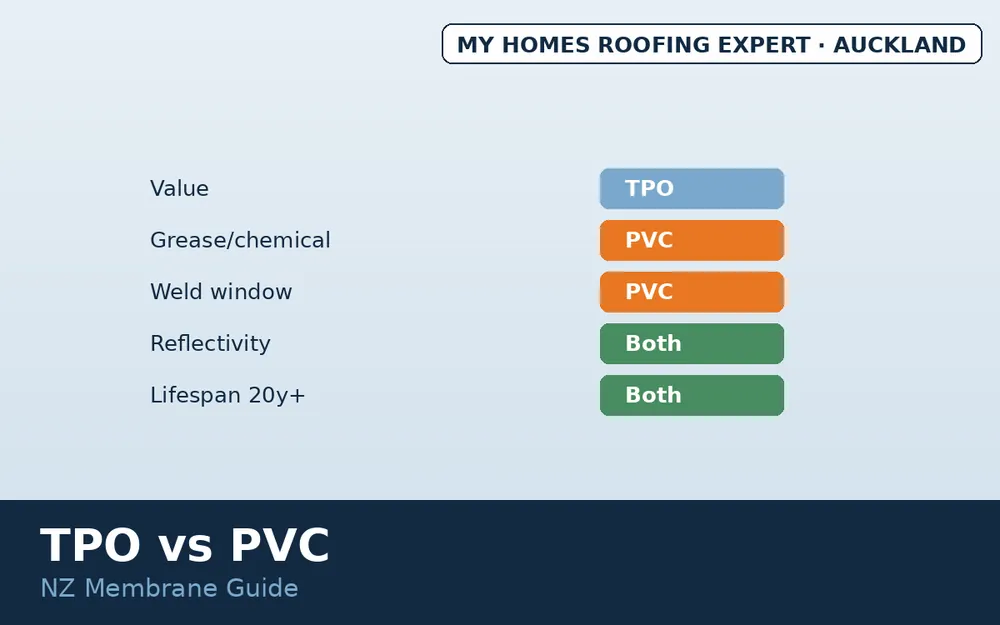
Two good membranes: TPO wins most general decks on value, PVC wins kitchens, plants, and chemistry. Specify proven UV-stable product, insist on weld testing, and put your scrutiny on the installer — single-ply roofs are made or lost at the seams and details.
| Topic | TPO | PVC |
|---|---|---|
| Best for | General duty — standard commercial or residential decks | Chemical and grease exposure, such as extract plumes over restaurants and food production |
| Welding | Welds excellently with disciplined parameters | A wider welding window forgives more variation in temperature and speed |
| Cost | Typically the sharper number | Dearer, in return for chemical resistance |
| Grease and chemicals | Grease ages it prematurely | The clear win |
| Service life | Commonly 20+ years for quality UV-stable product installed well | Commonly 20+ years for quality UV-stable product installed well |
| What outranks both | The installer — single-ply roofs are made or lost at the seams and details | The same |
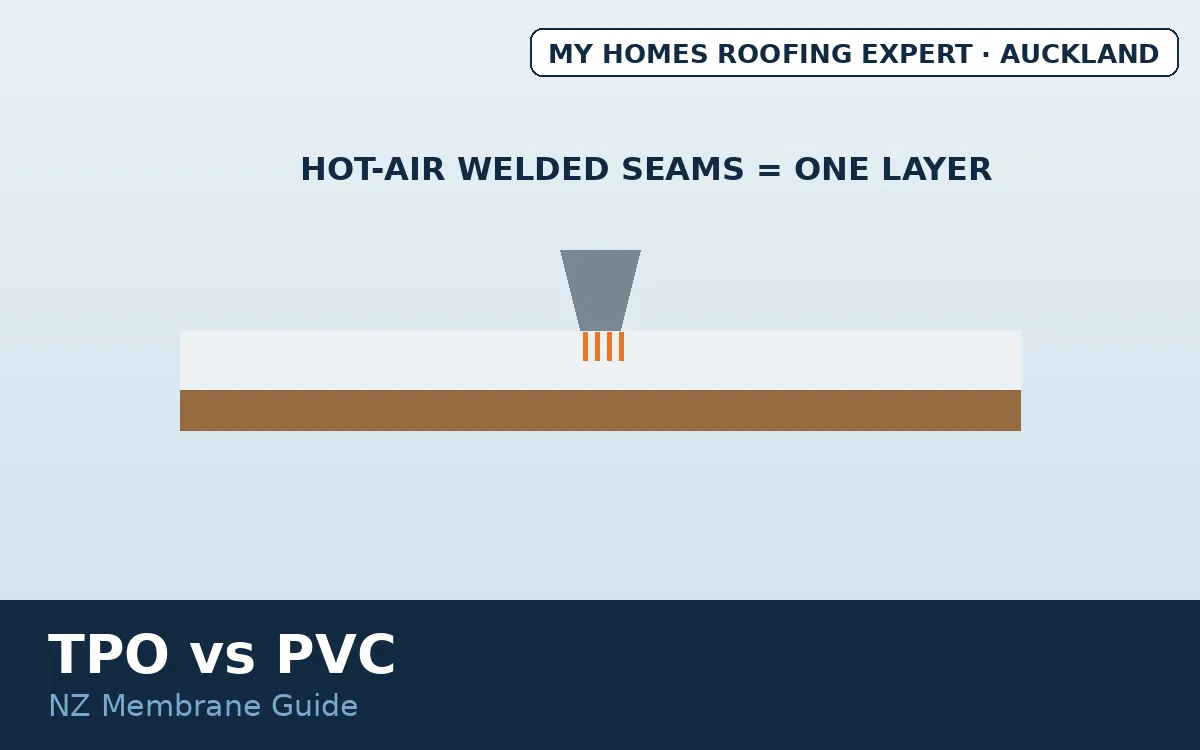
TPO vs PVC membrane is the single-ply question on larger NZ flat roofs — and unlike many material rivalries, this one has two good answers. Both are heat-welded thermoplastic sheets whose laps fuse into a monolithic waterproof layer; both serve 20+ years installed well; and both dominate commercial flat roofing worldwide. The differences are chemistry at the margins: TPO takes general-duty price-performance; PVC takes chemical resistance and weld forgiveness. The installer's torch discipline usually matters more than the initials.
In Auckland, these membranes carry warehouse roofs, apartment decks, plant platforms, and increasingly the parapet-edged residential flats of modern medium-density builds.
Is TPO or PVC better for your flat roof?
Direct answer: TPO for general duty, PVC for chemical and grease exposure — with installation quality outranking both. Choose TPO when the roof is a standard commercial or residential deck: it prices keenly, welds strongly, reflects heat in its light colours, and modern formulations have matured past the early-generation issues of decades ago. Choose PVC when the environment bites: restaurant and food-production extract plumes (grease degrades TPO faster), chemical exposure, or projects where its long weld-window forgiveness suits complex detailing. Both want reputable manufacturers with UV-stable formulations proven in strong-light climates — New Zealand sunlight audits coatings honestly. System-level context sits in our membrane cost guide, and the butyl/torch-on side of the family in our butyl vs torch-on comparison.
What separates the chemistries in service?
Welding: both heat-weld; PVC's wider welding window forgives more variation in temperature and speed, which experienced crews exploit on cut-up detail work; TPO welds excellently with disciplined parameters. UV and heat aging: quality formulations of both endure; the specification point is manufacturer track record rather than chemistry family. Chemical and grease: PVC's clear win — extract fans over kitchens drop grease that ages TPO prematurely. Reflectivity: both ship in white and light grey that cut rooftop heat load meaningfully — welcome over commercial space, and the mechanism behind our cool roofs guide. Flexibility in cold: both handle NZ temperature ranges comfortably; this is not an alpine problem here. Repairability: both weld-patch cleanly for their service lives — a genuine maintenance advantage over aged glued systems.
Why the installer outranks the initials
Single-ply roofs concentrate their risk at seams, terminations, and penetrations — exactly the places hands make. Quality markers to require: manufacturer-trained installers, since major membrane brands certify applicators and back them with system warranties; weld testing — probe testing of seams as standard practice, not a special request; detail competence — preformed corners, proper upstand heights, and clean outlet integration; substrate honesty — moisture checks before overlay decisions; and documentation — warranty registration and as-built records. A mid-tier membrane installed superbly will outlast a premium sheet installed casually, every time.
What Cost, Risk and Maintenance Factors Apply?
Commercially, both membranes price inside the ranges our membrane cost guide sets out, with TPO typically the sharper number. Maintenance is light and worth doing: keep outlets clear, walk debris off seasonally via protected paths, and weld-patch damage promptly — punctures from dropped tools and trades are the main service-life events. And the standing rule on any membrane: protect it from uncontrolled foot traffic, because the roof's enemies are mostly other contractors.
How Do You Get a single-ply membrane quote in Auckland?
My Homes Roofing Expert specifies and installs membrane systems across Auckland's commercial and residential flat roofs — chemistry matched to the environment, welds tested, warranties registered. Call 022 501 9921 or request a free quote.
What Questions Do Auckland Homeowners Ask?
TPO or PVC?
TPO for general-duty value; PVC for grease, chemicals, and weld forgiveness — installer quality outranks both.
What does heat welding do?
Fuses laps into one monolithic layer — seams as strong as sheet.
How long do they last?
Commonly 20+ years for quality UV-stable product installed and maintained well.
Why are they white?
Reflectivity cuts heat load — a real benefit over occupied and commercial space.
Can they overlay an old roof?
Sometimes, after moisture and substrate assessment — overlays over trapped moisture fail.
What else should you know?
What marks a good single-ply membrane installer?
Look for manufacturer-trained installers, since major membrane brands certify applicators and back them with system warranties; probe testing of seams as standard practice; detail competence such as preformed corners, proper upstand heights and clean outlet integration; moisture checks before any overlay decision; and warranty registration with as-built records. A mid-tier membrane installed superbly outlasts a premium sheet installed casually.
Topics covered
- flat roof membranes NZ
- single ply roofing
- commercial membrane Auckland
- TPO roofing NZ
- PVC roof membrane