
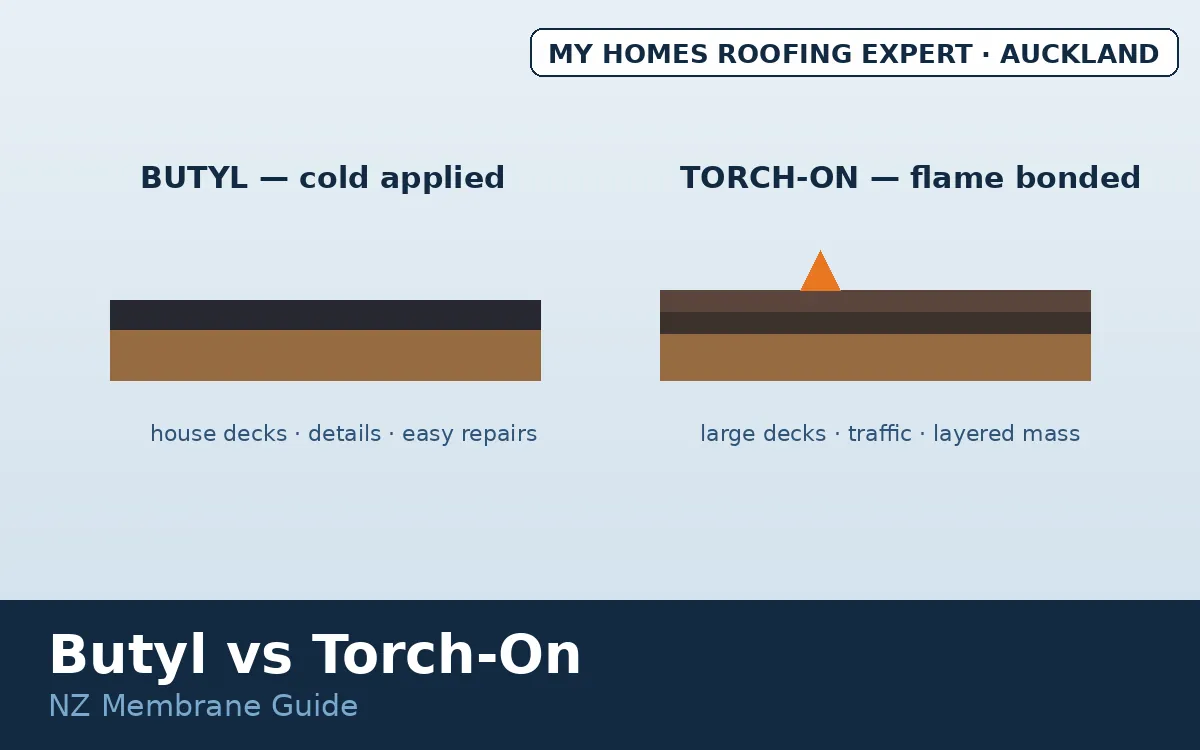
Butyl for house decks, detail work, and easy lifetime repairs; torch-on for larger, trafficked, commercial-leaning roofs wanting layered mass. Both reward substrate honesty and skilled detailing — and the flame in torch-on belongs exclusively to trained applicators with fire discipline.
| Topic | Butyl rubber | Torch-on bitumen |
|---|---|---|
| Application | Bonds cold over primed substrate — no flame near your timber | Fuses by heating the sheet underside, demanding flame management and a fire watch |
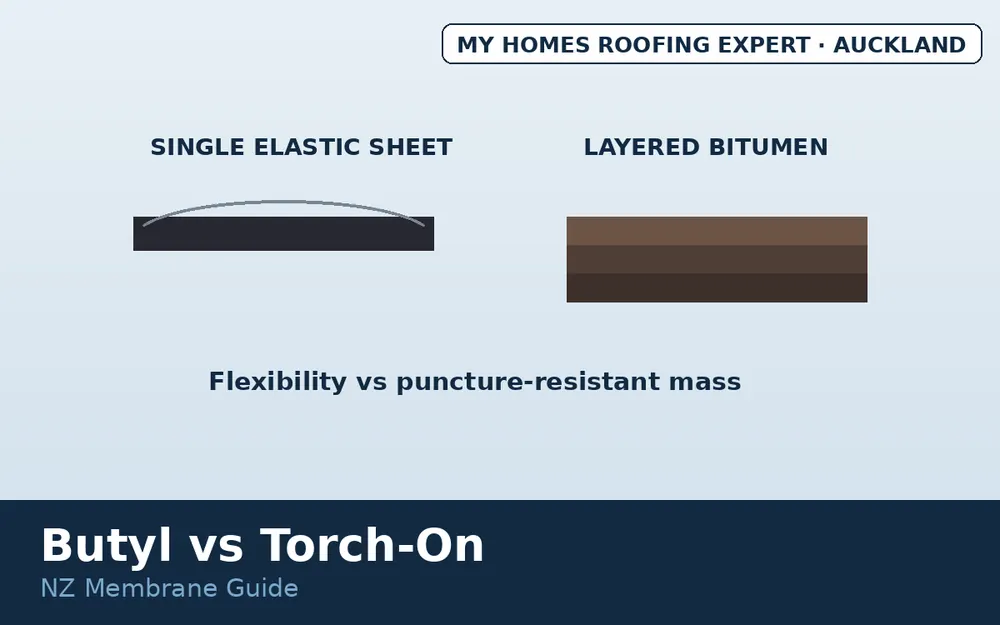
| Build-up | A single elastic sheet | Base plus cap layers into several millimetres of bitumen mass |
| Best for | Residential decks and detail-heavy small roofs | Larger areas such as apartment podiums, plant decks and commercial flats |
| Movement | Elasticity suits light timber structures that flex seasonally | Mass prefers stiffer substrates |
| Traffic | Wants protection layers under regular traffic | Thickness wins under regular feet and maintenance trades |
| Repairs | Patches simply for the life of the roof | Repairs well with installation-grade heat skills |
| Service life | Commonly 20+ years installed well | Commonly 20+ years installed well |
Butyl vs torch-on membrane is the classic NZ flat-roof pairing — rubber sheet against built-up bitumen, cold adhesive against open flame. Both are proven over decades of New Zealand decks and low-slope roofs; both serve 20+ years installed well; and they split the work between them along a clean line: butyl owns residential decks and detail-heavy small roofs; torch-on owns larger areas wanting thick, puncture-resistant build-up.
Auckland keeps both busy — butyl over the city's thousands of house decks and porch roofs, torch-on across apartment podiums, plant decks, and commercial flats where its layered mass earns its keep.
Should you choose butyl or torch-on?
Direct answer: size, traffic, and detail density decide. Butyl earns the residential deck: cold adhesive application suits timber substrates and tight detail work; its elasticity rides the movement of lighter structures; repairs patch simply for the life of the roof; and decades of NZ service back it — our butynol guide covers the local story. Torch-on earns the bigger deck: multiple bitumen layers build a thick, puncture-resistant mass that handles foot traffic and trades; mineral-finished cap sheets weather handsomely; and on commercial scale its coverage economics work. Between them sits judgment — a large simple house roof can go either way, and quotes both ways cost nothing. The single-ply branch of the family lives in our TPO vs PVC guide, and pricing context in the membrane cost guide.
How do they differ in service?
Application: butyl bonds cold over primed substrate — no flame near your timber; torch-on fuses by heating the sheet underside to the substrate and previous layers, demanding flame management, fire watch, and substrate awareness as professional standard practice. Build-up: butyl is a single elastic sheet doing everything; torch-on builds base plus cap layers into several millimetres of bitumen mass. Movement: butyl's elasticity excels on light timber structures that flex seasonally; torch-on's mass prefers stiffer substrates. Puncture and traffic: torch-on's thickness wins under regular feet and maintenance trades; butyl under traffic wants protection layers. UV: both ship in UV-stable finishes for exposed service — mineral cap sheets for torch-on, stabilised formulations for butyl. Repairs: butyl's patch simplicity is the ownership win; torch-on repairs well with the same heat skills as installation.
The decisions around the membrane
Either way, the membrane is only the visible half of the system: substrate must be dry, sound, and falled — ponding shortens every membrane's life, per our ponding guide; details — upstands, outlets, and junctions — are where both systems succeed or leak, so judge installers on their detail photographs; buried applications under tiles or floating decks need protection layers and serviceability thinking, because excavating a deck to find a leak is the expensive version of maintenance; and fire-sensitive situations have flame-free options — self-adhesive bitumen variants — worth knowing exist. An inspection settles which system your roof actually wants; book one free before choosing on price alone.
What Cost, Risk and Maintenance Factors Apply?
Costs for both live inside the general membrane ranges — small detail-heavy jobs price higher per metre, large simple areas lower, with torch-on's economics improving as area grows. Maintenance for both is the flat-roof standard: outlets clear, debris off, prompt patching of trade damage. The risk ledger is mostly human: flame discipline on torch-on, substrate honesty on both, and keeping uncontrolled foot traffic off either. Professional territory throughout — flat does not mean safe, and membrane work is height work.
How Do You Get a membrane recommendation in Auckland?
My Homes Roofing Expert installs and repairs butyl and torch-on systems across Auckland — honest system matching, detail-first installation, free no-obligation quotes. Call 022 501 9921 or get in touch.
What Questions Do Auckland Homeowners Ask?
Butyl or torch-on?
Butyl for house decks and detail work; torch-on for larger trafficked roofs wanting layered mass.
Is torch-on risky on houses?
Flame demands trained applicators and fire discipline; flame-free bitumen variants exist for sensitive cases.
Which lasts longer?
Both commonly 20+ years installed well — substrate and detailing decide more than chemistry.
Which repairs easier?
Butyl patches simply for life; torch-on repairs well with installation-grade heat skills.
Can they go under decks?
Yes, with protection layers and serviceability designed in.
What else should you know?
Is there a flame-free alternative to torch-on membrane?
Yes. Fire-sensitive situations have flame-free options such as self-adhesive bitumen variants, and butyl itself bonds cold over primed substrate with no flame near your timber. Torch-on fuses by heating the sheet underside, so it demands flame management, a fire watch and trained applicators. An inspection settles which system your roof actually wants.
Topics covered
- torch on roofing NZ
- butynol comparison
- flat roof material choice
- bitumen membrane Auckland
- rubber roof NZ