
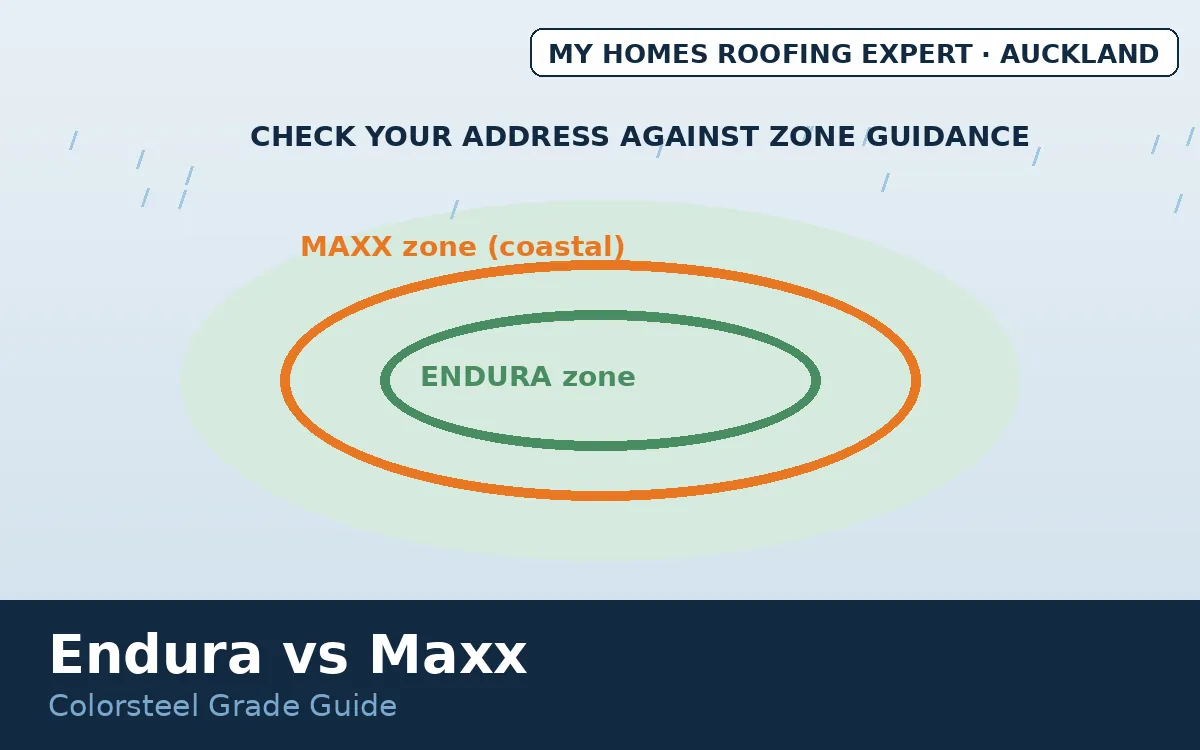
Endura for most addresses; Maxx where salt air works hardest — close to surf, harbour mouths, and exposed coastal positions. Confirm your specific address against current NZ Steel exposure-zone guidance (your roofer should do this as standard), and keep the warranty documents with your house records.
| Topic | Endura | Maxx |
|---|---|---|
| What it is | The standard grade, engineered for most New Zealand environments | A heavier-duty substrate and coating system built for severe marine exposure |
| Appearance | Same colours and profiles | Identical on the roof — you buy corrosion chemistry, not looks |
| Where it fits | Most of suburban Auckland, inland suburbs and sheltered streets back from the coast | Open-coast and harbour-mouth positions, cliff-top and beachfront sites |
| Cost | The friendlier price | A real but modest premium inside a whole re-roof |
| Matching parts | Standard coastal ratings suit the site | Flashings, fixings and spouting need compatible coastal ratings — a Maxx roof with standard fixings corrodes at the screws first |
| Check | Confirm your address against current NZ Steel exposure-zone guidance | The same |
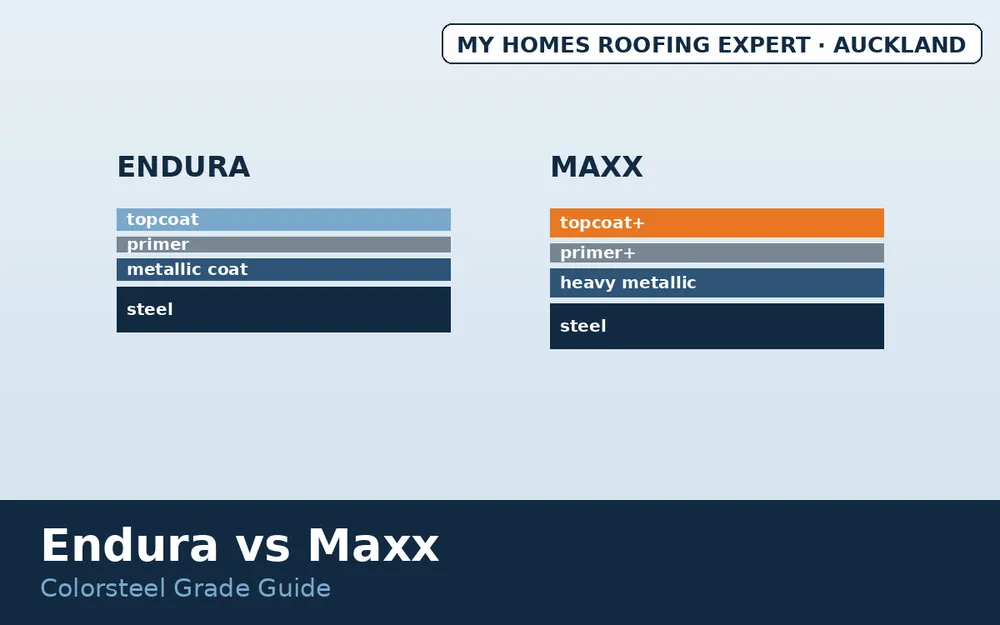
Colorsteel Endura vs Maxx is really a question about your address. Both are NZ Steel pre-painted roofing products sharing the same colours and profiles; the difference is protection level. Endura is the standard grade engineered for most New Zealand environments. Maxx carries a heavier-duty substrate and coating system built for severe marine exposure — the salt-laden air zones where standard products corrode early. In Auckland, a city wrapped around two harbours, the question comes up on a large share of re-roofs.
Getting it right matters in both directions: under-specifying near the coast costs roof life and can compromise warranty positions; over-specifying inland pays a premium for protection the site never tests.
What is the difference between Endura and Maxx?
Direct answer: coating system and exposure rating. Both grades start with a protective metallic-coated steel substrate and add primer and topcoat layers; Maxx steps up the substrate protection and coating build to handle severe coastal and geothermal environments, and its warranty schedule reflects that engineering. Endura covers the broad middle of New Zealand conditions — most suburban Auckland included — with a robust system at a friendlier price. The colours, profiles, and on-roof appearance are identical between grades; what you are buying with Maxx is corrosion chemistry, not looks. For the cost side of Colorsteel decisions, our Colorsteel cost guide covers pricing, and grade selection sits inside every metal roofing Auckland quote we prepare.
How does Auckland geography map to the grades?
The working pattern across our jobs: open-coast and harbour-mouth suburbs — east coast bays from Torbay to Browns Bay, cliff-top and beachfront positions, Te Atatū and West Harbour water edges, Bucklands Beach and the Half Moon Bay marina fringe — regularly sit in elevated zones where Maxx is the sensible specification. Sheltered coastal and near-harbour streets a few hundred metres back often return to Endura territory, shelter and prevailing wind doing real work in the assessment. Inland suburbs — most of central, west-inland, and south Auckland — are comfortably standard-grade country. The honest caveat: zones follow manufacturer guidance that accounts for surf type, distance, and shelter, and that guidance is the authority — our quotes check your address against it rather than estimating from memory. Coastal corrosion behaviour itself is covered in our salt air roofing guide.
Warranties, washing, and the details that protect them
Three practical points keep either grade performing: warranty registration and terms — product warranties scale with environment and expect correct installation and reasonable care, so keep the documentation; washing — coastal sites accumulate salt on sheltered surfaces rain never rinses (under eaves, behind chimneys), and the published care schedule asks for periodic washing there — light work that protects long cover; and matched accessories — flashings, fixings, and spouting should carry compatible coastal ratings, because a Maxx roof with standard-grade fixings corrodes at the screws first. Our fixings guide covers that last point in detail.
What Cost, Risk and Decision Factors Apply?
The premium for Maxx over Endura is real but modest inside a whole re-roof — and against the cost of early corrosion on a mis-specified coastal roof, it is small insurance. Risk runs the other way too: paying marine premiums on a sheltered inland site buys nothing measurable. Let the address decide, get the zone check documented in your quote, and treat any quote that never asks where you live relative to the sea as a quote missing a step.
How Do You Get a grade-checked metal roofing quote in Auckland?
My Homes Roofing Expert specifies Colorsteel grades against current exposure-zone guidance on every Auckland quote — coast or inland, the right chemistry for the address. Call 022 501 9921 or request a free, no-obligation quote.
What Questions Do Auckland Homeowners Ask?
What is the difference between Endura and Maxx?
Protection level — Maxx carries heavier substrate and coating systems for severe coastal exposure; colours and profiles are identical.
How close to the sea needs Maxx?
Exposed positions within a few hundred metres of coast commonly do — confirm your address against current NZ Steel zone guidance.
Is Maxx worth it inland?
Generally no — Endura performs fully in benign environments.
Do they look different?
No — the difference is chemistry and warranty, not appearance.
Does washing matter?
Yes — rinsing salt from sheltered surfaces is part of published care schedules and protects warranties.
What else should you know?
Which Auckland suburbs usually need Colorsteel Maxx?
Open-coast and harbour-mouth suburbs regularly sit in elevated zones where Maxx is the sensible specification, such as the east coast bays from Torbay to Browns Bay, cliff-top and beachfront positions, Te Atatū and West Harbour water edges and Bucklands Beach. Sheltered streets a few hundred metres back often return to Endura, so your address should be checked against current NZ Steel guidance.
Topics covered
- Colorsteel grades NZ
- coastal Colorsteel
- Maxx warranty zones
- Endura roofing Auckland
- marine grade roofing steel