
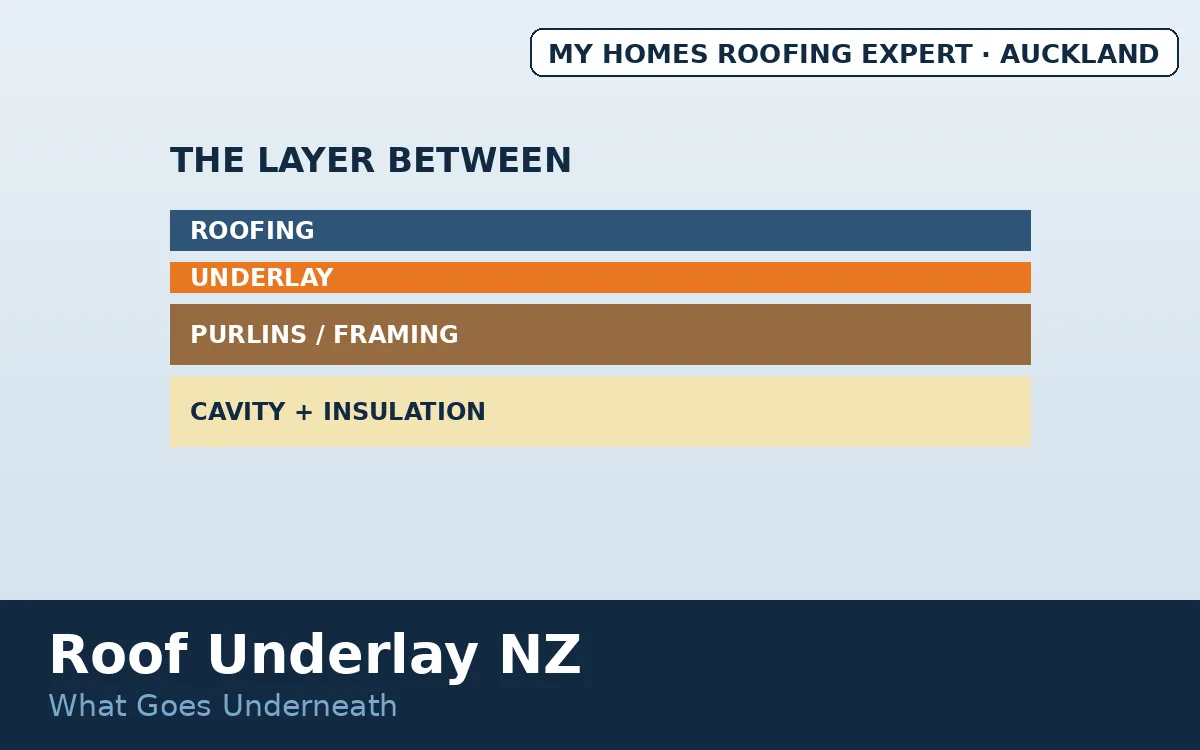
Roof underlay is the membrane between your roofing and your roof cavity: the second line of defence when wind drives rain past laps, and a manager of condensation under cold steel. NZ underlay comes in two families, traditional kraft papers and modern synthetics. Renew it at every re-roof and match self-supporting ratings to unsupported spans.
| Question | Short answer |
|---|---|
| What are the two product families? | Traditional kraft-based papers, which absorb and release condensation, and modern synthetics, which are lighter, stronger in tear and often self-supporting |
| What suits metal roofing? | Absorbent or appropriately rated product, because under-sheet condensation is its nightly reality |
| When must it be self-supporting? | Wherever no netting or sarking carries the underlay between purlins |
| What happens at a re-roof? | Renew it — old underlay is brittle, torn by original fixings and past its life |
| What should a quote say? | A quote naming its underlay product has read the specification |
Roof underlay NZ specifications decide more weathertightness than almost any visible choice — and nobody ever sees the result. Underlay is the membrane between your roofing and your roof cavity: the second line of defence when wind drives rain past laps, the blotter managing the condensation that forms under cold steel on clear nights, and the barrier keeping wind-blown dust out of the insulation. Roofs shed the weather; underlay handles the exceptions, quietly, for decades.
It earns this guide because re-roofing is the one moment owners can influence it — and because the difference between renewed and reused underlay is the difference between a complete re-roof and a cosmetic one.
What underlay should be used under an NZ roof?
Direct answer: the product the specification calls for — selected by roofing type, support situation, and exposure, from two families. Traditional kraft-based papers: absorbent fire-retardant building papers with a long NZ service record, managing condensation by absorbing and releasing it, suited to supported applications and familiar to every trade. Modern synthetics: lighter, far stronger in tear, often self-supporting rated, with engineered vapour behaviour — increasingly the default under new metal roofs. Selection logic: metal roofing wants absorbent or appropriately rated product because under-sheet condensation is its nightly reality (our condensation guide explains why); tile build-ups follow their own support and drainage detailing; and self-supporting ratings become mandatory wherever no netting or sarking carries the underlay between purlins — the specification detail that separates correct from sagging. Manufacturer tables and the roofing specification are the authorities; a quote naming its underlay product is a quote that has read them.
What Is the Short Answer?
Underlay is the roof's second chance: renew it at every re-roof, match self-supporting ratings to unsupported spans, choose the family the roofing type wants, and treat a quote silent on underlay as incomplete. The invisible layer is cheap on the day and priceless across the decades.
Why does old underlay have to go?
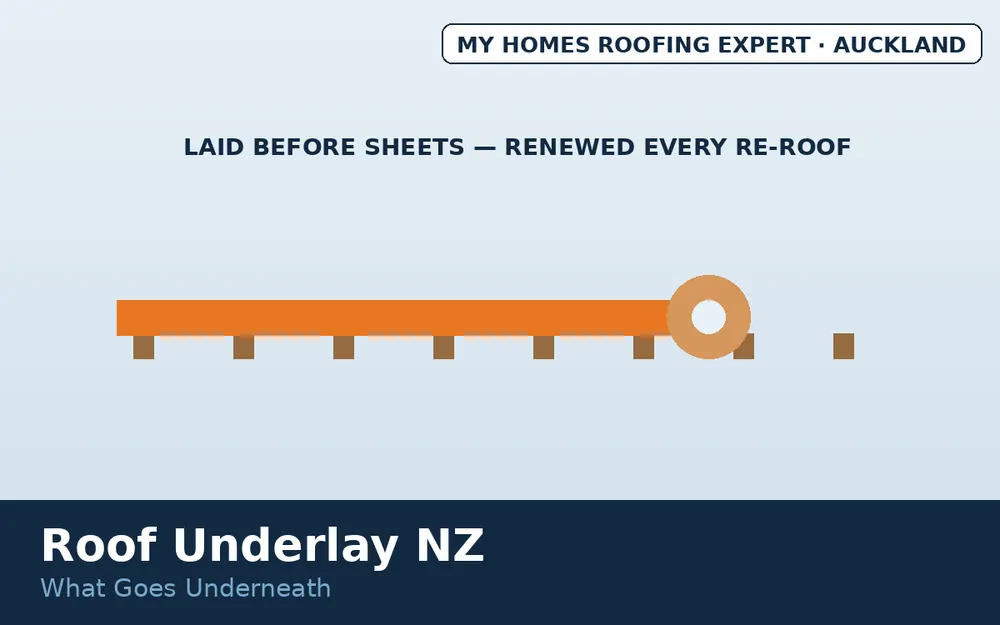
Because it ages on the same clock as the roof above it, in ways that disqualify it from a second tour: brittleness — decades of heat cycles leave old papers cracking at a touch, unable to survive re-roofing traffic let alone another thirty years; fixing wounds — every original nail and screw hole is a tear waiting to extend; UV exposure at edges and gaps finishing whatever flexibility remained; and on many older Auckland roofs, no underlay at all — direct-fixed eras and stripped-out cavities are common discoveries. The re-roof is the only moment renewal costs labour-nothing: the roof is off, the cavity is open, and new underlay rolls out as part of the sequence — exactly the logic our re-roofing service builds in and our conversion guides assume. Skipping it to shave a quote is the saving owners regret in the first winter storm.
How Does Underlay Work Within the Moisture System?
Underlay works as one organ in the cavity's moisture body: condensation management — absorbing the under-sheet dew of cold nights and releasing it to ventilation by day; ventilation partnership — airflow paths at eaves and ridge carry away what underlay buffers, per our ventilation guide; household moisture — bathrooms and kitchens venting into cavities overwhelm any underlay, a cause-side fix; and insulation interface — clearances and layering follow specification so the blanket and the membrane help rather than fight each other. Persistent cavity moisture is therefore a system diagnosis — our cavity moisture guide walks the signs — and underlay renewal is one move within it, not the whole cure.
What Cost, Risk and Specification Factors Apply?
Within a re-roof, underlay is small money doing large work — material plus minimal marginal labour. The risks are specification risks: non-self-supporting product on open spans, mismatched vapour behaviour under metal, or the silent reuse of dead paper. All are quote-stage questions with one-line answers, which is why asking them is worth the minute: what underlay, what rating, renewed throughout?
How Do You Get the invisible layer specified right in Auckland?
My Homes Roofing Expert names its underlay on every Auckland quote — product, rating, renewed as standard. Call 022 501 9921 or request a quote that covers what you'll never see.
What Questions Do Auckland Homeowners Ask?
What does underlay do?
Second line of defence, condensation manager, and cavity barrier — the exceptions handler under every roof.
What types exist in NZ?
Traditional absorbent kraft papers and modern synthetics, selected by roofing type and support situation.
What is self-supporting underlay?
Product rated to span purlins unsupported — mandatory where no netting or sarking sits beneath.
Replace at re-roof?
Almost always — old underlay is brittle, torn, and finished; the re-roof is its only affordable renewal moment.
Does underlay fix condensation?
It manages the normal kind; persistent moisture needs ventilation and source fixes too.
Topics covered
- roofing paper
- synthetic underlay
- self-supporting underlay NZ
- roof building paper
- underlay replacement reroof