
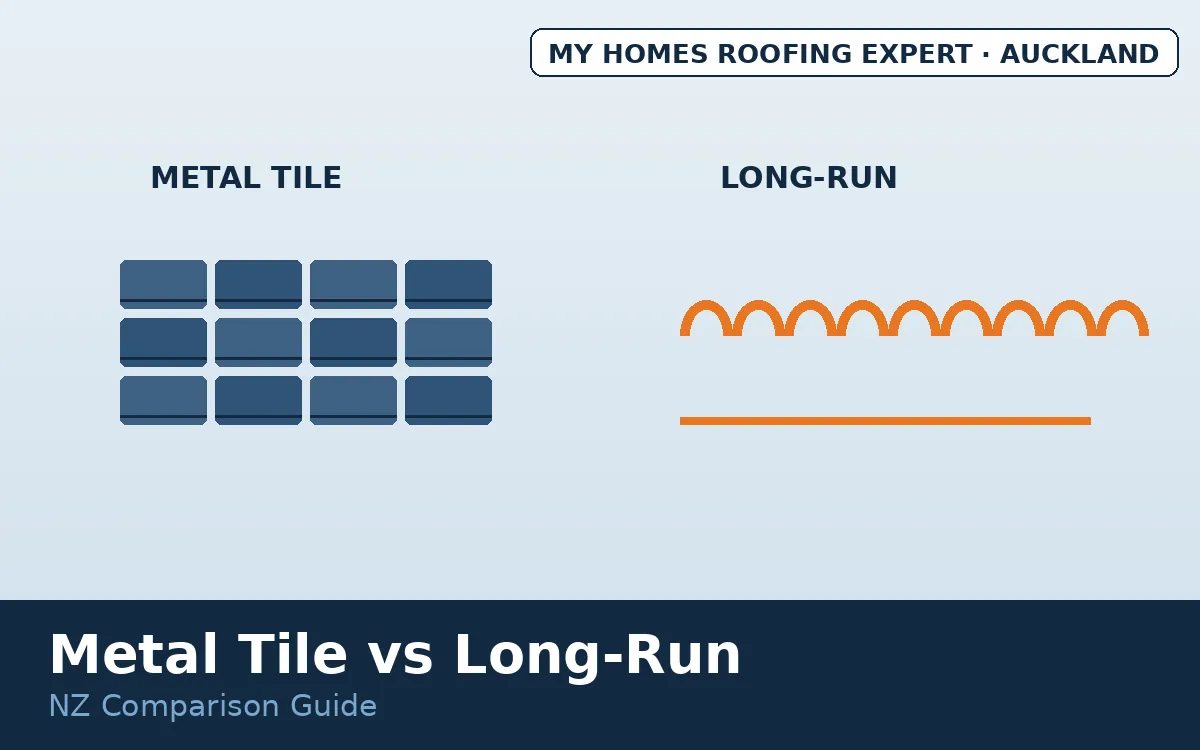
Metal tile vs long-run is a choice between two good lightweight steel systems. Long-run has fewer joints, installs faster and is easier to care for, while metal tile gives the tile look and lets a single panel be swapped. Most owners replacing old decramastic step to long-run, and framing is rarely the deciding factor because both are light.
| Factor | Long-run | Metal tile |
|---|---|---|
| Look | Clean, continuous lines | Genuine tile geometry and shadow lines, with chip or smooth finishes |
| Joints | Sheets run full length, with laps only at the sides | More laps and edges that catch debris |
| Repairs | Sheets are replaced; fewer joints to maintain | One damaged panel swaps without disturbing its neighbours |
| Weight | Lightweight steel on equivalent framing | Lightweight steel on equivalent framing |
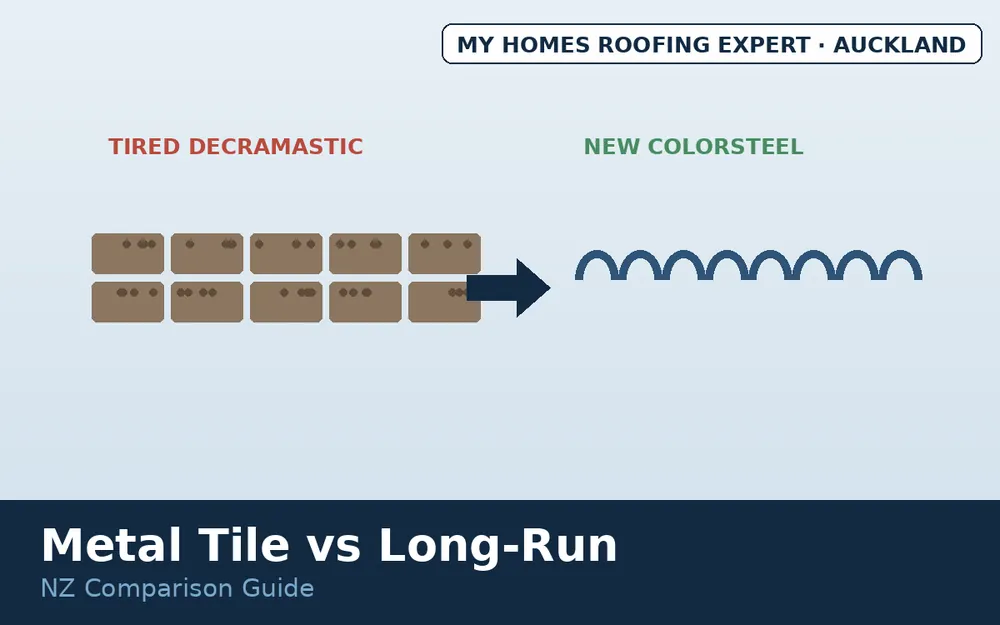
Metal tile vs long-run is the all-steel comparison: pressed steel tile panels with their masonry look against continuous roll-formed sheets running ridge to gutter. Both are lightweight, both wear modern coating systems, and both sit on the same framing class — so the decision turns on looks, joints, and maintenance temperament rather than structure. In NZ the question usually arrives wearing a specific outfit: a tired 1970s–80s decramastic roof asking what comes next.
Auckland's metal-tile belt — Pakuranga, Glenfield, Massey, and every suburb the chip-coated decades built — is hitting that decision in volume, which keeps this comparison permanently current.
Should you choose metal tile or long-run?
Direct answer: long-run for simplicity, metal tile for the look. Long-run wins on: joint count — sheets run full length with laps only at sides, leaving fewer places for weather to negotiate; installation speed, which shows up in labour pricing; maintenance temperament — washing and recoating a continuous surface is straightforward; and low-pitch reach, where trapezoidal profiles extend below tile territory. Metal tile wins on: appearance — genuine tile geometry and shadow lines, with textured chip or smooth satin finishes; discrete repairs — one damaged panel swaps without disturbing neighbours; streetscape matching where surrounding stock is tile-look; and hail or dent visibility, where a textured surface forgives small imperfections that show on smooth sheet. Both arrive through the same metal roofing channels in equivalent coating grades — coastal addresses still trigger the exposure-zone check either way.
What Is the Short Answer?
Two good lightweight systems: long-run for fewer joints and easier long-term care, metal tile for tile aesthetics with steel weight. Our Auckland metal roofing guide covers how the profiles, colours and lifespans compare once either system is on the roof. Replacing old decramastic, most owners step to long-run; staying with tile-look is a style choice modern pressed systems serve well. Framing is rarely the deciding factor — both are light.
The decramastic question — replace, and with what?
Old decramastic announces end of life in a familiar sequence: chips shedding into gutters, exposed steel chalking and freckling with rust, panels dented by decades of feet and hail, and laps weeping in driven rain. Recoating systems exist for mid-life roofs, but genuinely tired decramastic is replacement territory — our decramastic replacement guide covers the assessment. The replacement fork: to long-run, the volume choice — cleaner lines, fewer joints, often the sharper quote; to modern metal tile, the continuity choice — same silhouette the street has always had, current-generation coatings and chip bonding far beyond the 1970s product. Weight is a non-issue in either direction; both successors sit lighter than the framing was built to expect. What does deserve attention is everything under the panels: underlay renewal, batten condition, and fixing upgrades come with either path, per our underlay guide.
What Service-Life Habits Does Each System Need?
Metal tile care: keep feet off — panels dent under careless point loads, which is professional-access rule number one; watch chip loss patterns on textured finishes as the aging signal; and keep valleys and laps clear, since the panel geometry creates more debris-catching edges than sheet does. Long-run care: the standard steel regime — wash unwashed zones in coastal areas, monitor fixings (our fixings guide explains why screws age before sheets), and recoat on the coating system's schedule rather than after failure. Both systems reward the same annual ground-level check and gutter discipline as every Auckland roof.
What Cost, Risk and Decision Factors Apply?
Pricing between the systems lands close enough that job specifics — pitch, complexity, access — move quotes more than the material choice does; getting both priced costs nothing and settles the style question with real numbers. Risks are the familiar specification trio: coating grade matched to coastal exposure, fixings rated for the wind zone, and underlay renewed rather than inherited. All quote-stage checks, all standard practice on a proper re-roof.
How Do You Get both options priced in Auckland?
My Homes Roofing Expert quotes metal tile and long-run side by side across Auckland — honest comparison, exposure checked, free and no-obligation. Call 022 501 9921 or get in touch.
What Questions Do Auckland Homeowners Ask?
Replace metal tiles with long-run?
Most do at end of life — fewer joints and simpler care; modern metal tile remains a genuine style choice.
What is decramastic?
The 1970s–80s generation of chip-coated pressed steel tiles — now reaching end of life across NZ.
Are modern metal tiles better?
Substantially — current steel, coatings, and chip bonding outclass the old product.
Which repairs easier?
Metal tile swaps single panels; long-run replaces sheets but has fewer joints to maintain.
Do they weigh the same?
Both lightweight steel on equivalent framing — conversion either way rarely raises structure questions.
Topics covered
- pressed metal tiles NZ
- decramastic alternative
- roof material upgrade Auckland
- stone chip metal tile
- longrun conversion