
Standing seam is concealed-fix tray roofing: premium price, premium look, genuine low-pitch and movement engineering underneath. It earns its money on architectural forms and roof-as-design projects; conventional hip roofs get most of the performance from standard long-run at standard prices.
| Topic | Standing seam | Standard long-run |
|---|---|---|
| Fixing | Concealed clips locked inside raised seams | Fastened through the sheet with exposed screws |
| Movement | Panels float free to expand and contract along their length | Through-fixed sheets stress on long runs |
| Maintenance | Washing regime of any steel roof, minus the fixing checks | Includes checking exposed fixings and washers |
| Cost | A meaningful premium — more metal, more labour, more craft | Standard pricing |
| Best suited to | Architectural forms, roof-to-wall wraps, very low pitches and long uninterrupted runs | Conventional hip roofs |
| Variants | Mechanically seamed, snap-lock and angled-seam | Profiles by manufacturer |
Standing seam roofing NZ conversations start with the look: long unbroken metal planes, crisp raised seams, and not a screw head in sight. The system behind the look is concealed-fix tray roofing — panels joined at raised interlocking seams, held down by clips hidden inside the joint. It is the profile of architectural New Zealand: monopitch pavilions, roof-to-wall wraps, galleries and high-end homes where the roof is the design.
Auckland's contemporary builds keep it busy, and its low-pitch capability gives it practical work beyond aesthetics — but it carries a real premium over standard long-run, so knowing where it earns that premium is the useful part of this guide.
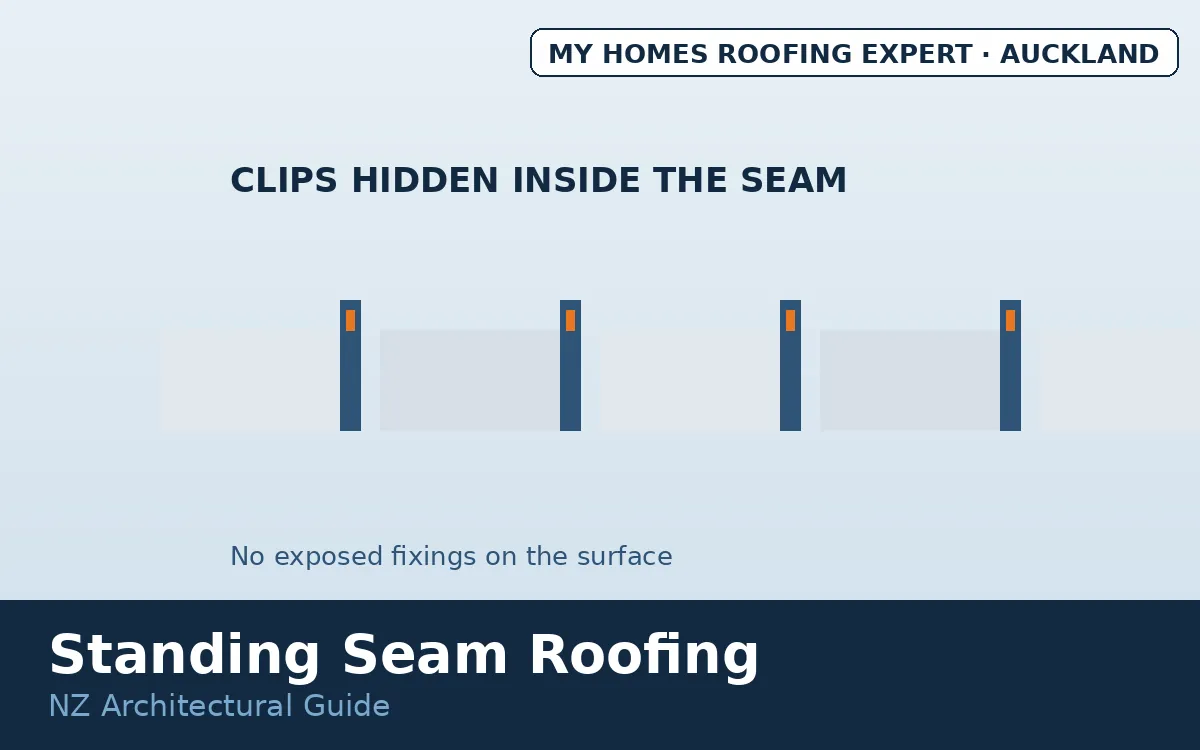
What is standing seam and how does it differ from long-run?
Direct answer: fixing method and geometry. Standard long-run fastens through the sheet with exposed screws; standing seam fastens with concealed clips locked inside raised seams, so panels float free to expand and contract along their length. The differences that follow: weather path — seams stand proud of the water plane, giving excellent driven-rain performance and very low minimum pitches by profile specification; movement — clip systems handle long panel runs gracefully where through-fixed sheets would stress; surface — no penetrations means no washer maintenance and nothing interrupting the plane; and craft content — panels are often site-formed or precision-folded, with seaming and detail work that rewards specialist installers. The family includes mechanically seamed, snap-lock, and angled-seam variants — selection territory inside any metal roofing specification conversation.
Where does standing seam genuinely earn its premium?
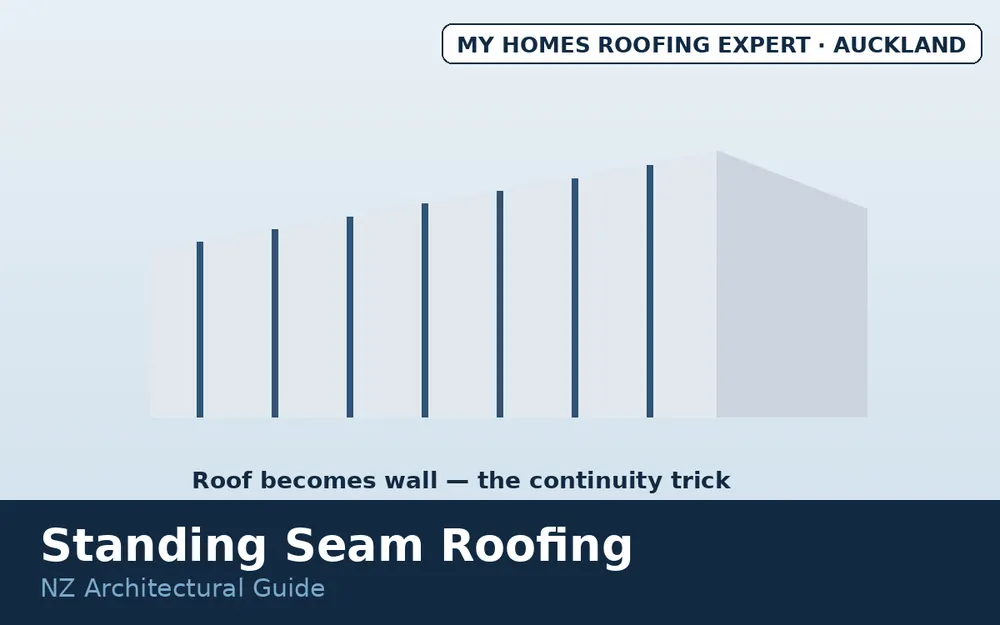
Architectural forms — monopitch and skillion planes where the roof reads as a facade element, and the low-pitch modern aesthetic the profile was made for; roof-to-wall continuity — the same trays turning down as cladding, wrapping forms in one material, which exposed-fix profiles cannot do as cleanly; very low pitches — specific tray profiles carry manufacturer ratings down to angles standard profiles cannot serve, making them the metal answer where membrane would otherwise rule; long uninterrupted runs — clip movement engineering suits big single panels on big planes; and longevity-led projects — no surface penetrations removes the screw-and-washer aging cycle entirely. On design-led builds these add up; our project gallery shows the look on Auckland homes, and architectural projects beyond the roof sit with the building expertise at our parent brand My Homes Construct.
Specification essentials before you commit
Four make-or-break details: installer pedigree — seaming and folding are craft skills, and tray roofs reward crews who do them weekly; clip engineering — type and spacing matched to panel length, pitch, and wind zone is the system's structural heart; substrate and underlay — tray systems are often laid over sarking or rigid underlay by specification, a build-up difference from batten-and-sheet long-run worth pricing properly; and material grade — coastal addresses run the same exposure-zone logic as any steel roof, with aluminium trays as the severe-marine alternative. A quote that itemises these four is a quote from the right installer.
What Cost, Risk and Maintenance Factors Apply?
Expect a meaningful premium over standard long-run — more metal, more labour, more craft — justified where the design uses it and hard to justify where it does not. Maintenance afterwards is gentle: the washing regime of any steel roof minus the fixing checks, since there are no exposed fixings to check. The risks are specification risks concentrated at the start, which is exactly where an experienced installer pays for themselves.
Talk standing seam for your Auckland project
My Homes Roofing Expert quotes concealed-fix tray systems alongside standard long-run on Auckland architectural projects — honest advice on where the premium earns its keep. Call 022 501 9921 or start the conversation.
What Questions Do Auckland Homeowners Ask?
What is standing seam?
Concealed-fix tray roofing — raised interlocking seams, hidden clips, no exposed screws.
Why the premium?
More metal in the seams, specialist forming and seaming labour, detail-heavy installation.
Right for an ordinary house?
Standard long-run usually serves conventional roofs better; standing seam earns its keep on architectural forms.
Low pitch capable?
Yes — among the best low-pitch metal systems, by profile-specific manufacturer rating.
How does movement work?
Hidden clips let panels expand along their length — engineering that suits long runs.
What else should you know?
What should a standing seam roofing quote itemise?
Four details separate a good quote from a poor one: installer pedigree, since seaming and folding are craft skills; clip type and spacing matched to panel length, pitch and wind zone; the substrate and underlay build-up, which differs from batten-and-sheet long-run; and the material grade, with aluminium trays as the severe-marine alternative on coastal addresses.
Topics covered
- concealed fix roofing
- architectural metal roof
- tray roofing Auckland
- standing seam cladding
- euro tray roof