
Relining restores the continuous waterproof channel; resealing only buys time on sound linings. The repair that lasts addresses falls, outlets, and overflow provisions — not just the visible leak — because box gutters fail by discharging inside, and the fix is preventing that, not patching it.
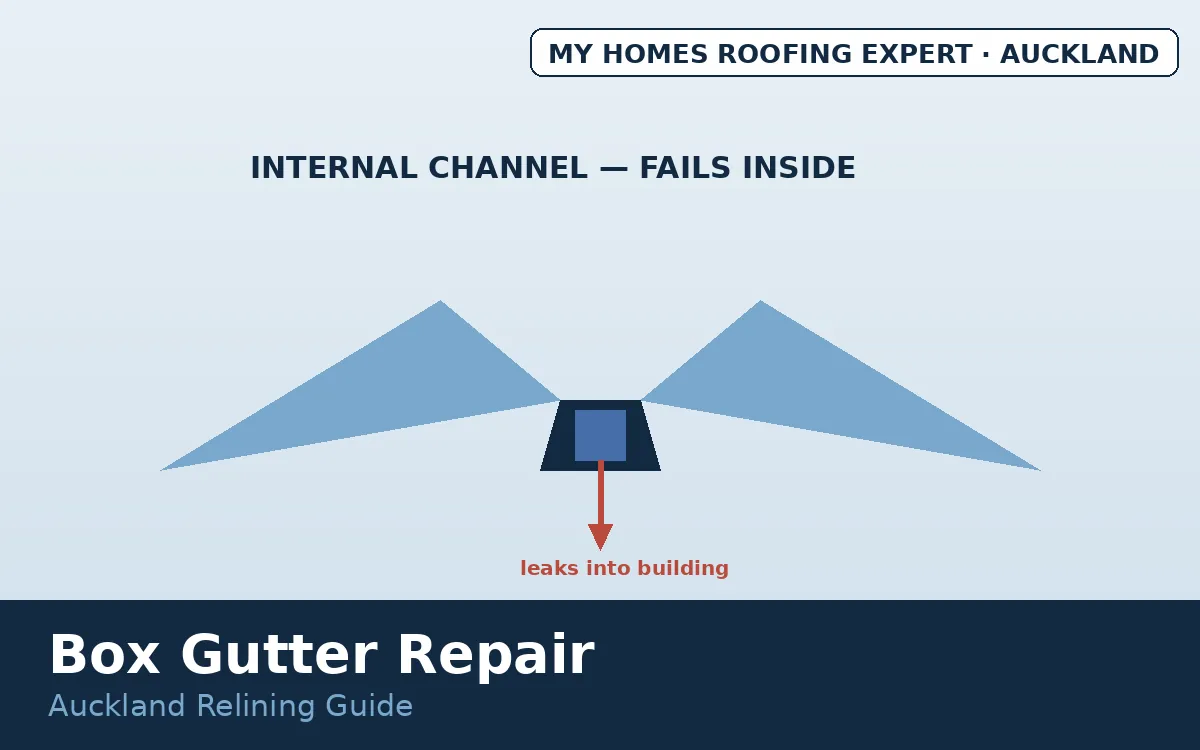
Box gutter repair Auckland work carries a weight ordinary spouting does not, because box gutters leak inside the building. An internal gutter — the waterproofed channel running within the roofline between planes, in a valley, or behind a parapet — has no harmless overflow: when it fails, water discharges into the roof structure, ceiling, or wall cavity. That single fact makes box gutters among the highest-consequence elements on any roof, and their repair a job for restoring continuous waterproofing rather than patching a leak.
Auckland's commercial buildings, terraces, and complex residential roofs all carry them, and their failures fill the consequential end of the leak-callout book.
How are leaking box gutters repaired?
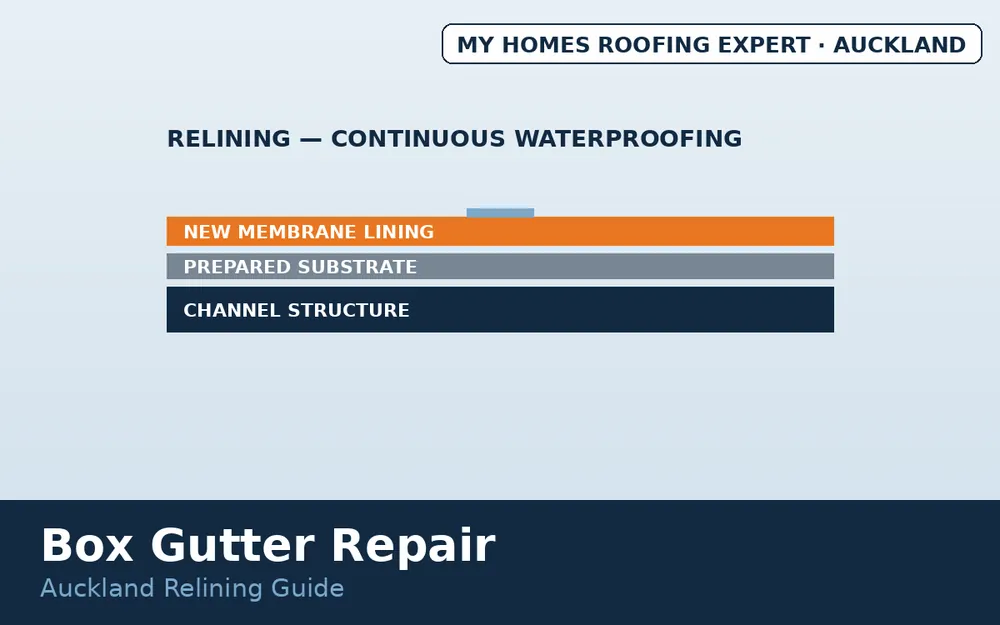
Direct answer: by relining the channel to continuous waterproofing. The repair ladder: joint and detail reseal — honest triage on sound linings with localised faults, dishonest as a cure for failed ones; relining — the standard fix, where the failed lining is stripped or suitably overlaid and a new continuous membrane (the butyl, torch-on, or single-ply systems) or metal lining is installed with proper falls to outlets, upstand heights to specification, and outlet detailing done right; and rebuild — where the gutter's structure or capacity is itself the problem, reconstructing the channel correctly. The non-negotiables across all three: continuous waterproofing (box gutters fail at joints and details, so the fewer of both the better), adequate falls (ponding is a membrane killer per our ponding guide), and the outlet and overflow detailing the next section makes central. Internal-gutter pros and cons sit in our internal gutters guide; the commercial scale in commercial roofing.
The overflow provision — the detail that protects the building
The design lesson box gutters teach loudest is overflow: edge gutters overflow harmlessly outside; box gutters overflow into the building unless designed not to. Proper box gutter design includes overflow outlets — secondary discharge points sized and placed to spill excess clear of the structure when the primary outlets block or the capacity is exceeded, the safety valve older internal gutters frequently lack. The capacity that drives the need is the same arithmetic as edge gutters — catchment area and rainfall intensity, the sizing logic of our overflow guide — but the consequence of getting it wrong is internal, which raises the stakes from nuisance to weathertightness. Relining and rebuild projects are therefore the moment to fix provisions, not just linings: an internal gutter renewed without overflow protection is renewed half-finished, and the overflow detailing our provisions guide covers belongs in every box gutter scope.
Maintenance — box gutters reward the attention their stakes demand
Because the consequences are internal, box gutters justify maintenance discipline edge gutters can sometimes survive without: outlet clearing — the blockage point whose backup floods inside, cleared on the schedule the catchment and tree cover demand (the maintenance calendar applied with extra seriousness); lining inspection — membrane and metal linings aging on their schedules, checked before failure during the roof's inspection rounds, especially on the commercial roofs whose maintenance contracts list internal gutters as priority items; ponding watch — standing water in the channel signalling fall problems before they become lining failures; and early intervention — the small relining done on schedule against the ceiling-and-cavity repair the ignored leak delivers. The asymmetry is stark and the lesson simple: the element that leaks inside is the element to maintain first.
What Cost, Risk and Timing Factors Apply?
Box gutter repair prices above edge-gutter work — access, the continuous lining systems, and the detailing all cost more — but against the internal damage of failure, the relining is the cheap side of the comparison. Risks concentrate at the details: discontinuous linings, missing overflow provisions, and the reseal sold as a relining. All are scope-stage questions, and all are why box gutter work belongs with people who treat internal gutters as the high-stakes elements they are. The work is height and detail work throughout — professional territory, with the ceiling-stain watch the owner's early-warning role.
How Do You Get box gutters relined right in Auckland?
My Homes Roofing Expert repairs and relines box gutters across Auckland — continuous waterproofing, overflow provisions restored, outlets detailed properly. Call 022 501 9921 or visit roof repair Auckland.
What Questions Do Auckland Homeowners Ask?
How are box gutters repaired?
By relining to continuous waterproofing — with falls, outlets, and overflow provisions addressed, not just the leak.
Why are the leaks serious?
They discharge inside the building — into structure, ceiling, or cavity — not harmlessly outside.
What is a box gutter?
An internal gutter — a waterproofed channel within the roofline, between planes or behind parapets.
Why do they overflow inside?
No overflow provision — proper design spills excess clear of the structure; older ones often cannot.
Can problems be prevented?
Largely — capacity, overflow provisions, scheduled outlet clearing, and maintained linings.
Topics covered
- internal gutter relining
- box gutter leak
- membrane gutter lining NZ
- internal box gutter repair
- concealed gutter leak