
Single replacement suits localised damage on sound roofs: a careful swap, a matched profile, a new sheet that weathers in over seasons. When the damage is the roof telling its age, one sheet is a postponement — and the honest quote says which situation yours is before the ladder goes up.
Roof sheet replacement answers a common and reasonable question: a branch came through, a storm lifted a sheet, something localised failed — can you fix just that, without re-roofing the house? Often yes — a single sheet swaps out of a sound roof through a careful lift-remove-refit sequence — and the honest qualifier is that the rest of the roof has to deserve it. One new sheet in an end-of-life roof solves a symptom and leaves the disease; one new sheet in a sound roof fixes the problem cleanly.
This guide covers when single replacement is right, how the swap works, and the weathered-in reality the new sheet brings with it.
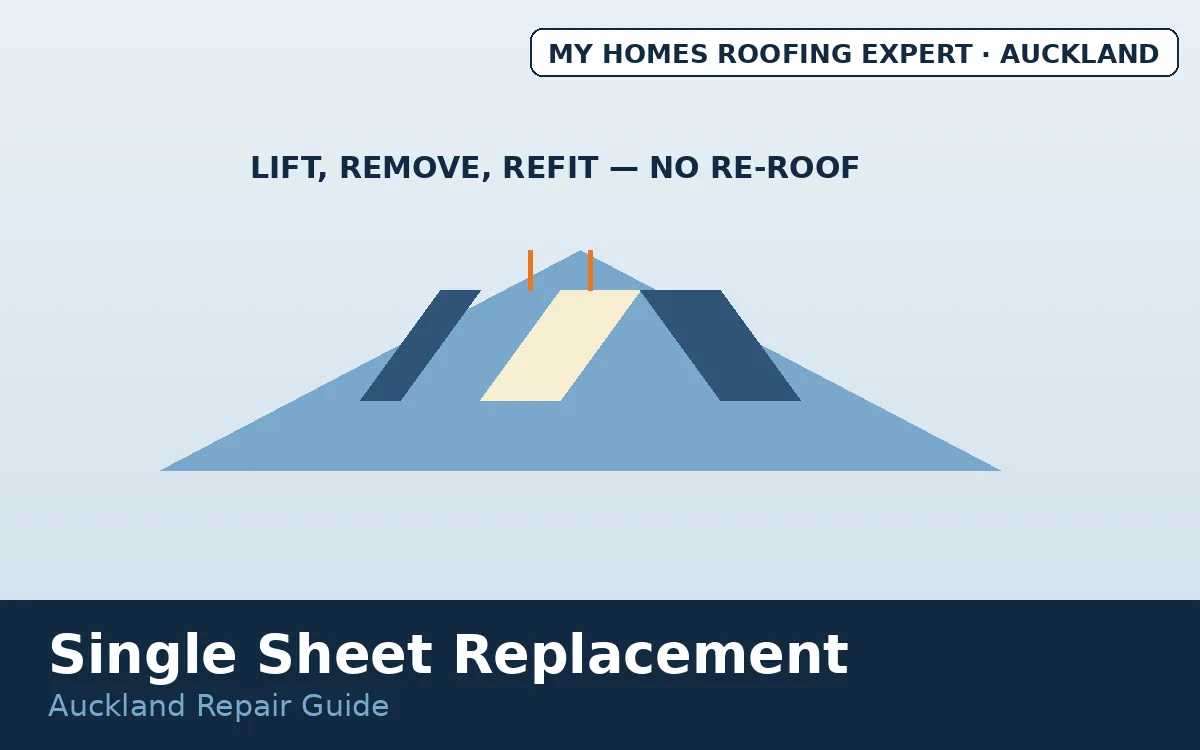
Can a single damaged roof sheet be replaced?
Direct answer: yes on a sound roof with matchable profile; no when the damage is whole-roof age in disguise. The right-call cases: localised impact — fallen branches, dropped objects, hail dents confined to a sheet or two; storm uplift — sheets lifted or lost where the fixing failure was local rather than general, the wind-damage scenario our wind-lift guide distinguishes from systemic loosening; and isolated corrosion — a single sheet perforated at a specific fault while the field stays sound, the metal-loss endpoint of our rust staging guide. The wrong-call cases: widespread rust, general fixing failure (the lead-head and washer aging of our conversion and fixings guides), and end-of-life coating — where the honest answer routes to re-roofing rather than a sheet that ages out with its neighbours next season. The staging call is an inspection finding, exactly as it is for rust.
The swap sequence and the matching question
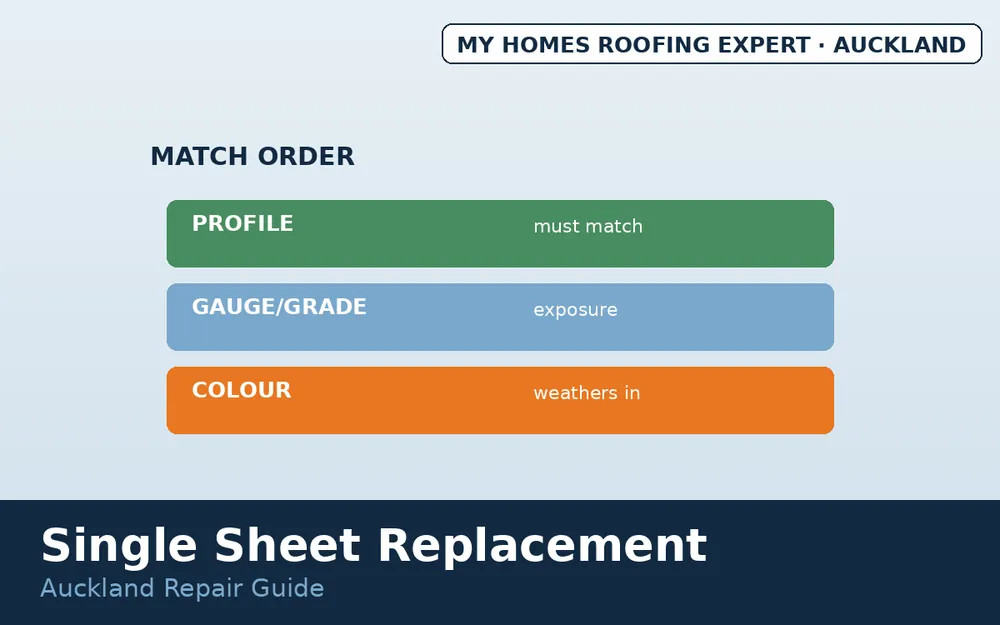
How the replacement runs: access and assessment — the surrounding sheets and fixings read, the damage confirmed as local; the lift — overlapping sheets carefully lifted at side and end laps to free the damaged one without disturbing more than necessary (the interlocked nature of long-run meaning a sheet is rarely removed in isolation); removal — old fixings withdrawn, the damaged sheet out, the underlay and purlins beneath checked while exposed; fit and fix — the new sheet laid into the run, fixed with current class-rated screws to wind-zone pattern (the fixings discipline), laps re-dressed and sealed where specification requires; and reinstatement — the lifted neighbours re-fixed, the run made continuous again. The matching that makes it work: profile exactly — rib geometry must match or the laps leak, the same precision our profile guide and salvage guide demand; then gauge and grade to the address's exposure; then colour, knowing the new sheet arrives brighter.
The weathered-in reality — and the emergency version
Two honest realities round out the job. The brightness: a new sheet in a weathered roof sits visibly fresher — the faded field has years of UV the replacement has not, the geometry our fade guide explains — and it tones in over following seasons rather than matching on day one; on prominent roofs, owners weigh accepting the temporary contrast against broader work, an options conversation the inspection frames honestly rather than hiding. The timeline: storm-driven replacement often runs as a two-stage job — the emergency tarp first (the make-safe bridge of our tarping guide), then the sheet itself once matching material arrives, since profile-correct stock can take days to source — the emergency service managing the bridge while the proper sheet is found. Planned replacement skips the drama: known damage, matched material, scheduled swap.
What Cost, Risk and Timing Factors Apply?
Single-sheet replacement prices as a contained repair — material per sheet, the lift-and-refit labour, access by height — among the friendlier lines in roof repair, and far below the re-roofing it avoids on genuinely sound roofs. Risks are the staging shortcut (a sheet sold into a dying roof) and the matching shortcut (near-profile sheets that lap badly) — both filtered by honest inspection. The work is height work on an interlocked surface, professional throughout, with the damage-spotting and the brightness-expectation the owner's informed part.
How Do You Get a sheet swapped properly in Auckland?
My Homes Roofing Expert replaces single sheets across Auckland — staging honest, profiles matched, new sheets fixed to current pattern. Call 022 501 9921 or visit roof repair Auckland.
What Questions Do Auckland Homeowners Ask?
Can one sheet be replaced?
Often — on a sound roof with matchable profile. Whole-roof age in disguise routes to re-roofing instead.
When is it the wrong call?
Widespread rust, general fixing failure, or end-of-life coating — one new sheet solves nothing there.
How is the sheet matched?
Profile exactly, then gauge and grade, then colour — knowing the new sheet sits brighter.
Why does the new sheet look brighter?
The field has faded over years; the replacement weathers in over following seasons.
Emergency or planned?
Both — storm damage often tarps first then swaps when matched material arrives.
Topics covered
- replace one roofing sheet
- damaged iron sheet
- partial reroof Auckland
- single sheet swap
- storm damaged roof sheet