
How Colorsteel colours fade in NZ sun — the pigment science, which shades hold longest, chalking vs fading, and warranty realities.
Colorsteel colour fade is the slow-motion story every NZ steel roof tells: pigments weathering under some of the world's strongest residential UV, dark shades shifting first, north faces leading south faces, and owners wondering at year fifteen whether the roof is aging or failing. The short reassurance — fade is cosmetic; the protection underneath keeps working — and the useful knowledge is which colours tell the story slowest.
It matters at two moments: choosing a colour for a roof that will face the sun for decades, and reading an existing roof's fade honestly when deciding between living with it, recoating, and replacing.
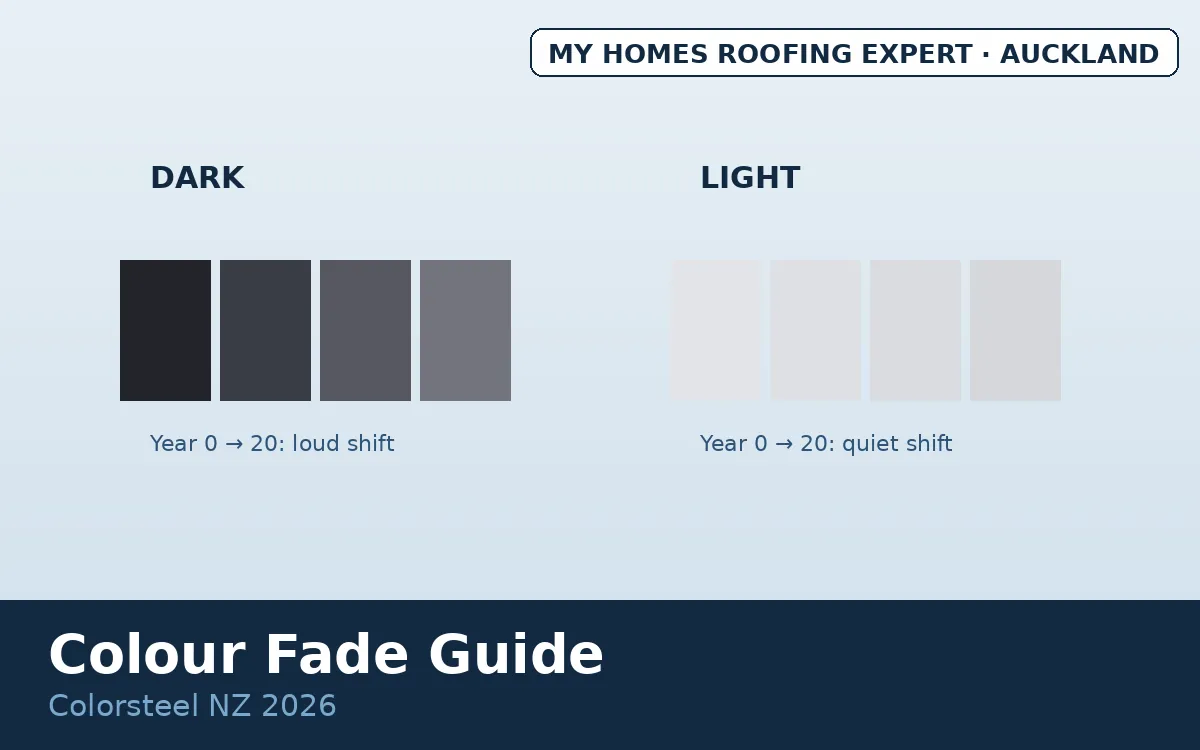
Which Colorsteel colours fade the least?
Direct answer: lighter and earth-toned shades hold longest; strong darks and saturated colours shift soonest. The mechanics: pale colours absorb less solar energy, run cooler, and weather their pigments slower — and when shift happens, low-saturation starting points hide it; dark colours run hotter (the thermal story our dark vs light guide covers), drive their pigment chemistry harder, and display every increment of change against a saturated baseline. The practical ladder, most enduring to most demanding: whites and off-whites; light greys and beiges; mid greys and muted greens; dark greys; and deep blacks plus bold accent shades. Manufacturer warranty schedules quietly agree — appearance terms scale with colour family — and premium pigment technologies in current ranges have genuinely improved dark-shade endurance over older generations, without repealing the physics. Colour-choice context beyond fade lives in our roof colour guide.
In short
Choose pale and earth tones for minimum visible aging, accept that loved darks will mellow on schedule, expect north faces to lead the change, and read heavy chalking — not fade alone — as the recoating signal. Fade is the topcoat's diary, not the roof's obituary.
Fading, chalking, and the aging sequence
Steel-roof topcoats age through a readable sequence. Gloss loss arrives first — the new-roof sheen settling to matte within early years, universal and harmless. Fade follows — pigment shift under UV, gradual, exposure-patterned. Chalking deepens the story — the resin binder breaking down into the powdery film a finger-wipe reveals — normal in moderation, and in heavy form the honest signal that the topcoat is finishing and the recoating conversation has arrived. Beyond chalk lies porosity and surface breakdown, where moss finds purchase and water lingers — the stage our paint failure guide picks up. The sequence runs over decades on quality product; the owner's job is reading which chapter the roof is in, ideally with a professional eye every couple of years.
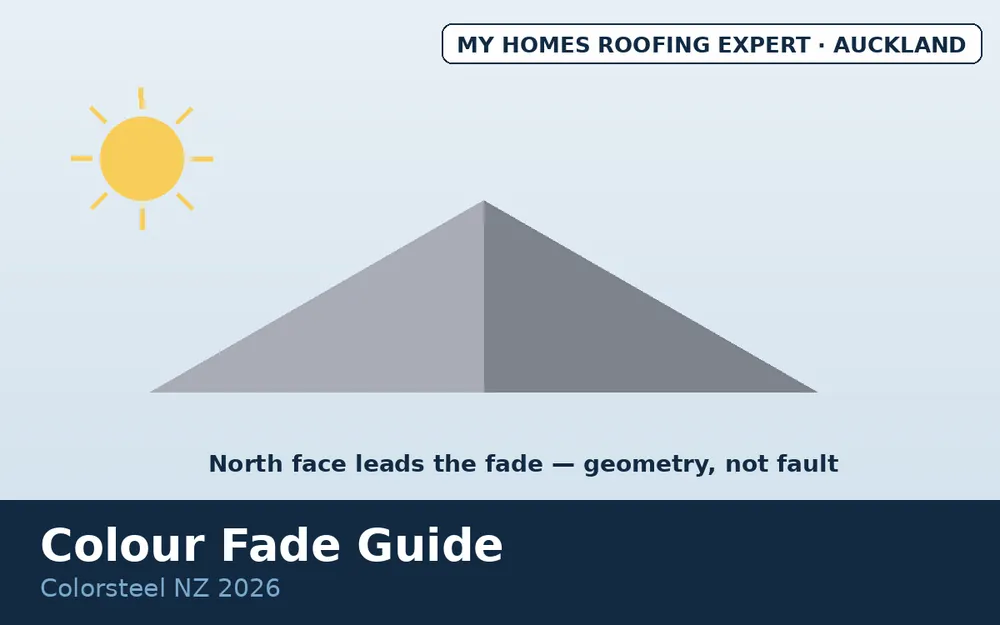
Why fade arrives unevenly — and what that means
Uneven fade unsettles owners more than fade itself, and it is pure geometry: north-facing planes take NZ's heaviest UV dose and age first; south faces lag years behind, manufacturing the two-tone roofs of every older streetscape; pitch modulates dose; and shelter — trees, walls, chimneys — prints its shadows as fresh patches on aged fields. Implications: judge a roof's age by its north face; expect replacement sheets and repairs to sit visibly newer until they weather in (the matching reality our repair teams flag honestly); and when uniformity matters — sale presentation, colour change, heavy chalk — a full recoat resets every plane to the same day one.
Cost, risk, and decision factors
Fade itself costs nothing and risks nothing; the decisions around it do. Choosing colour: balance the architectural pull of darks against their louder aging, or split the difference in the mid-grey families half of Auckland has sensibly chosen. Reading aging: fade alone is patience territory; heavy chalking is budgeting territory; bare metal is action territory. And warranty literacy: appearance terms, colour families, and maintenance expectations live in the documents — keep them, and let quotes reference them.
Get a colour and coating assessment in Auckland
My Homes Roofing Expert reads roof aging honestly across Auckland — fade, chalk, and coating condition assessed free, recoating quoted only when the roof actually asks for it. Call 022 501 9921 or get in touch.
Frequently asked questions
Which colours fade least?
Whites, light greys, and earth tones; strong darks and saturated shades shift soonest.
Why do dark roofs fade faster?
They run hotter, driving pigment weathering — and show every change against a saturated base.
Fading vs chalking?
Fade is pigment shift; chalk is resin breakdown — the finger-wipe powder that signals recoating time.
Why uneven fade?
Exposure geometry — north faces lead, shade lags, shelter prints patches. Normal, not a fault.
Does fade mean failure?
No — cosmetic topcoat aging over working protection. Heavy chalk and porosity are the action signals.
Topics covered
- roof colour fading NZ
- UV fade roofing
- dark roof fade Auckland
- chalking roof paint
- fade resistant roof colours