
How roofers match discontinued tiles — the salvage networks, profile and colour matching, weathered-in blending, and when matching fails.

Matching replacement roof tiles is a sourcing craft most owners never see and could not perform alone: a tile cracks or a storm breaks a few, and the question is whether a roof laid decades ago — possibly in a long-discontinued pattern — can be invisibly repaired. The answer is more often yes than owners expect, because NZ's tile-matching ecosystem runs deeper than the catalogue: current ranges, salvage yards, and a reclaimed-tile network keep old patterns circulating. The craft is knowing where to look and how to blend.

This guide opens the sourcing networks and explains the profile-before-colour priority that makes tile repairs hold water and disappear from the street.
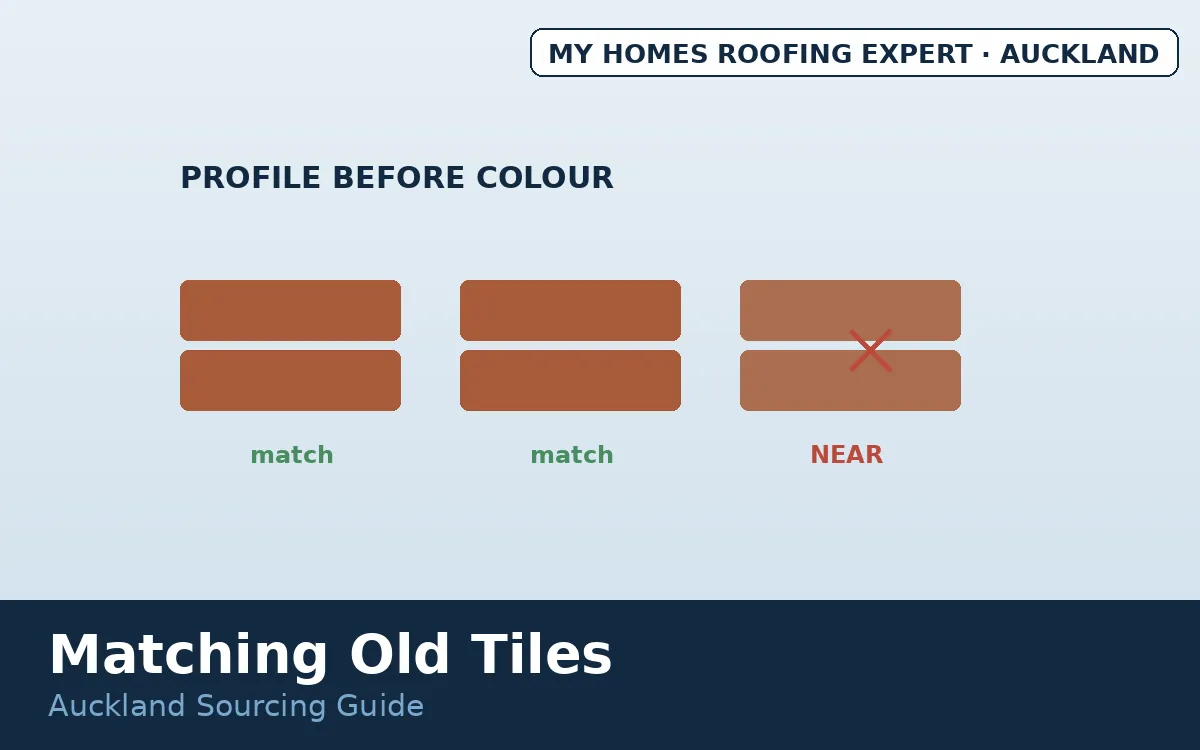
Matching replacement roof tiles — tile profiles compared for matching Auckland
Profile exact first — interlocking tiles leak if the pattern is merely close

How do roofers match discontinued tiles?

Direct answer: profile first, through current ranges and salvage networks; colour as closely as available; blending to hide the rest. The sequence: identify the profile — the exact tile pattern read from the roof, since tiles interlock and a near-profile tile breaks the weather seal (functional necessity, not aesthetics); source the match — current manufacturer ranges where the profile continues (many NZ concrete patterns do), salvage and demolition yards holding reclaimed tiles from removed roofs, and the tile reuse network that keeps discontinued patterns alive — the sources a tile roofer carries and an owner rarely finds; match colour as closely as the stream allows, knowing colour is cosmetic where profile is structural; and blend — placing any imperfect matches where they show least and letting new tiles weather toward the field. The clay-and-concrete context — and which patterns survive — sits in our tile comparison, and the work itself in tile roofing Auckland.

In short

Profile is the must-match (interlocking tiles leak otherwise); colour is the want-match (visible but not functional); and salvage networks make far more old roofs repairable than owners realise. When exact matching genuinely fails, honest options remain — harvest from a hidden face, accept a sympathetic near-match, or weigh restoration — and a good roofer presents them rather than forcing a mismatch.

The salvage advantage — and the harvest trick

Salvage is tile repair's quiet superpower, and it works two ways: direct sourcing — reclaimed tiles of the right age and pattern often blend immediately, weathered to the same decade as the roof receiving them, which is why heritage tile repairs frequently look seamless from day one where a new tile would shout; and the harvest trick — when no external match exists, roofers borrow from the roof itself: matching tiles lifted from a hidden area (a rear slope, a garage roof, a section behind a parapet) repair the highly visible face, and the closest-available substitutes fill the hidden area where the mismatch never shows. It is the standard professional move on genuinely unmatchable roofs, and it keeps the street-facing roofline perfect at the cost of a near-match where nobody looks. The sourcing and harvest knowledge is exactly what separates a tile roofer from a generalist — and what our project work draws on across Auckland's heritage stock.
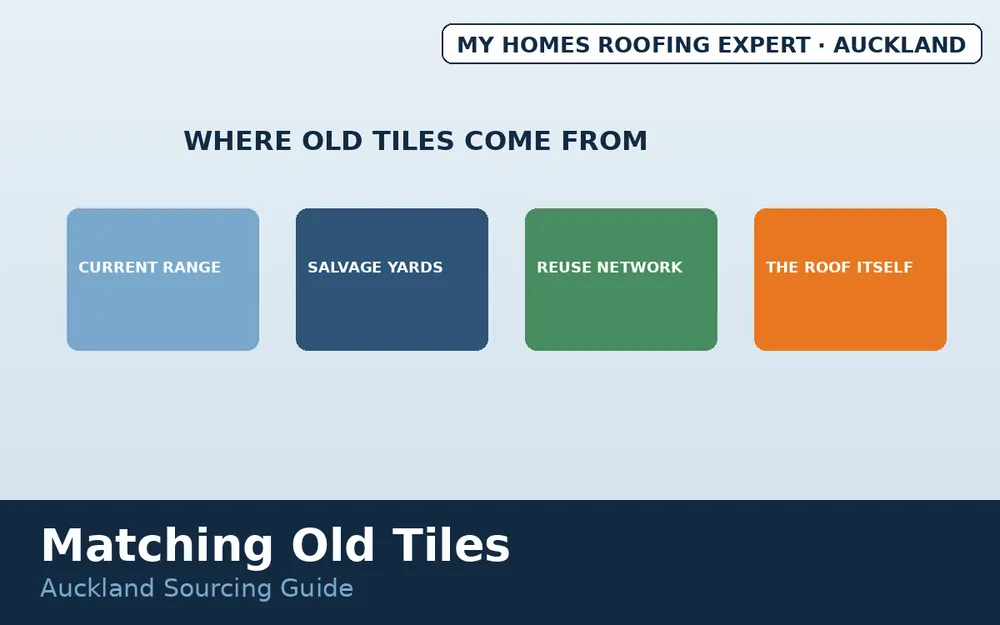
Salvage tile sourcing networks for discontinued tiles Auckland
Current ranges, salvage yards, reuse networks — and the roof itself as a last source

When matching meets the bigger decision

Tile matching usually serves repair, but sometimes it surfaces the larger question: repair-and-blend — the normal case, a handful of tiles matched and the roof carried on for years, often inside the rebedding and repointing rounds our rebedding guide covers; restoration unifying — where treatment, cleaning, and recoating during a full restoration blend matched and existing tiles under a uniform finish, the recoat masking colour differences the salvage could not; and the honest end-point — where matching fails across a roof that is itself deteriorating (porous, drinking tiles, widespread cracking), the conversation moves from matching to the restoration-versus-replacement fork our tile guide frames, because chasing matches across an end-of-life roof spends sourcing effort on a roof that needs a decision. The matching skill, in other words, knows its own limits — and a roofer who only ever finds a match may be selling repairs a roof has outgrown.

Cost, risk, and sourcing factors

Matched-tile repair prices as contained work — the tiles (salvage often cheap, rare patterns occasionally not), the access, the careful lift-and-set of fragile material — well below the alternatives on a sound roof. Risks are the matching shortcuts: near-profile tiles that leak, and matches forced onto roofs past saving. Both are inspection-stage filters. And the tile-roof constant closes as ever — fragile, slippery, professional-only underfoot, the broken tile noted from the ground and matched by people who source for a living.

Get old tiles matched in Auckland

My Homes Roofing Expert matches and sources tiles across Auckland's older roofs — profiles identified, salvage networks worked, repairs blended to disappear. Call 022 501 9921 or visit roof repair Auckland.

Frequently asked questions

How are discontinued tiles matched?

Profile first via current ranges and salvage networks, colour as closely as available, then blended.

Where do replacement tiles come from?

Current manufacturer ranges, salvage and demolition yards, and the tile reuse network.

What if no exact match exists?

Harvest from a hidden face, accept a sympathetic near-match, or weigh restoration — options presented honestly.

Why does matching matter?

Profile mismatch leaks (tiles interlock); colour mismatch is cosmetic but visible.

Do new tiles blend over time?

Partially — they weather toward the field, and salvaged tiles of the right age often blend immediately.

PreviousSingle Roof Sheet Replacement in Auckland
Next ArticleFibre Cement Roof Repair in Auckland: Safe Ha…

Related Roofing Services

Looking for professional roofing services in Auckland? Our licensed team covers the full range — free quotes, written warranties, and same-day response.

Tile Roofing AucklandRoof Repair AucklandProjects

Ready to Fix Your Auckland Roof?

Get a free, no-obligation quote from Auckland's trusted licensed roofing specialists. Same-day response guaranteed Auckland wide.

Auckland’s Trusted Roofing Specialists — My Homes Roofing Expert

My Homes Roofing Expert is a licensed, fully insured roofing company serving homeowners, property managers and commercial clients across the entire Auckland region. Since 2023, our team of qualified roofers has completed thousands of roof repair, re-roofing, roof painting, roof cleaning, moss treatment and emergency roofing projects across every Auckland suburb — from the North Shore and West Auckland to the eastern bays, Central Auckland and South Auckland.

As a 5-star rated Auckland roofing contractor with 22+ verified Google reviews, we’ve built our reputation on honest pricing, high-quality workmanship and long-lasting results that withstand New Zealand’s demanding coastal climate.

Whether your roof has a small leak that needs urgent attention, your tiles are losing their colour after years of UV exposure, your spouting and gutters are blocked with debris, or you’re ready to replace an aging Decramastic, concrete tile or corrugated iron roof, our registered building company team has the experience and equipment to deliver the right roofing solution at the right price.

Every job is backed by a written workmanship warranty and supported by transparent quoting — no hidden costs, no high-pressure sales, just clear roofing advice from people who do this work every day.

Roofing Services We Provide Across Auckland

Our core roofing services cover the full lifecycle of an Auckland roof. Roof painting in Auckland restores the appearance and adds years to the lifespan of tile, Decramastic and metal roofs using premium NZ-formulated roof coatings designed for New Zealand’s harsh UV and rainfall.

Roof repair Auckland covers leak detection, broken tile replacement, ridge re-pointing, flashing repair, valley iron replacement and storm damage repair — usually completed same-day for emergency callouts. House re-roofing in Auckland replaces old, failing roofs with modern long-run Colorsteel, Endura or Maximus metal roofing, fully consented and installed to NZ Building Code E2 weather-tightness standards.

Roof cleaning Auckland uses soft-wash methods to safely remove moss, lichen, algae and grime without damaging the roof surface or surrounding paintwork. Roof moss treatment Auckland applies long-acting moss inhibitor that continues killing spores for up to 12 months, preventing the regrowth that plain waterblasting can’t. Spouting and guttering Auckland covers seamless continuous spouting, half-round and quarter-round profiles, downpipe replacement and internal gutter repair.

Commercial roofing Auckland serves body corporates, schools, warehouses, churches and factories with Butynol membranes, TPO, colorsteel re-cladding and large-scale roof painting projects. Our emergency roof repair Auckland service operates seven days a week for storm damage, active leaks and weather-related roof failures.

Roofing Materials We Work With in New Zealand

Auckland’s housing stock includes almost every common roofing material used in New Zealand over the last seventy years, and each one needs a different approach. Long-run Colorsteel is the most widely specified new-build roofing in Auckland today — produced by NZ Steel under the Colorsteel Endura and Colorsteel Maximus brands, it carries a manufacturer paint warranty whose term varies by product grade and proximity to the coast — exact cover is confirmed in your written quotation.

Maximus is the heavier-grade coating system designed for severe marine exposure on the east coast bays and inner harbour. Decramastic pressed-steel tileswere installed extensively from the 1970s through the 1990s and are still on tens of thousands of Auckland homes. They respond well to high-pressure cleaning, primer and recoating but reach the end of their service life after 35–45 years depending on exposure.

Concrete tiles like Monier and Gerard Coronet have a longer structural life — often 50 years or more — but the surface coating fades and the ridge mortar fails on roughly the same 15-year cycle, which is when we recommend re-pointing and re-coating rather than replacement.

Corrugated iron and tray-profile metal remains the workhorse roof for Auckland villas, bungalows and rural lifestyle blocks. Modern long-run replacements use galvanised steel or Colorsteel with hidden fixings and concealed gutter systems for a cleaner heritage look. Butynol and TPO membrane systems are used on flat or low-pitch roofs — common above garages, decks, additions and modern flat-roofed architectural homes.

Membrane work is highly technical: poor seam welding or flashing detail will leak within a few seasons, which is why we only use experienced membrane installers and provide a written installation warranty. Clay tile, slate and shingle roofs appear on heritage villas and listed buildings around Ponsonby, Mt Eden, Devonport, Parnell and Remuera, and these need specialist hand-replacement and careful colour-matching that respects the heritage character of the original roof.

Auckland Suburbs and Service Areas We Cover

We provide roofing services across every suburb in the wider Auckland region — including Henderson, Takapuna, Albany, Devonport, Glen Eden, New Lynn, Mt Albert, Mt Eden, Ponsonby, Remuera, Onehunga, Manukau, Manurewa, Papakura, Howick, Pakuranga, Botany, East Tamaki, Otahuhu, West Harbour, Massey, Hobsonville, Te Atatu, Avondale, Mount Roskill, Three Kings, Royal Oak, Epsom, Greenlane, Newmarket, Parnell, Mission Bay, St Heliers, Glendowie, Pakuranga Heights, Bucklands Beach, Half Moon Bay, Cockle Bay, Beachlands, Maraetai, Whitford, Clevedon, Pukekohe and Waiuku.

Each Auckland region has different roofing demands — coastal eastern suburbs need salt-resistant Colorsteel Marine grade, western suburbs deal with heavy native tree debris and moss, and southern Auckland’s older housing stock often requires full re-roofing rather than repair. Our local crews know these patterns because we’ve worked in every one of these areas.

Coastal exposure dominates roofing decisions in the eastern and northern bays — Mission Bay, St Heliers, Kohimarama, Glendowie, Bucklands Beach, Devonport, Cheltenham, Takapuna, Browns Bay, Mairangi Bay and Long Bay all sit within 500m of saltwater, which means standard Colorsteel Endura coatings will reach the end of their warranty life faster than the inland equivalent.

For homes inside that coastal zone we generally recommend Colorsteel Maximus or stainless fixings combined with regular fresh-water rinsing of the roof surface twice a year. West Auckland suburbs such as Henderson, Massey, Glen Eden, New Lynn, Titirangi and Laingholm sit under heavy native canopy — pohutukawa, kauri, totara — which drops debris into spouting and creates shaded micro-climates where moss and lichen flourish.

We see far more moss-related roof failures west of Lincoln Road than anywhere else in the region. Inland southern and central suburbs typically deal with UV-driven coating breakdown and older roof structures from the 1960s–1980s, where the underlying timber substrate is often the deciding factor between re-coating and full re-roofing.

Why Auckland Homeowners Choose My Homes Roofing Expert

Registered and qualified. All structural and weather-tightness work is carried out in full compliance with the New Zealand Building Act 2004 by our registered building company team. Fully insured. We carry $1 million public liability insurance and full workers’ compensation cover, so you’re protected on every job.

Transparent pricing.Every quote breaks down materials, labour, scaffolding, edge protection, disposal and GST line by line — what you see is what you pay. Local Auckland team.We aren’t a franchise or a national call-centre — when you ring 022 501 9921 you speak to a roofer, usually within minutes, and the same team that quotes your job is the team that does the work.

Warranty-backed workmanship.Roof painting carries a written workmanship warranty as per quotation; new long-run metal re-roofing is backed by both our installation warranty and the manufacturer’s coating warranty (as per quotation) from NZ Steel, Dimond or Steel & Tube. Health-and-Safety certified. SiteWise Green certified, working with fully compliant edge-protection, harnesses, mobile scaffold and roof anchor systems on every job over 3 metres.

Real reviews from real Auckland homeowners.Our Google rating of 5.0 stars is built from 22+ verified five-star reviews — no incentivised reviews, no fake profiles. Read them at google.com/maps under “My Homes Roofing Expert Auckland”.

How Auckland’s Climate Affects Your Roof

Auckland has one of the most demanding residential climates in the country for roofing. High ultra-violet exposure year-round breaks down the acrylic and polyester topcoats on metal and Decramastic tiles, fading the colour and eventually exposing the primer and substrate.

Annual rainfall of 1,200–1,500mm — combined with prolonged shoulder seasons of damp, mild weather — creates ideal conditions for moss, lichen and algae, which lift roof coatings from below, hold moisture against the substrate and shorten roof life by 20–30%. Salt-laden air from the Tasman, Manukau and Waitematā harbours accelerates corrosion of steel roofing and unprotected fasteners, with the effect measurable for several kilometres inland.

Stronger wind-driven rain events linked to ex-tropical systems (Gabrielle, Hale, Dovi) are now lifting ridge caps, displacing tiles and forcing water back under flashings on roofs that were perfectly compliant when first installed. Designing — and maintaining — a roof for Auckland in 2026 is materially different from doing the same job ten or fifteen years ago.

Roof Inspection and Maintenance Schedule for Auckland Homes

A small annual maintenance investment dramatically extends roof life. We recommend a full visual inspection every twelve months — ideally late autumn, before winter storms — covering ridge caps and mortar, all roof penetrations (flues, vents, skylights, aerials), the condition of fasteners and washers, valley irons, flashings around chimneys and parapet walls, and the entire spouting and downpipe network.

Gutters and downpipes should be cleared at least twice a year (more often if your property has overhanging trees), as a single blocked gutter during heavy rain is the leading cause of water ingress claims we see across Auckland.

Moss should be treated as soon as it appears — a single application of a quality moss inhibitor in early autumn typically keeps a roof clear for an entire year, far cheaper than the high-pressure cleaning and re-coating that becomes necessary when moss takes hold.

Roof paint is generally inspected at five-year intervals and recoated at ten to fifteen years depending on condition, exposure and the coating system originally specified.

Repair, Re-Coat or Replace — Making the Right Decision

Whether to repair, recoat or fully replace a roof comes down to three factors: the condition of the substrate, the cost of repair as a percentage of replacement, and the remaining service life you can realistically expect.

As a general guide, if the underlying steel or tile is sound and the failure is cosmetic — fading, chalking, minor surface rust — re-coating after a thorough wash, prime and prep is the right call and typically buys another 12–15 years of life at roughly 30–40% of the cost of full replacement.

If the substrate itself has perforated, if fasteners have failed across multiple sheets, if ridge timber is rotted, or if the roof has had successive patch repairs over many years, replacement almost always works out cheaper over the ten-year horizon.

We give honest advice on this — there’s no commission incentive on our team to push replacement when re-coating is the right answer, or vice versa.

What a Typical Roofing Project Looks Like

Every job starts with a free on-site inspection — usually 30–45 minutes for a residential roof — where we photograph all elevations, identify any structural, weather-tightness or compliance issues, measure the roof area accurately, and discuss your preferred outcome. A written, itemised quote follows within two to three working days, broken down by material, labour, access and disposal.

Once accepted, we book a start date that suits the weather forecast and your household, organise scaffold and edge protection where required (over 3m fall risk), and arrange any building consent paperwork through Auckland Council.

A standard residential roof painting project takes three to five working days; full re-roofing typically runs five to ten working days depending on the size, complexity and number of penetrations; emergency leak repairs are usually completed in a single visit.

The work area is left clean every evening, and the final invoice is only issued after a hand-over walk-through where you sign off that the work meets the agreed scope.

Insurance Claims, Storm Damage and Building Consents

Auckland storm seasons mean a steady volume of insurance roof claims, and we work regularly with IAG (State, AMI, NZI), Tower, AA Insurance, Vero, FMG and most other residential and commercial insurers. We provide itemised, insurer-formatted quotes with photographic evidence suitable for assessors, and where the loss involves urgent weather-tightness issues we can attend within hours to make the property safe and watertight before the claim is settled.

For building consent, a like-for-like replacement on a single-storey home using the same roofing material generally qualifies as exempt work under Schedule 1 of the Building Act 2004; changing materials (e.g. tile to metal), changing roof pitch, structural alteration to trusses or purlins, or any alteration above 10 square metres that affects the building’s weather-tightness will require consent.

We can submit and manage the Auckland Council consent process on your behalf, including pre-application advice, producer statements for the structural and weather-tightness elements (PS1, PS3 and PS4), and Code of Compliance Certificate sign-off at completion.

Pricing — What Actually Affects the Cost of an Auckland Roof

Most roofing quotes vary because of access, complexity and condition — not because of the headline material price. The five biggest cost drivers are: roof pitch (anything above 35° needs more time, harness work and edge protection), single versus two-storey (scaffold doubles the access cost), number of penetrations and changes of direction (each flue, skylight, parapet and valley adds labour), substrate condition (rotten purlins or rusted fasteners need replacement before re-coating), and the chosen coating or material system.

As a working guide for 2026: roof painting on a typical 150–200 m² single-storey Auckland home runs NZ$3,500–$6,500 fully prepped and coated; full re-roofing in long-run Colorsteel on the same home is generally NZ$18,000–$32,000 inclusive of removal, disposal and new building paper; spouting replacement is NZ$45–$80 per linear metre installed; soft-wash roof clean with moss treatment is NZ$650–$1,400 depending on size and access.

We always quote a fixed price, not an hourly rate, and we honour the quoted figure unless the scope changes.

Common Auckland Roofing Questions

How much does roof painting cost in Auckland?A typical 150–200 m² family home costs between NZ$3,500 and NZ$6,500 fully prepared and painted, depending on roof condition, pitch, access and coating system. Decramastic and concrete tile usually sit at the higher end because they need full priming. We supply a fixed-price quote before any work starts.

How long does an Auckland roof last? Long-run Colorsteel installed correctly will last 30–50 years before re-coating; pressed metal tile (Decramastic) typically reaches 35–45 years; concrete tiles 50+ years with re-pointing every 15 years. Coastal exposure within 500m of the sea typically reduces those lifespans by 20–30%.

Do I need building consent to replace my roof? A direct like-for-like replacement on a single-storey home using the same material usually qualifies as exempt work under Schedule 1 of the Building Act. Changing material (e.g. tile to metal), changing roof pitch, or any structural alteration requires consent from Auckland Council. We can manage the consent process for you.

How quickly can you respond to an emergency leak? Same-day for active leaks during business hours across Auckland; within 2–4 hours for most central and inner suburbs. After-hours emergency cover is available — call 022 501 9921 and our team will either attend immediately or talk you through a safe temporary fix until we arrive.

Do you handle insurance roof claims? Yes — storm damage, hail damage, fallen-tree damage and water-ingress claims are part of regular work for us. We provide itemised quotes formatted for IAG, AA, Tower, Vero and State insurers, plus photographic evidence for the assessor.

How long does a full re-roof take? A standard single-storey Auckland home with a long-run metal re-roof typically takes five to ten working days from scaffold-up to final clean — weather dependent. Two-storey properties, complex roof shapes with multiple valleys and dormers, or full membrane work on flat sections will add a few days. We always provide a realistic written timeline at quote stage.

Can you re-coat a Decramastic roof or does it need replacing? Most Decramastic roofs under 35 years old can be successfully high-pressure cleaned, primed and recoated — gaining another 12–15 years of service life at roughly a third of the cost of replacement. Roofs over 40 years old, or those with widespread perforation, lifted edges or failed fasteners are usually better replaced with modern long-run Colorsteel rather than recoated.

What roof colours work best in Auckland? The most popular Colorsteel tones in Auckland over the last five years have been Ironsand, Grey Friars, FlaxPod and Lignite for contemporary builds; Karaka and Sandstone Grey for villas and bungalows; and Permanent Green or Titania for heritage and country-style homes.

Lighter colours reflect more heat (better summer attic temperatures), darker colours mask weathering for longer but absorb more solar energy. We show physical sample chips on site so you can see the colour in your actual light conditions before committing.

Will moss come back after roof cleaning? Yes, unless the clean is paired with a long-acting moss inhibitor treatment. Plain water-blasting removes the visible growth but leaves the spores, which germinate again within a single Auckland winter. The treatment we apply continues killing new spores for up to twelve months, which is why our soft-wash plus inhibitor service typically keeps the roof clear for two to three full seasons.

To book a free, no-obligation roof inspection and written quote, call 022 501 9921 or email info@roofingexpert.co.nz. Our roofers cover every Auckland suburb from West Harbour to Howick, North Shore to Papakura, six days a week — Monday to Friday 7am–6pm, Saturday 8am–4pm.

Licensed roofing across every Auckland region and suburb — from the North Shore coast to South Auckland and the western ranges.

Every roofing service we provide is available across all Auckland regions. Choose a service to see local options, or browse full coverage.

Free expert advice from licensed Auckland roofers — costs, comparisons and how-to guides for homeowners.

View all roofing guides →