
Clean first — cheapest, commonest, and it clears the read. If heavy-rain overflow survives clean, falled gutters, the cause is capacity: larger profile, more downpipes, bigger outlets, sized to the roof rather than inherited. Chronic overflow is a fascia-rot driver, so the fix is building protection, not just convenience.
| Cause | Signature | Cure |
|---|---|---|
| Blockage | Overflow concentrates at one point, such as a downpipe head or debris dam | Cleaning — the commonest cause and the cheapest cure |
| Lost fall | Overflow at mid-run low points, with standing water lingering after rain | Fall correction by realigning the brackets |
| Undersized capacity | Overflow along whole runs, only in heavy rain, even when clean and falled | Larger gutter profile, more downpipes, bigger outlets |
| Bad design | Too few downpipes or poorly placed outlets back the run up at its exits | Re-sizing the system to the roof rather than inheriting it |
Gutter overflow fixes start with a diagnosis, because overflow has four causes and each wants a different cure: blockage, lost fall, undersized capacity, and bad design. Throw cleaning at a capacity problem and the overflow returns with the next downpour; add downpipes to a blocked gutter and you have spent money on the wrong cause. Reading the overflow's pattern — where, when, and whether cleaning helps — names the culprit, and this guide teaches the reading.
Auckland sharpens every cause: intense downpours test capacity, leaf-heavy suburbs test blockage, aging fascia tests fall, and decades-old systems test designs sized for gentler rain than the city now delivers.

Why do your gutters overflow in heavy rain?
Direct answer: read the pattern. Blockage — overflow concentrates at the blocked point (a downpipe head, a debris dam), and cleaning fixes it; this is the commonest cause and the cheapest cure, the leaf-and-moss-shed problem our cleaning guide handles and the vacuum guide modernises. Lost fall — overflow at mid-run low points with standing water lingering after rain, the sagged-gradient story our fall correction guide diagnoses and realigns. Undersized capacity.
Overflow along whole runs, only in heavy rain, clean and falled or not: the system simply cannot carry what the roof delivers. Bad design — too few downpipes, undersized outlets, or outlets poorly placed, so even adequate gutter runs back up at their exits. The last two are capacity problems, cured by sizing rather than cleaning — the engineering the drainage specialists at Gutter Expert calculate across Auckland from catchment area and rainfall intensity.
The capacity question — when the system is simply too small
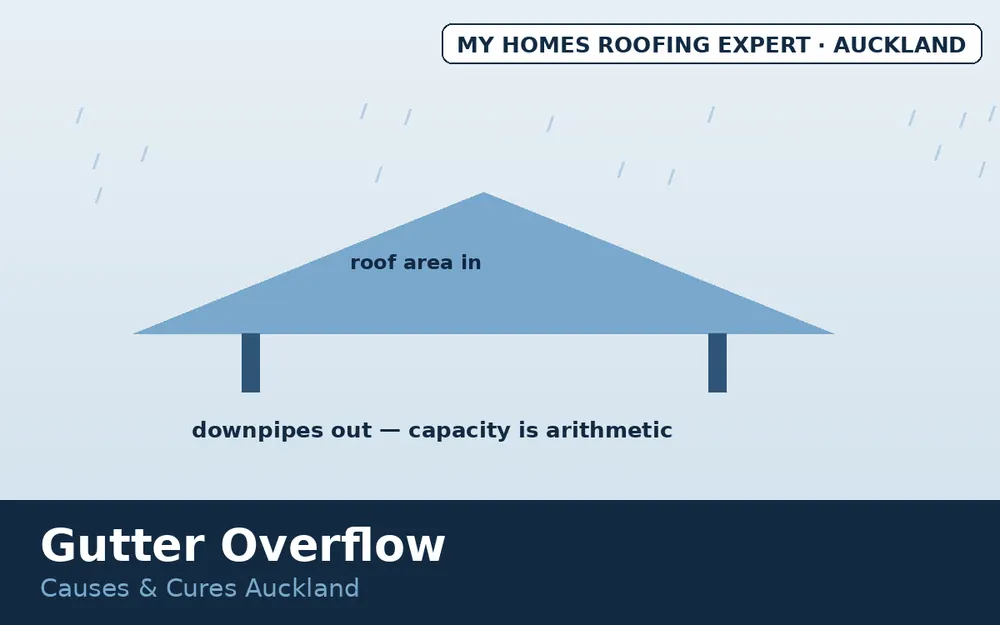
Capacity overflow is the cause owners least suspect and most often have, because the system was sized for a gentler assumption than reality delivers: catchment arithmetic — a roof's plan area and pitch set how much water arrives and how fast, and a large or steep roof can outpace narrow spouting and sparse downpipes; rainfall intensity — Auckland's heavy bursts deliver volume faster than average figures suggest, and gutters sized for averages crest in the bursts that matter; the downpipe bottleneck.
Gutters fill from the roof and empty through downpipes, so too few outlets back the whole run up regardless of gutter size, the most common design fault; and outlet sizing — undersized or debris-restricted outlets throttle even generous downpipes. The cures scale the system to the truth: larger gutter profiles, additional downpipes splitting long runs, and properly sized outlets — the capacity engineering our materials guide frames as the once-a-generation chance to fix undersizing rather than replace it like-for-like.
Replacement is the natural moment, the logic the fascia-gutter process builds in.
Why overflow is a building problem, not a weather annoyance
The reason overflow earns urgent attention is where the water goes: over the front edge in sheets down the fascia, wicking into the timber the way that rots it behind the gutter — the failure chain our fascia guide prices and the blockage damage guide traces; over the back edge in the worst cases, behind the gutter and into the roof structure or wall cavity, a weathertightness route rather than a cosmetic one; against walls and windows where splashback drives moisture into cladding.
And at the foundations where concentrated discharge undermines and pools. Each consequence converts a wet-day nuisance into a maintenance bill, which is why the diagnose-and-cure discipline matters — the overflow you ignore this winter is the fascia you replace in three.
What Cost, Risk and Sequencing Factors Apply?
The cure ladder runs cheap to substantial: cleaning (minor visit), fall correction (contained bracket work), capacity upgrades (downpipe additions to profile replacement), priced across the cleaning and spouting cost guides. The sequencing discipline is the money-saver: clean and read before sizing, since solving the wrong cause is the commonest overflow mistake. Risks are the diagnostic shortcuts — and the gutter-line height work that makes assessment inspection territory, with the heavy-rain watch the owner's contribution.
How Do You Get overflow diagnosed and cured in Auckland?
My Homes Roofing Expert reads overflow patterns and cures the actual cause across Auckland — cleaned, falled, or sized to catchment as the diagnosis demands. Call 022 501 9921 or visit spouting and guttering Auckland.
What Questions Do Auckland Homeowners Ask?
Why do gutters overflow in heavy rain?
Blockage, lost fall, undersized capacity, or bad design — the overflow pattern names which.
Blockage or undersized?
Blockage overflows at one point and clears with cleaning; undersizing overflows along runs in heavy rain regardless.
Can gutters be too small?
Yes — a large or steep roof can outpace narrow spouting and few downpipes. The cure is capacity.
Why does overflow damage matter?
It wicks into fascia and walls — a rot and weathertightness driver, not just a wet-day nuisance.
What to check first?
Clean and clear — cheapest, commonest cause, and it clears the read for what remains.
What else should you know?
Why does gutter overflow damage the building and not just the garden?
Overflow runs over the front edge down the fascia, wicking into the timber and rotting it behind the gutter. In the worst cases it goes over the back edge into the roof structure or wall cavity, a weathertightness route. It also splashes against walls and windows and pools at the foundations, which turns a wet-day nuisance into a maintenance bill.
Topics covered
- gutters overflowing heavy rain
- undersized spouting Auckland
- gutter capacity NZ
- why gutters overflow
- stop gutter overflow