
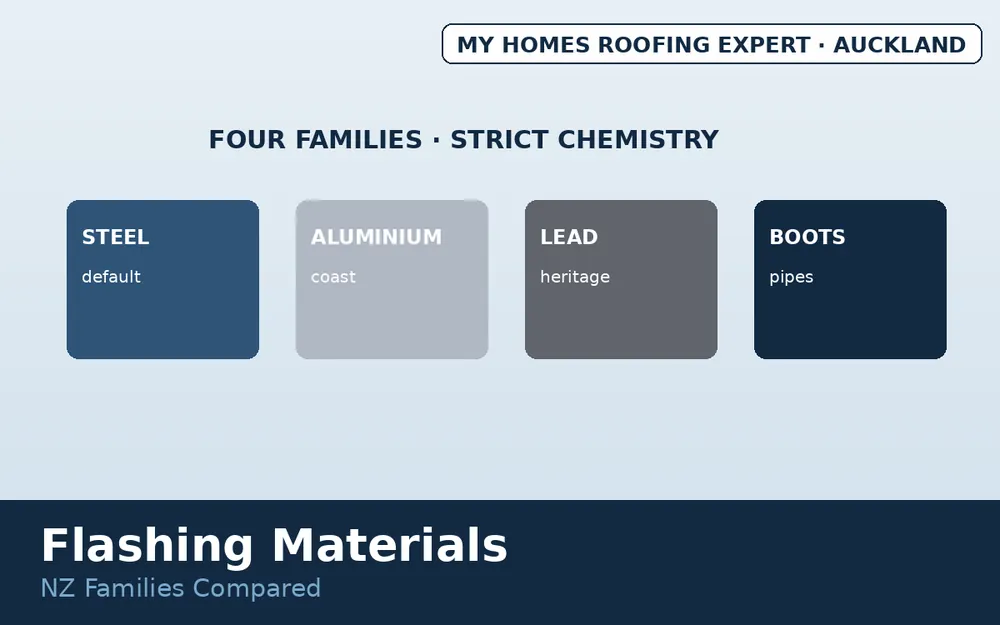
Match the family to the junction: steel by default, aluminium for coast and curves, lead where heritage demands and water rules allow, boots for pipes — replaced on their UV schedule. And hold every choice to the compatibility tables, because flashings meet more materials than any other part of the roof.
Roof flashing materials do the roof's hardest work in its smallest pieces: every ridge, valley, wall junction, chimney, and pipe is a flashing, hand-formed to manage the water the field geometry cannot. The NZ palette is four families — coated steel, aluminium, lead, and the flexible boot-and-tape class — each with a placement logic and a compatibility rulebook, and most roof leaks are flashing stories, which makes this the most practical materials guide on the site.
The craft framing matters: flashing failures are rarely material failures — they are forming, fitting, and compatibility failures wearing a material's name.
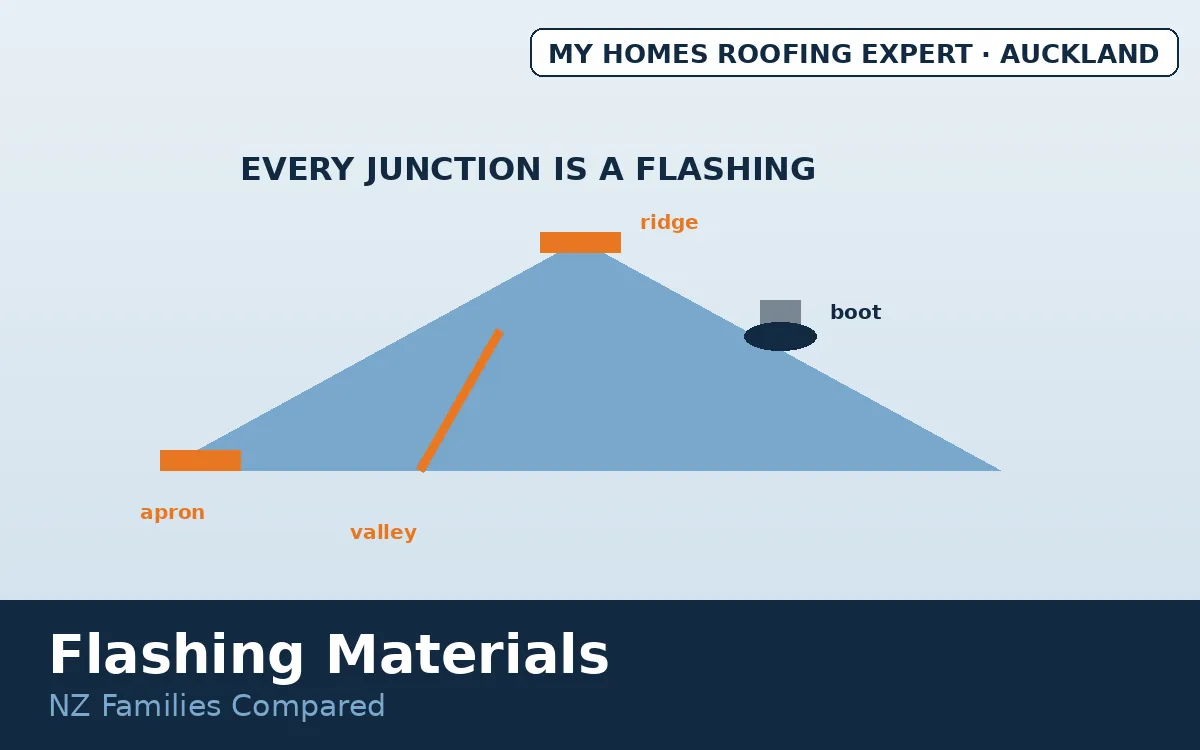
What flashing materials belong where?
Direct answer: coated steel as the default, aluminium for the coast and soft forming, lead selectively for heritage complexity, flexible boots and tapes for penetrations. The placements: Coated steel — folded to profile in the roof's own colour and grade, serving ridges, barges, aprons, and valleys as the system-matched standard; its grade follows the roof's exposure logic, and its details our flashing repair guide. Aluminium.
Softer and more formable, taking complex shapes steel resists, immune to rust in the salt zones, and the upgrade pick where coastal air retires coated edges early. Lead — the heritage former, dressing over tile profiles and chimney shoulders like nothing else; its modern constraints are handling precautions, theft economics, and the absolute drinking-water exclusion our lead guide details — which together route most new work to steel, aluminium, and modern formable substitutes. Flexible class.
EPDM and silicone pipe boots sealing flues and vents, and butyl tapes dressing the awkward — standardised, effective, and mortal on a UV clock, per our penetration guide.
The compatibility rulebook — small parts, strict chemistry
Flashings sit at material meetings, where galvanic chemistry does its quiet work: runoff hierarchies — lead and copper wash attacks coated steel below, so noble metals never drain onto coated surfaces (the same rule our copper guide enforces); contact pairs — aluminium against incompatible treatments and metals corrodes at the touch line, separated by design; fixing matches — every flashing metal takes its own fastener chemistry, the fixings discipline in miniature; and sealant compatibility.
The wrong chemistry attacks EPDM, butyl, and coatings alike, which is why manufacturer-specified sealants are specification, not preference. The tables are published; professional work cites them; and the freelance mixing of salvage flashings with whatever screws were in the van is how mystery corrosion lines are born.
Reading flashing condition from the ground
Flashings age visibly for owners willing to look — binoculars from the lawn, after storms and annually: lifted edges at aprons and barges, the wind-entry invitation; sealant reliance — beads of product where folds should be, the signature of past shortcuts; rust lines tracking flashing edges and fixings ahead of the field, the compatibility or grade story told early; cracked boots — pipe seals crazed and split on their UV schedule, the single most findable pre-leak on Auckland roofs; and chimney suspects.
The junction our chimney guide ranks among the most common leak sources. Any of the five earns the inspection that prices a flashing fix while it is still small — flashing repairs being the contained, high-value end of roof repair.
What Cost, Risk and Maintenance Factors Apply?
Flashing economics favour attention: materials are minor, forming labour moderate, and the leaks they prevent expensive — the asymmetry that makes flashing renewal standard practice inside re-roofs and restorations rather than a deferred extra. Risks are craft and chemistry, both hired: formed-not-forced fitting, table-cited compatibility, boots on their replacement clock. The field gets the brochure; the flashings deserve the scrutiny.
How Do You Get flashings assessed in Auckland?
My Homes Roofing Expert forms, fits, and renews flashings across Auckland — families matched to junctions, chemistry to tables, boots replaced before they leak. Call 022 501 9921 or book a free inspection.
What Questions Do Auckland Homeowners Ask?
What materials are used?
Coated steel by default, aluminium for coast and forming, lead selectively, EPDM/silicone boots for pipes.
Why do flashings leak most?
They are the hand-crafted junction work — geometry protects the field, craft protects the joints.
Is lead still used?
Selectively, for heritage formability — with handling cautions and a hard drinking-water exclusion.
How long do pipe boots last?
10–20 years on the UV clock — cracked boots are the classic single-point leak.
Can materials mix freely?
No — runoff hierarchies, contact pairs, and fixing chemistry follow published compatibility tables.
Topics covered
- flashing types NZ
- aluminium flashing
- EPDM flashing Auckland
- lead flashing alternatives
- pipe boot flashing