
Overlays earn their place on engineered commercial projects where continuity rules; homes strip. The strip reveals and renews the system — underlay, battens, fixings, framing — that the next thirty years actually stand on, and burying those questions to save strip labour is borrowing against them at interest.
| Topic | Overlay | Strip off |
|---|---|---|
| Default for homes | No — only where a specific engineered case says otherwise | Yes — the NZ residential default |
| Where it fits | Engineered commercial projects where continuity matters, with new steel on spacer systems above the old | Houses and most other roofs |
| What it reveals | Buries the underlay, battens, framing and leak history | A one-day diagnostic window onto underlay, battens, framing and past leaks |
| Consent | Not like-for-like, so exempt-work assumptions lapse — confirm with Auckland Council first | The sequence is set out in the house reroofing process guide |
| Lifetime cost | Saves strip labour upfront, but defers discovery and doubles the eventual removal | Renews the whole system the next decades stand on |
| Old fibre-cement roofs | Follow specialist and regulatory asbestos guidance — never a casual decision | The same |
Reroof over existing roof proposals sound like the clever shortcut — skip the strip, bury the old iron, stay dry throughout — and occasionally, at commercial scale with engineering behind them, they genuinely are. But NZ residential practice keeps returning a firm default: strip off, because the strip is half the value. What gets removed is information and renewal opportunity in equal measure, and what gets buried under an overlay stays buried, aging, and unanswered.
This guide gives the overlay its honest hearing — the real use cases exist — and then explains why the default holds. Where the strip is the default, our house reroofing process guide sets out the sequence that follows it.
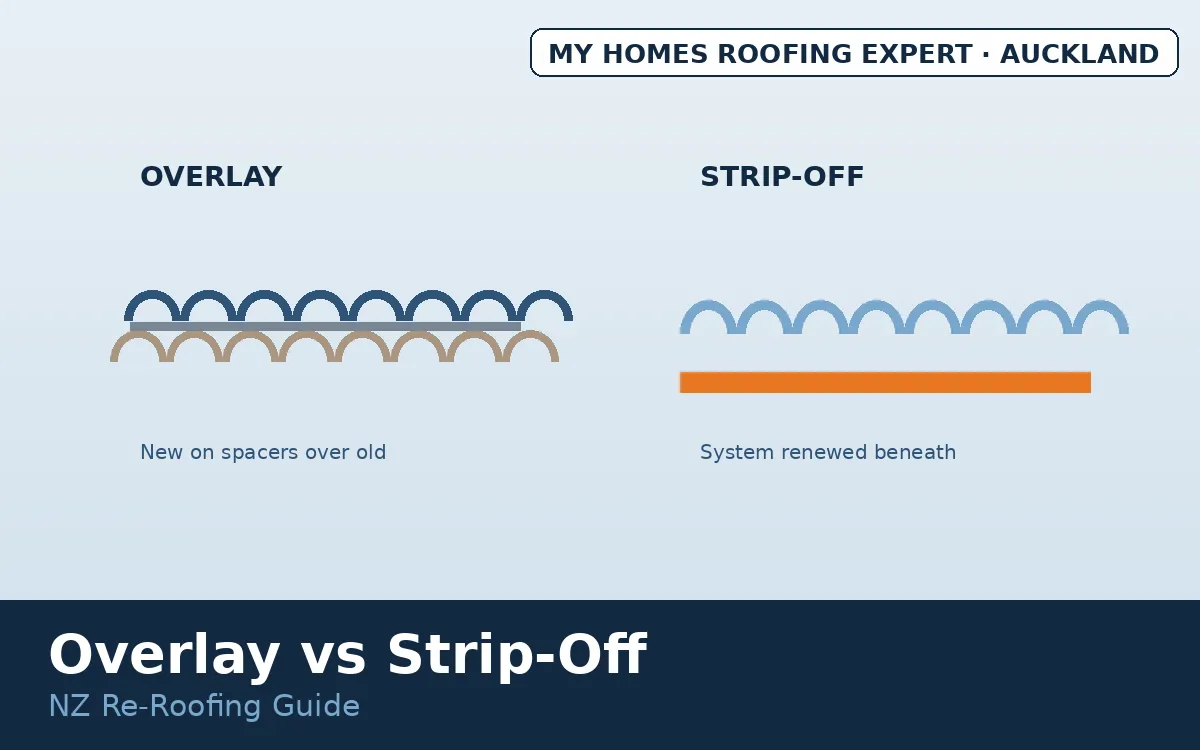
Should you re-roof over or strip off?
Direct answer: strip off, unless a specific engineered case says otherwise. The overlay's legitimate territory: commercial continuity — large operating buildings where strip-phase weather exposure threatens stock and operations, the staging problem our commercial guide wrestles, solved by new steel on spacer systems above the old; engineered additions — structure verified for the added weight and fixing loads, the assessment that is never optional because the weight-class logic applies to additions exactly as to changes; and the consent conversation.
An added layer is not like-for-like replacement, so exempt-work assumptions lapse and Auckland Council confirmation belongs at the start, rules varying by building. The asbestos footnote stands apart: old fibre-cement roofs raise encapsulation-versus-removal questions that follow specialist and regulatory guidance per our asbestos guide — never a casual overlay decision.
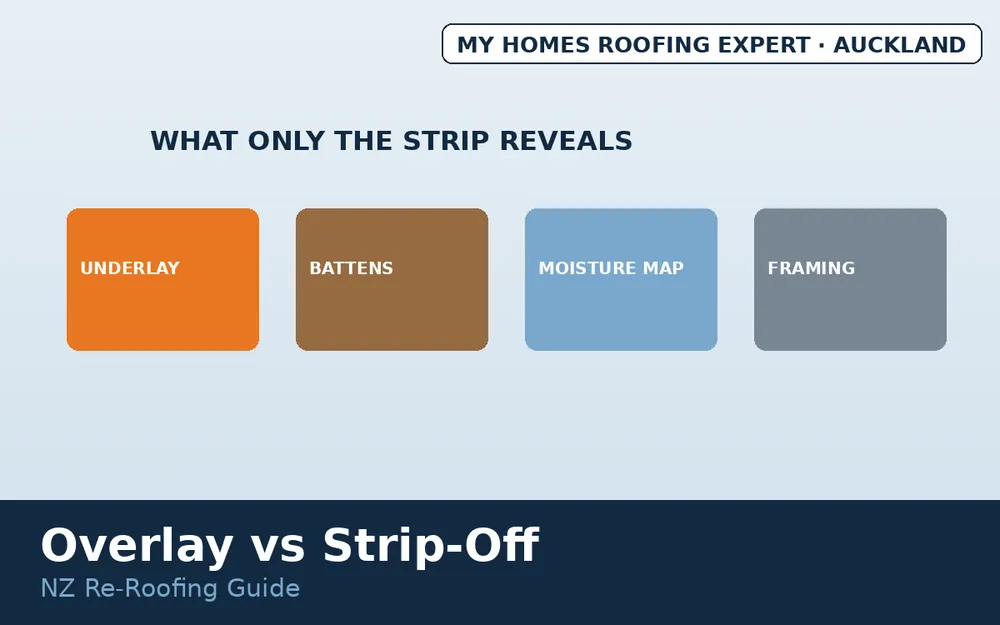
What strip-off reveals — the hidden half of re-roofing value
The exposed roof is a one-day diagnostic window worth more than any inspection: underlay truth — the brittle, torn, or absent layer our underlay guide predicts on older homes, renewed as a matter of course in strip-and-replace and impossible to renew under an overlay; batten and purlin condition — the soft, split, and borer-visited timber that fixing withdrawal hints at and only exposure confirms, repaired in-sequence per the framing guide; moisture history.
Staining maps of every past leak, reading the flashing and detail lessons the new roof should learn; framing surprises — the notched rafters, undersized members, and past-renovation improvisations that surface on a meaningful share of older Auckland strips; and the clean slate — new underlay, renewed battens, current-class fixings to wind-zone pattern, the complete-system renewal that re-roofing warranties and the service's decades-long promises genuinely rest on. The overlay buries all five.
And the buried roof keeps aging, its condensation behaviour altered by the new cavity above it, its problems maturing toward a future strip that now removes two roofs at double disposal.
The lifetime economics — where the overlay saving goes
The upfront comparison flatters the overlay: strip labour and disposal costs avoided, programme shortened, weather risk reduced. The lifetime comparison reverses it for most homes: deferred discovery — the framing and underlay issues that strip-stage repairs fix cheaply mature into structural jobs under the buried layer; doubled future removal — the eventual strip takes two roofs at twice the tipping; warranty and weathertightness friction — systems installed over non-standard substrates carry caveats their data sheets spell out; and resale reading.
A buried layer in the building file is a due-diligence question mark, the documentation point our pre-purchase guide approaches from the buyer's side. The honest accounting usually lands where the trade default already sits — which is why our quotes price the strip as standard and the overlay only where its engineered case genuinely stands.
What Cost, Risk and Decision Factors Apply?
Strip-and-replace pricing lives in the re-roofing cost guide; overlay proposals price their spacers, engineering, and consent path case by case. Risks concentrate exactly where this guide has placed them: unengineered weight, unconsented change, and unanswered substrate. The decision discipline: any overlay pitch should arrive carrying its engineering, its consent position, and its substrate assessment — and a pitch without all three is a shortcut wearing a saving's name.
How Do You Get the fork priced honestly in Auckland?
My Homes Roofing Expert prices strip-and-replace as standard across Auckland and assesses overlay cases on their engineering — defaults defended, exceptions earned. Call 022 501 9921 or get in touch.
What Questions Do Auckland Homeowners Ask?
Can you roof over an existing roof?
Sometimes — engineered commercial cases mainly. Homes default to strip-and-replace.
Why is strip-off the default?
The strip reveals and renews underlay, battens, fixings, and framing — the system the decades rest on.
Genuine overlay cases?
Commercial continuity with engineering and consent behind it; asbestos follows its own specialist rules.
Does an overlay save money?
Upfront somewhat; over the asset's life usually not — buried problems and doubled future removal collect.
Consent needed?
Check-first territory — added weight and changed structure lapse the like-for-like exemptions.
What else should you know?
What does stripping a roof reveal that an overlay hides?
Stripping opens a one-day diagnostic window: the true condition of the underlay, soft, split or borer-visited battens and purlins, staining maps of past leaks, and framing surprises such as notched rafters. New underlay, renewed battens and current-class fixings can then be fitted. An overlay buries all of this, and the buried roof keeps ageing under the new one.
Topics covered
- roof overlay NZ
- strip and reroof
- roofing over old iron
- second roof layer
- overlay vs tear off