
Start with a free contractor inspection for ordinary leaks — detection plus a repair quote in one visit. Escalate to paid investigation for intermittent, contested, or documentation-needing leaks. Either way, resist patching guesses: sealant over the wrong spot wastes money and muddies the evidence trail.
Leak detection cost in Auckland has a pleasant surprise at its core: when detection leads to a repair quote, most established roofing contractors — My Homes Roofing Expert included — do not charge for finding the leak. Standalone specialist investigation is the paid tier: as a general guide, thermal imaging surveys, systematic water testing, and documented leak reports commonly fall in the $300–$800 range depending on complexity.
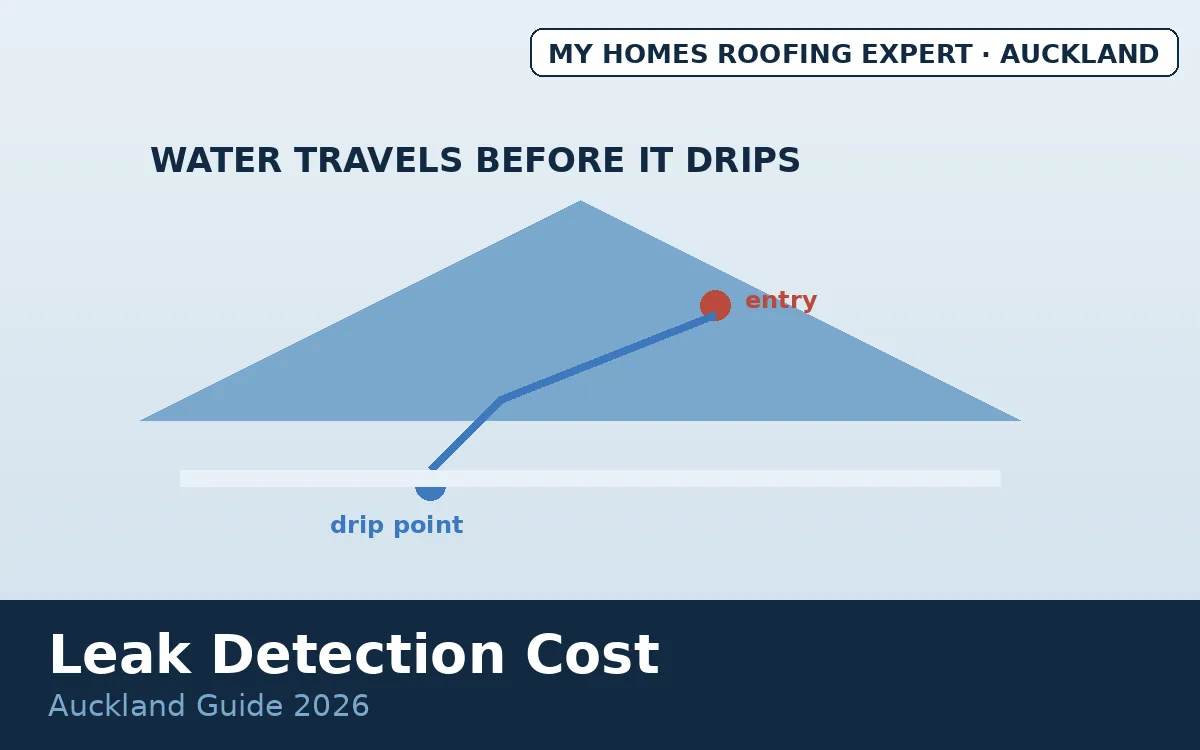
The reason detection is a discipline of its own is simple physics: water travels. Auckland's wind-driven rain enters at a flashing edge, a backed-out fixing, or a cracked tile, then runs along underlay and framing before dropping onto your ceiling somewhere else entirely. Patching beneath the stain treats the symptom's address, not the problem's.
How much does professional leak detection cost in Auckland?
Direct answer: free when bundled with a repair quote from a roofing contractor; roughly $300–$800 as a general guide for standalone specialist investigation. The paid tier earns its fee on the hard cases: intermittent leaks that only appear in certain wind directions, multi-storey or complex roofs where access is involved, leaks contested between building elements (roof versus cladding versus joinery), and situations needing a documented report — insurance claims, body corporate disputes, or tenancy disagreements. Our thermal imaging guide covers the technology side in depth.
How do professionals actually find a leak?
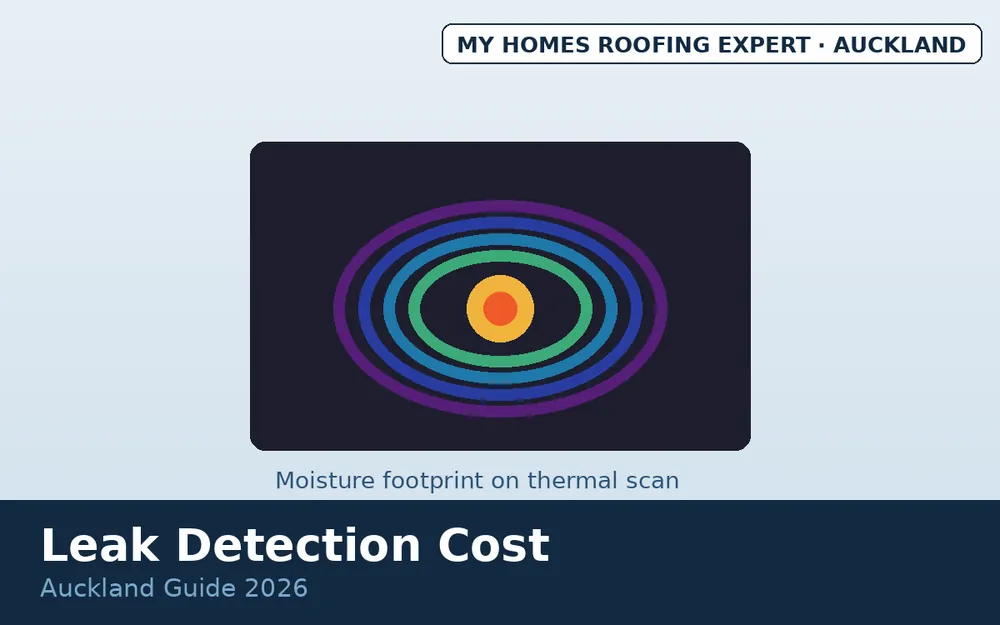
In rough order of deployment: pattern reading — leak location, weather correlation, and roof type narrow suspects fast, because experienced roofers know where each roof style fails (our guide to finding roof leaks walks through the common patterns); surface inspection — flashings, penetrations, fixings, laps, and valleys examined up close; cavity inspection — water staining on underlay and timber traces the run path backward toward entry; thermal imaging — moisture mapping through ceilings and structure, most revealing after rain; and water testing — controlled hose testing of one zone at a time until the drip reproduces. Persistent leaks usually fall to the combination, not any single tool.
Why does the leak only appear sometimes?
Intermittent leaks are Auckland classics, and they nearly always encode a clue. Leaks only in heavy rain often point to capacity problems — overflowing gutters and blocked outlets pushing water backward under flashings. Leaks only in certain wind directions implicate wind-driven rain forced uphill under laps and flashings on the exposed elevation. Leaks in light drizzle but not downpours sometimes trace to capillary paths or condensation rather than holes — a different fix entirely, covered in our condensation guide. Telling your roofer the weather pattern is genuinely useful diagnostic data; note it down before the visit.
Cost, risk, and what to do while you wait
While detection is being arranged: contain water with buckets and towels, move valuables, and pierce a small drain hole in a bulging paint blister over a catch container only if it is safe — water pooling near light fittings or in ceilings is an electrical hazard, so keep clear and treat it seriously. Do not climb on the roof to look; wet roofs are dangerously slippery and the evidence is mostly invisible from above anyway. If water is coming in actively and heavily, that is emergency roof repair territory — call rather than wait.
How Do You Get a roof leak found in Auckland?
My Homes Roofing Expert traces and repairs roof leaks across Auckland from our West Harbour base — free detection with repair quotes, specialist investigation where leaks demand it. Call 022 501 9921 or book an inspection.
What Questions Do Auckland Homeowners Ask?
How much does leak detection cost in Auckland?
Commonly free with a repair quote; roughly $300–$800 as a general guide for standalone specialist investigation.
Why is the stain far from the leak?
Water runs along underlay and framing before dropping — entry and drip points are routinely metres apart.
Does thermal imaging find leaks?
It maps moisture paths, which combined with physical inspection pins the entry point.
What is water testing?
Controlled hose testing of one suspect zone at a time until the leak reproduces — slow, methodical, and effective.
Should I patch before detection?
No — protect the interior, note the weather pattern, and leave the roof evidence undisturbed for diagnosis.
Topics covered
- find roof leak price NZ
- thermal imaging cost roof
- leak investigation Auckland
- roof leak tracing
- water testing roof leaks