
Roof waterproofing in NZ commonly costs $60–$120 per square metre applied, covering everything from single-purpose sealers to multi-coat liquid membranes. Preparation, film thickness and detail work move the price most. Liquid systems suit sound concrete, aged-but-sound membranes and weathered metal, but they are no fix for ponding, soft substrate or end-of-life membranes.
| Situation | Will a coating work? |
|---|---|
| Concrete roofs and decks | Yes — liquid systems seal porosity and hairline cracking |
| Aged-but-sound membranes | Yes — a compatible overlay can add years to intact butyl or torch-on |
| Parapets, upstands and detail zones | Yes — liquid follows complex shapes |
| Metal roofs with surface wear | Yes — full-system coatings restore weathered long-run |
| Ponding water | No — fall correction is structural work, not chemistry |
| Soft or wet substrate | No — the coating traps moisture and the rot continues |
| End-of-life membranes | No — brittle, shrunken or delaminating material needs replacing |
Roof waterproofing cost in NZ is mostly a per-square-metre conversation about liquid systems. As a general guide, professionally applied waterproof coatings commonly fall in the region of $60–$120 per square metre — the spread covering everything from single-purpose sealers to multi-coat liquid membranes with reinforcing at details. Small, detail-heavy areas like decks and parapets price higher per metre; large open roofs price lower.
Liquid waterproofing occupies a useful middle ground in Auckland: more than paint, less than re-roofing. Done on the right roof at the right time, it extends life by a decade or more. Done on the wrong roof, it is expensive decoration over a continuing leak — so the honest part of this guide is as much about where coatings do not belong.
How much does roof waterproofing cost in NZ?
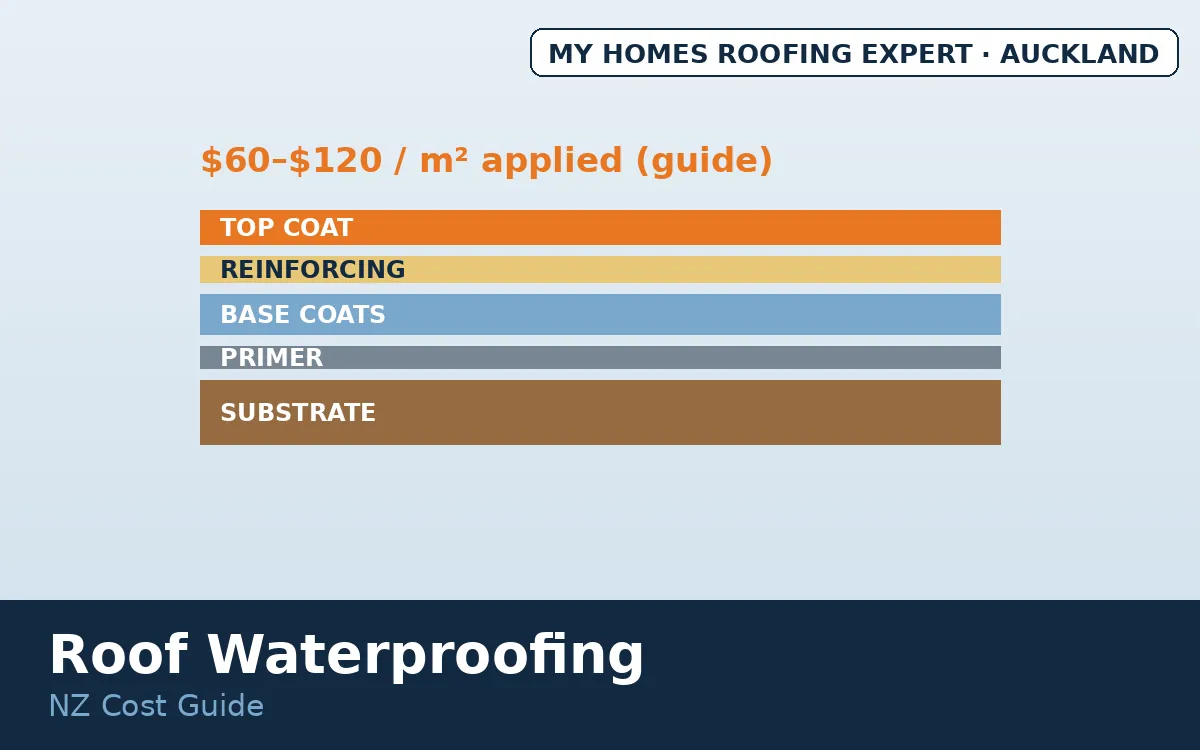
Direct answer: roughly $60–$120 per m² applied, as a general guide. What moves it: system class — acrylic roof coatings sit lower, elastomeric and polyurethane liquid membranes higher, with reinforced systems (fabric bedded into liquid at joints and details) at the top; preparation — washing, moss treatment, rust conversion, crack repair, and priming are where the real labour lives, and skipping them is how coatings fail; coats and film build — manufacturers specify minimum thickness, and honest quotes price the coats to reach it; details — upstands, outlets, cracks, and junctions take reinforcing and time; and access and area — the usual roofing economics of height, pitch, and scale. For paint-class recoating of pitched roofs, see our roof painting Auckland service — waterproofing systems are the heavier-duty cousin.
What Is the Short Answer?
Budget $60–$120 per m² applied as a general guide; insist preparation and film thickness are specified in the quote; and only coat roofs whose substrate is genuinely sound. Where ponding, soft substrate, or end-of-life membrane exists, compare against membrane replacement honestly before spending.
Where does liquid waterproofing genuinely work?
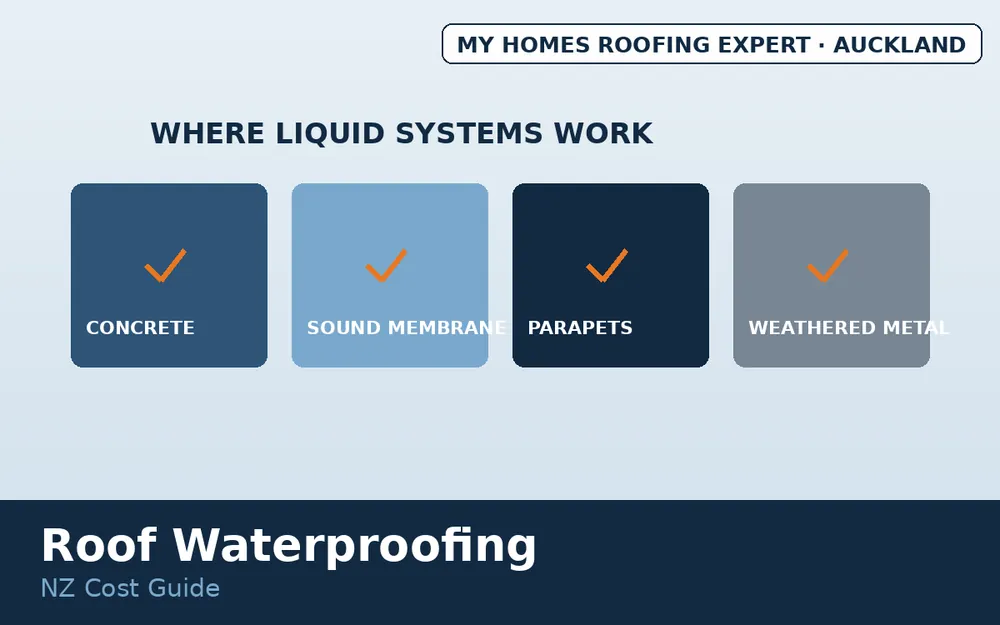
The strong use cases: concrete roofs and decks — liquid systems are the natural fit for concrete, sealing porosity and hairline cracking; aged-but-sound membranes — a compatible liquid overlay can add years to butyl or torch-on that is intact but weathering; parapets, upstands, and detail zones — liquid follows complex shapes that sheet membrane fights; metal roofs with surface wear — full-system coatings restore weathered long-run as part of a roof restoration; and targeted problem zones — a reinforced liquid repair at a chronic junction, properly prepared, outperforms repeated sealant. The common requirement across all of them is a stable base: liquid systems transfer trust onto whatever they cover.
Where Do Coatings Disappoint — the Honest List?
Coatings cannot fix: ponding — standing water defeats most systems over time, and fall correction is structural work, not chemistry (see our flat roof repair guide); soft or wet substrate — coating traps the moisture and the rot continues underneath; structural movement — active cracks reopen through anything brushed over them; and true end-of-life membranes — brittle, shrunken, delaminating material needs replacing, not topping. A trustworthy applicator will decline these roofs or scope the underlying fixes first. If a quote promises waterproofing over an obviously failing roof at a too-good price, that is the warning sign our cowboy roofer guide exists for.
What Cost, Risk and Maintenance Factors Apply?
Weather windows matter: liquid systems need dry surfaces and curing time, so Auckland programmes flex around rain — allow for it. Warranty terms usually require approved applicators and specified film builds, which is another reason professional application earns its cost. Afterwards, maintenance is light: keep the surface clean, keep outlets clear, and recoat within the system's maintenance cycle rather than after failure. And the standing safety note: coated roofs are slippery when wet and application work happens at height — this is trained-applicator territory, not weekend painting.
How Do You Get a waterproofing assessment in Auckland?
My Homes Roofing Expert assesses, prepares, and applies waterproofing systems across Auckland — and tells you plainly when replacement is the better spend. Call 022 501 9921 or request a free, no-obligation quote.
What Questions Do Auckland Homeowners Ask?
How much does roof waterproofing cost in NZ?
Roughly $60–$120 per m² applied as a general guide, varying with system, prep, coats, and detailing.
Is coating as good as new membrane?
On sound substrates, quality systems perform well; over failing bases they only look like waterproofing.
Which roofs suit liquid waterproofing?
Sound concrete, intact aged membranes, parapets and details, and weathered metal as part of restoration.
How long does it last?
Commonly 10–15+ years applied to spec — preparation and film thickness decide real lifespan.
Can I DIY it?
Deck surfaces at ground level perhaps; roof application is hazardous, spec-dependent work for trained applicators.
What else should you know?
What affects the cost of roof waterproofing?
Five things move the price: the system class, with acrylic coatings lower and elastomeric or polyurethane membranes higher; preparation such as washing, moss treatment, rust conversion and crack repair; the coats needed to reach the specified film thickness; details such as upstands and outlets; and access and area. Skipping preparation is how coatings fail.
Topics covered
- waterproof coating price
- deck roof waterproofing Auckland
- sealing roof cost
- liquid membrane roof NZ
- roof coating systems