
Roof debris removal is clearing leaves, palm fronds and other litter off a roof before it holds moisture against the metal. On this Auckland job we cleared palm fronds and leaf litter off a low-pitch metal roof. The ribs and pans are now clear, but staining and a few rust spots remain.
Roof debris removal is clearing leaves, palm fronds, twigs and other litter off a roof. On this Auckland job, My Homes Roofing Expert cleared palm fronds and leaf litter off a low-pitch metal roof under a palm tree. Here is what we found, what clearing changed and what it did not, and what to check on your own roof.
What is roof debris removal?
Roof debris removal is the job of taking organic litter off the roof surface before it builds up. It is narrower than a roof wash. It removes what is lying on the roof, not the staining or growth on the metal itself.
NZ Metal Roofing Manufacturers, the industry body behind the metal roof code of practice, puts debris in its basic maintenance advice. Its maintenance letter says “roof inspections should be carried out at least annually to remove any build-up of debris and conduct any required localised maintenance.”
Debris removal sits alongside our roof cleaning service in Auckland, which covers the wash itself.
What did we find on this roof?
The roof is low-pitch, unpainted ribbed metal, under a palm tree with a metal band around its trunk. Fallen palm fronds and leaf litter had built up across the ribs. In places the fronds lay across several ribs, with leaves packed into the pans between them.
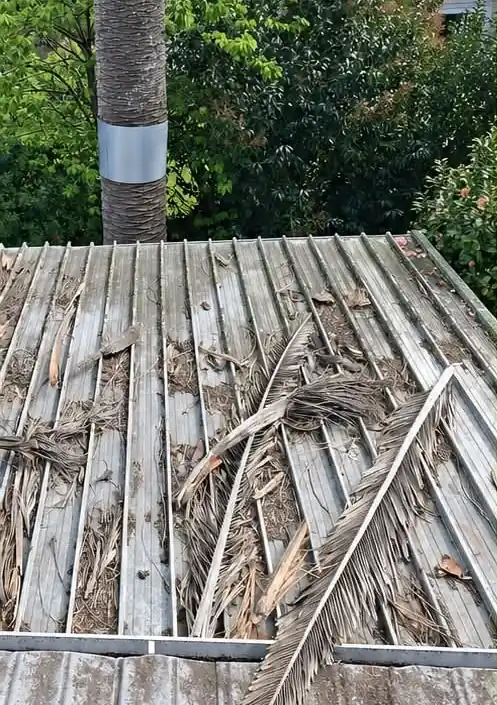
The roof’s age and the metal’s coating are not recorded for this job, so we do not guess at them. What the photo shows is a roof surface largely covered by litter.
Can leaves and palm fronds on a metal roof cause rust?
They can contribute to it. NZ Metal Roofing Manufacturers explains that corrosion needs an electrolyte such as water. Its maintenance letter says “surfaces coated with dirt or salt debris will take longer to dry than a clean surface, hence prolonging the time of reaction.”
The same letter notes that “dirt or vegetation build-up may be either acidic or alkaline”, and that large degrees of either affect the speed of the reaction. The Code of Practice section on other causes of corrosion adds a design rule.
“Design details that trap moisture, dirt, and debris should be avoided.”
NZ Metal Roof and Wall Cladding Code of Practice, Durability: Other Causes of Corrosion
We are careful here. No source we checked says palm fronds themselves are acidic, so we do not claim it. The documented risk is debris that keeps the metal wet for longer.
What does a roof look like after debris removal?
We removed the fronds and leaf litter, and the ribs and pans are now clear. The after photo is honest about the limits of the job.
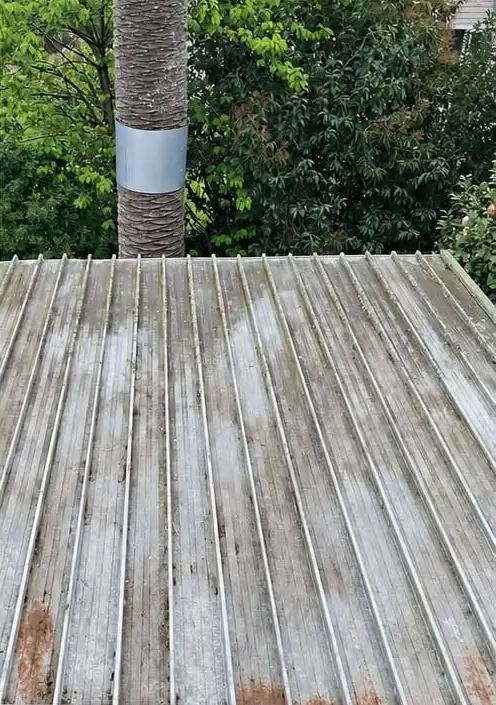
Staining and a few rust spots are still visible on the bare metal, because clearing debris does not remove them. That is worth knowing before you book. Debris removal clears the surface. It is not a wash, it is not a moss treatment, and it does not repair rust.
You can see the pair side by side in our roof debris removal case study.
Is debris removal the same as a roof wash or moss treatment?
No. They are three different jobs, and a quote should say which one you are getting.
| Job | What it does | Our published price |
|---|---|---|
| Debris removal | Clears leaves, fronds and litter off the roof surface | Quoted after a look |
| Roof cleaning | Soft-wash and low-pressure methods remove moss, lichen, algae and salt deposits | $300–$1,400, by roof size |
| Moss treatment | The wash and biocide treatment, the dwell period and removal of dead growth | $250–$1,400+, by coverage |
On our published prices, roof cleaning in Auckland costs $300–$500 for a roof up to 100 m², $500–$800 for 100–180 m², and $800–$1,400 for larger roofs. Debris removal on its own is quoted after we have seen how much litter there is and how safely the roof can be reached.
How often should you clear debris from a metal roof?
NZ Metal Roofing Manufacturers recommends inspecting at least annually to remove any build-up of debris. A roof under trees may need it more often. The trees decide the timing, not the calendar.
The code of practice also sets washing intervals for “unwashed areas”, the parts rain does not reach. The maintenance letter defines them as surfaces above a line drawn at 45 degrees from any overhang, the exposed undersides of roofing, and all wall cladding.
Its scheduled maintenance section says these should generally be washed every 3 months in severe environments and every 6 months in moderate ones. It also says most exposed metal roofing is “adequately cleared of dirt by rain washing”. Debris lying on the roof is the exception, because rain cannot wash it away.
Should you fit leaf guards to stop roof debris?
Not without thinking it through. The code of practice says leaf guards may keep leaves out of the gutter, “but instead they often result in a build-up of a plant material poultice on the eaves line of the roof.” It then states: “The COP recommends against the installation of such products.”
For gutters, our gutter cleaning cost guide covers how often Auckland gutters need clearing. For the wider picture, see our professional roof cleaning guide.
What can you check from the ground?
- Leaves or fronds you can see on the roof from an upstairs window or the street.
- Trees overhanging the roof, especially palms that drop whole fronds.
- Gutters overflowing in heavy rain.
- Rust staining on the roof or the fascia below it.
- Dark streaks or patches where water and litter have been sitting.
Please do not climb up to clear it yourself. A low-pitch roof looks easy to walk on, but it is still work at height. WorkSafe New Zealand’s working-at-height guidance explains the risks. Book a free roof inspection or call 022 501 9921.
What Questions Do Auckland Homeowners Ask?
Can leaves on my roof cause rust?
They can contribute to it. NZ Metal Roofing Manufacturers explains that surfaces coated with dirt or debris take longer to dry than a clean surface, which prolongs the corrosion reaction, and that vegetation build-up may be acidic or alkaline. No source we checked says palm fronds themselves are acidic. The documented risk is debris keeping the metal wet for longer.
How often should roof debris be removed?
NZ Metal Roofing Manufacturers recommends roof inspections at least annually to remove any build-up of debris and carry out any localised maintenance. A roof under trees, especially palms that drop whole fronds, may need clearing more often. The trees decide the timing, so check from the ground after windy weather and in autumn.
Does debris removal clean the roof?
No. Debris removal clears leaves, fronds and litter off the roof surface. It is not a wash and not a moss treatment. On our Auckland job the ribs and pans were clear afterwards, but staining and a few rust spots remained on the bare metal, because clearing debris does not remove them.
Should I put leaf guards on my gutters?
Think it through first. The NZ Metal Roof and Wall Cladding Code of Practice says leaf guards often result in a build-up of a plant material poultice on the eaves line of the roof, and that the code recommends against installing them. Regular clearing of the roof and gutters avoids that problem.
How much does roof debris removal cost in Auckland?
We quote debris removal on its own after seeing how much litter there is and how safely the roof can be reached. For a full clean, our published roof cleaning prices are $300–$500 for a roof up to 100 m², $500–$800 for 100–180 m² and $800–$1,400 for larger roofs.
Topics covered
- leaves on metal roof
- palm fronds on roof
- can leaves on my roof cause rust
- clear debris off a low-pitch roof
- metal roof maintenance Auckland