
Expanding foam is a gap filler, not a roof flashing, so on this job we did not leave it in place. On this Auckland roof the foam was already in the gap when we arrived. We cleaned it out, repaired the leak and fitted a new flashing down the roof over the joint.
An expanding foam roof leak repair is when spray foam has been pushed into a gap in a roof to stop water. On this Auckland job, the foam was already in the gap when My Homes Roofing Expert arrived. We cleaned it out, repaired the leak and fitted a new flashing. Here is what we found, and why foam is not a flashing.
Can you fix a roof leak with expanding foam?
Expanding foam is not a roof flashing, so we do not treat it as a repair. Resene’s roofing glossary defines a flashing as “an overlay cover to waterproof a structure.” Foam is not an overlay. It fills the gap it is pushed into.
The metal roofing industry’s own code is wary of filling joints from the outside. The NZ Metal Roof and Wall Cladding Code of Practice says a sealant does its job by “being sandwiched in the joint”. Foam pushed into an open gap is applied from the outside instead.
If you have foam in a gap on your roof, our Auckland roof repair team can look at what is underneath it.
What did we find on this Auckland roof?
The roof is dark corrugated metal. Along one joint, the sheets had been cut back, leaving black underlay exposed. Yellow expanding foam filled the gap.
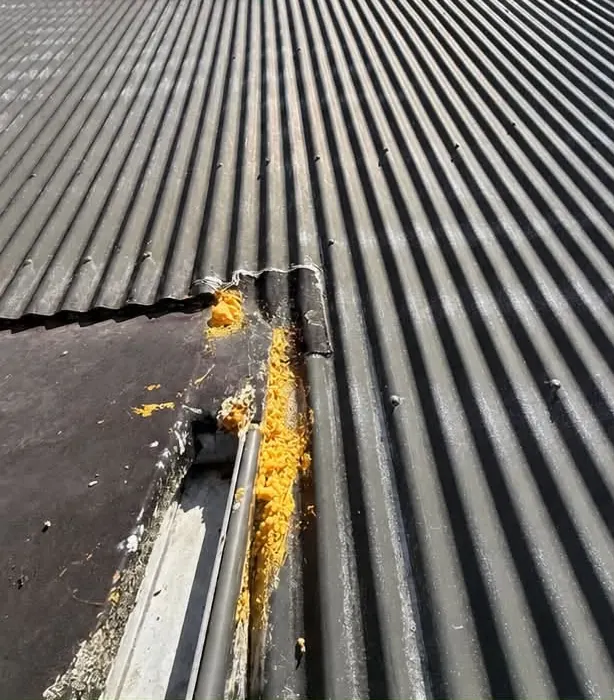
The foam was already there when we arrived. We do not know who put it there or when, and we do not guess. What we do know is that the roof still had a leak to repair.
Why is expanding foam not a roof flashing?
Because a roof keeps water out by shedding it. The NZ Metal Roof Code of Practice puts it simply: “The primary function of a roof is to shed external moisture.” A flashing sheds water by lapping over a joint so rain runs past it.
Foam in a gap does not lap over anything. In our view it blocks a hole and depends on staying stuck to both sides of it. The code of practice takes a firm line on material added to the outside of a joint.
“In most cases, the post application of sealant to the outside of a joint is both futile and unacceptable.”
NZ Metal Roof and Wall Cladding Code of Practice, Flashings: Sealants
The legal benchmark sits above all of this. Building Code clause E2 External Moisture, published by MBIE, sets the weathertightness requirements a roof must meet.
What did we do to repair the leak?
We removed the foam from the gap first. A new flashing needs to sit on the roof, not on old foam.
We then repaired the leak and fitted a new flashing down the roof over the joint. The after photo shows a green flashing running down the roof, covering the line where the foam had been.
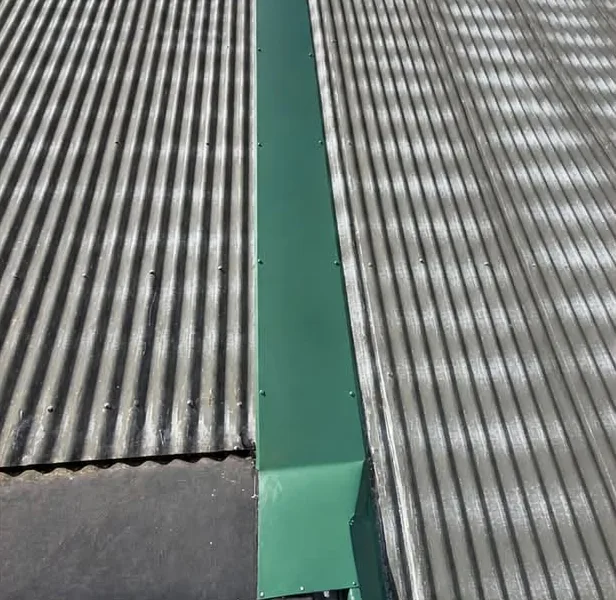
We do not name the type of flashing or the exact source of the leak on this job. Our job record does not state them, and a wrong label would mislead anyone with a similar roof. You can see the before and after together in our foam-to-flashing leak repair case study.
How do foam, sealant and a flashing compare?
| Material | What it does on a roof | What the sources say |
|---|---|---|
| Expanding foam | Fills a gap from the outside of the joint | Not a flashing. The code warns against material added to the outside of a joint |
| Sealant | Seals inside a joint, alongside fixings | Sealant designs “must always include a mechanical fastening” |
| Flashing | Laps over a joint so water runs past it | “An overlay cover to waterproof a structure” (Resene glossary) |
How can you tell if your roof has a foam patch?
You can often spot one from the ground or an upstairs window. Look for:
- Yellow or orange foam showing at a roof joint, a wall junction or around a pipe.
- Sheets that look cut short along a joint, with dark underlay showing.
- A leak that came back after someone “fixed” it.
- Damp patches on the ceiling under a roof joint.
Please do not climb up to pull the foam out. Roof work is work at height, and an open gap lets rain in until the repair is done. Our guides on how to find a roof leak and how to fix a roof leak properly cover the next steps.
How much does a roof leak repair cost in Auckland?
Our published prices put most roof repairs in Auckland at $150–$1,800, and flashing repair or replacement at $300–$800. A job like this one is quoted after we have seen the joint. What sits under old foam is not visible until it is cleaned out.
The inspection is free and includes a written quote. Book a free roof inspection or call 022 501 9921.
What Questions Do Auckland Homeowners Ask?
Can you fix a roof leak with expanding foam?
We do not treat foam as a roof repair. A flashing laps over a joint so rain runs past it, while foam only fills the gap it is pushed into. On our Auckland job the foam was already in the gap when we arrived. We cleaned it out, repaired the leak and fitted a new flashing over the joint.
Is expanding foam waterproof?
Whether a foam product resists water is a question for its maker. The bigger issue on a roof is that foam is not a flashing. The NZ Metal Roof and Wall Cladding Code of Practice warns that sealant added to the outside of a joint is, in most cases, futile and unacceptable, and foam in an open gap sits outside the joint too.
Should I remove expanding foam from my roof myself?
Get it looked at first. On our Auckland job the foam was already in the gap when we arrived, and the leak still needed repairing after it was cleaned out. Removing foam yourself means working at height, and it can leave the gap open to rain until the repair is done.
What is a roof flashing?
Resene’s roofing glossary defines a flashing as an overlay cover to waterproof a structure. It notes that roof flashings are used at the ridge and the gables, and that hip flashings cover the intersecting roof planes. A flashing works by lapping over a joint so water runs past it, rather than by filling the gap.
How much does it cost to repair a roof leak in Auckland?
Our published prices put most roof repairs in Auckland at $150–$1,800, and flashing repair or replacement at $300–$800. A leak under old foam is quoted after we have seen the joint, because what sits underneath is not visible until the foam is cleaned out. The inspection is free and includes a written quote.
Topics covered
- can you fix a roof leak with expanding foam
- is expanding foam waterproof
- corrugated roof leak flashing
- foam in a roof gap
- roof leak repair Auckland