
Most spouting leaks are joints, ends, corners, or outlets — cleaned and resealed with the right product on prepared metal. Rust holes patch where local. But a leak on a generally rusting system is a replacement signal, not a reseal job — the repair-or-replace test comes before the sealant.
Spouting leak repair is mostly a matter of knowing where spouting leaks, because the points are predictable and each has its own fix: joints, end caps, corners, outlets, and rust holes. A drip at a sectional joint cleans and reseals; a weeping corner re-beds; a rust hole patches or signals something larger. The one judgment that runs through all of them is whether the leak is a local fault on a sound system — fix it.
Or an early symptom of a system generally giving out, where resealing one joint just buys months.
This guide maps the leak points, the matching repairs, and the line where repair gives way to replacement.

How are leaking spouting joints repaired?
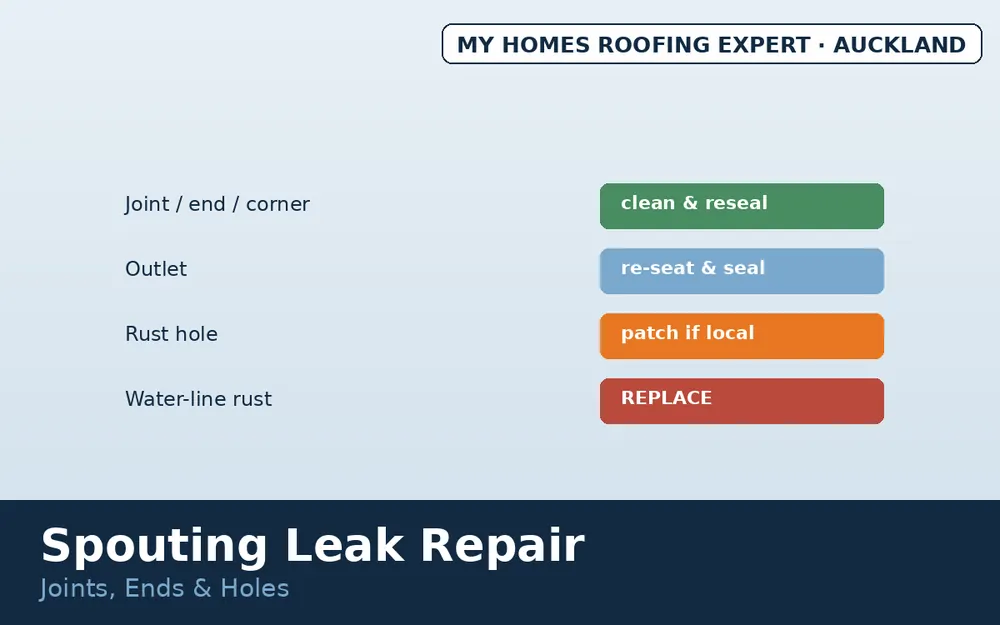
Direct answer: identify the point, then match the fix. The points and their repairs: sectional joints — the commonest leak, between lengths of older sectional spouting, fixed by cleaning the joint back to sound dry metal, removing failed old sealant, and resealing with the correct gutter sealant (preparation being most of the job — sealant over dirt or damp fails fast); end caps — the closed ends of runs, where the seal perishes, re-sealed the same way; corners.
Internal and external, the junction points that flex and work loose, re-bedded properly; outlet connections — where spouting meets the downpipe, a common drip point, re-sealed and re-seated; and rust holes — perforations along the base, patched where local and sound around them, or signalling the larger conversation below. Continuous spouting helpfully removes most sectional joints — the repair-vs-replace guide's argument for it — leaving only corners and outlets as joint-leak candidates.
The work runs through spouting and guttering and roof repair, with the drainage specialists at Gutter Expert handling the full system across Auckland.
The repair-or-replace line — when a leak means more
The judgment that protects the spend is reading whether a spouting leak is local or systemic: local fault, sound system — a single weeping joint, one perished end cap, an isolated corner on spouting that is otherwise straight, falled, and rust-free: repair it, and the system carries on for years; systemic decline.
Rust blooming along the internal water line (the thinning-everywhere signal our repair-vs-replace guide reads as retirement), multiple joints weeping in sequence, lost fall pooling water (the fall correction story), or the metal soft and freckled throughout: here, resealing one leak is chasing holes across a dying system, and the honest answer is the replacement conversation. The tell is the pattern: one fault on good metal repairs; a fault that is the latest of several, on metal showing its age, replaces.
And the fascia behind it shares the verdict — new sealant on spouting mounted to rotting timber, per the fascia guide, restarts the failure clock regardless. An inspection reads which situation yours is before the repair money moves.
Doing the reseal right — and the safety reality
For the genuinely local fault on sound spouting, the reseal succeeds or fails on preparation and product: clean and dry — the joint stripped of failed sealant, debris, and moisture, since the commonest reseal failure is sealant applied over what it cannot bond to; the right sealant — a product suited to gutters and compatible with the spouting material, the compatibility logic our flashing materials guide applies across the roof, where wrong-chemistry sealant on the wrong metal fails or even attacks the substrate.
Correct application — a properly bedded joint, not a smear over the outside (the surface-sealing shortcut that the cowboy guide flags); and the test — a hose check confirming the fix before the job is called done. But the honest closing note is the access one: the reseal method is simple, yet gutter-line work means ladders and roof edges where the injury statistics concentrate, so beyond easy single-storey reach it is professional territory for safety reasons regardless of how straightforward the sealant itself is.
The same standing rule every gutter guide on this site returns to.
What Cost, Risk and Decision Factors Apply?
Spouting leak repair prices as contained spot work — the reseal or patch, the access by height — among the friendliest lines in roofing, and far below the replacement it postpones on a sound system. Risks are the two judgment calls: resealing onto a dying system (money chasing holes), and the access hazard of the gutter line. Both are settled by an honest read — local or systemic, reachable safely or not.
Which is why even a simple reseal benefits from the eyes that have made the call a thousand times.
How Do You Get spouting leaks fixed properly in Auckland?
My Homes Roofing Expert finds and fixes spouting leaks across Auckland — joints, ends, corners, and outlets resealed on sound systems, replacement advised honestly when the leak is the system speaking. Call 022 501 9921 or visit spouting and guttering Auckland.
What Questions Do Auckland Homeowners Ask?
How are leaking joints repaired?
Cleaned back to sound dry metal, old sealant removed, resealed with the correct product — preparation is most of the job.
Where does spouting leak?
Sectional joints, end caps, corners, outlet connections, and rust holes — each with its own fix.
When does a leak mean replacement?
When it is systemic — water-line rust, multiple weeping joints, metal thinning throughout.
What sealant for gutters?
One suited to gutters and compatible with the material, on a clean dry joint — preparation over brand.
Can I reseal it myself?
The method is simple but the access is dangerous — beyond single-storey reach, it is professional territory.
Topics covered
- leaking gutter joint
- spouting end cap leak
- gutter sealant NZ
- spouting hole repair
- gutter corner leak