
Titirangi's native bush canopy keeps roofs shaded, damp, and litter-covered — so moss treatment, cleaning, and frequent gutter clearing lead the list, on a shorter cycle than open suburbs. The canopy is the suburb's beauty and its roofing challenge in one. We cover Titirangi from nearby West Harbour.
Roof care Titirangi homes need is bush-suburb roof care, which is its own discipline: Titirangi sits under a native bush canopy that keeps its roofs in near-constant shade and damp, sheds leaf litter year-round, and creates exactly the conditions moss, lichen, and algae thrive in. Roofs that rarely see direct sun stay wet, grow growth readily, and fill their gutters with litter — which puts moss treatment, cleaning, and gutter care firmly at the top of the Titirangi roofing list.
This guide covers roofing under the canopy — why the bush conditions matter and what they ask of a Titirangi roof.
Who does roofing in Titirangi?
My Homes Roofing Expert covers Titirangi and the wider West Auckland area from our West Harbour base — moss treatment, cleaning, repairs, and gutter work suited to the bush-suburb conditions. Because Titirangi's canopy makes moss, lichen, and gutter debris the leading issues, the work here leans toward the regular maintenance that keeps ahead of the damp-driven growth — done on a shorter cycle than sunnier suburbs need. A free inspection stages what a Titirangi roof needs, and our number is 022 501 9921 for a no-obligation quote.
Why the canopy makes Titirangi demanding on roofs
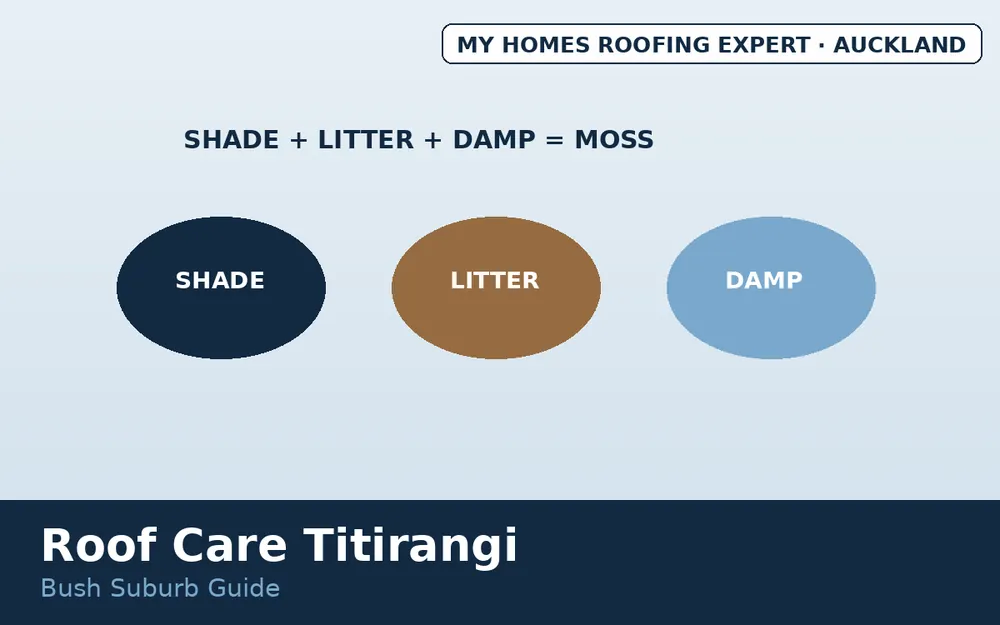
The bush conditions hit roofs three ways: constant shade — roofs under canopy rarely dry out in direct sun, staying damp in the way that grows moss, lichen, and algae prolifically, far beyond what sunnier suburbs see, which makes moss treatment on a shorter cycle the central Titirangi roof task (run in the treat-then-clean order our sequencing guide sets and kept up per the regrowth guide); year-round leaf litter.
The native canopy sheds continuously, not just in autumn, so Titirangi gutters block more often and need clearing more frequently than open-suburb gutters, with blocked gutters in the constant damp a fast route to the overflow-and-fascia problems our overflow and fascia guides cover, the drainage side connecting to Gutter Expert; and damp-accelerated aging.
The constant moisture compounds other aging, holding wet against surfaces and feeding the growth that lifts pointing and coatings, so the bush conditions make scheduled maintenance more clearly worthwhile here than anywhere. The canopy that makes Titirangi beautiful is the same canopy that keeps its roofs working hard.
Protecting a roof under heavy tree cover
The Titirangi roof-care regime is regular but manageable: moss treatment on a shorter cycle — the constant damp regrows moss faster than sunny suburbs, so the retreatment interval is shorter, and staying ahead of it prevents the maturing growth that does the damage; frequent gutter clearing — the year-round litter means more frequent clearing than the standard calendar, with the vacuum methods and regular visits keeping the litter from blocking; branch management where possible.
Keeping overhanging branches managed reduces both the litter load and the direct shade, though the bush setting limits how much (and resource-consent and protected-tree rules can apply to native vegetation, so significant tree work wants checking with Auckland Council); and scheduled maintenance — the maintenance plan approach genuinely earning its keep here, because staying ahead of the bush conditions is cheaper than catching up after them. Timber homes on slopes (common in Titirangi) add the structural-access and timber-care considerations the damp setting makes worth watching.
The canopy demands attention; regular attention keeps the roof comfortably ahead of it.
What Cost, Risk and Local Factors Apply?
Titirangi roof care costs reflect the regular maintenance the conditions need — moss treatment and gutter clearing on shorter cycles, priced in standard ranges per visit — which is genuinely the economical approach against the damp-driven damage neglect brings. The local risks are the bush ones: moss left to mature in the constant damp, gutters left to block under year-round litter, and the access challenges of timber homes on bush slopes.
All are managed by treating Titirangi as the bush suburb it is, with maintenance staying ahead of the canopy. Based nearby in West Harbour, we cover Titirangi and its bush conditions regularly.
How Do You Get a Titirangi roof on a bush-suburb regime?
My Homes Roofing Expert treats, cleans, and maintains roofs across Titirangi and West Auckland from our West Harbour base — bush-suburb cycles, gutter litter handled, free no-obligation quotes. Call 022 501 9921 or book an inspection.
What Questions Do Auckland Homeowners Ask?
Who does roofing in Titirangi?
My Homes Roofing Expert, covering Titirangi and West Auckland from West Harbour — moss treatment, cleaning, repairs, gutter work.
Why so much moss and lichen?
The native canopy keeps roofs shaded and damp — the ideal environment for moss, lichen, and algae.
What is the biggest bush-suburb issue?
Leaf litter and damp shade combined — blocking gutters and growing moss, leading the list.
Do gutters need more attention?
Yes — the canopy sheds litter year-round, so gutters block more often and need clearing more frequently.
How do you protect a roof under trees?
Shorter moss-treatment cycles, frequent gutter clearing, branch management where possible, and scheduled maintenance.
Topics covered
- Titirangi roofer
- roofing Titirangi Auckland
- roof repair Titirangi
- West Auckland roofing
- bush suburb roof moss