
Tile roof leak repair fixes the place where water gets past the tiles. The usual places are broken tiles, ridge pointing, valleys and flashings. On this Auckland job, broken tiles at the foot of a valley had exposed wire netting and weathered timber. The tiles now sit complete along the valley. Most repairs cost $150–$1,800 + GST.
Tile roof leak repair means finding the spot where water gets past the tiles, then fixing that spot, not just the stain it leaves indoors. This post uses one of our Auckland jobs to show what that looks like. Broken tiles at the foot of a valley had left the layers beneath them open. Here is where tile roofs let water in, what we found, and what repairs cost.
What is tile roof leak repair?
Tile roof leak repair is local work. A roofer traces the water back to its entry point and repairs that part of the roof. It is part of our roof repair service in Auckland, which covers tile and metal roofs, flashings and valleys.
Tiles are only the top layer. Under them sit the battens that hold them and, on many roofs, an underlay. So a sound repair looks at what is under the tiles as well as the tiles themselves.
Where do tile roofs let water in?
Most tile roof leaks start at one of five places. The table lists each one, what to look for and where to read more.
| Where | What to look for | Read more |
|---|---|---|
| A tile | A tile that is cracked, broken or has slipped out of line | Our broken roof tile replacement job |
| The ridge | Cracked or missing pointing along the ridge and hip caps | Tile re-pointing cost guide |
| A valley | Broken tile ends, debris or rust where two roof slopes meet | Valley iron replacement guide |
| A flashing | A lifted, loose or corroded flashing at a wall, pipe or chimney | The section on flashings below |
| Under the tiles | Damp timber or underlay seen from inside the roof space | A roofer’s inspection |
A valley deserves a closer look. It is the channel where two slopes meet, so it carries the water from both. The tiles on each side are cut to follow it. Those cut ends are smaller than a full tile, which is why damage often shows there first.
What did we find on this Auckland roof?
This is a tile roof with a valley that runs down to the eave above a gable. At the foot of that valley, the tile ends on both sides had broken away.
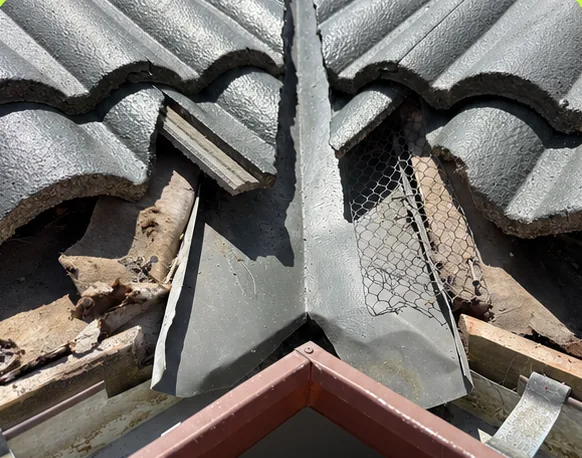
With the tile ends gone, the layers beneath were in view. On one side you can see wire netting under the tiles. On the other, weathered timber and loose debris sit beside the metal valley. Water running down this valley had an open path to the edge of the roof structure.
We do not know how the tiles broke, and the job record does not say this roof was leaking inside. So we say neither. What we can say is plain from the photo. This is the kind of damage that lets water in.
How did we repair the damaged area?
The repair stayed where the damage was. We repaired and restored the damaged area at the foot of the valley, and the rest of the roof was left alone.
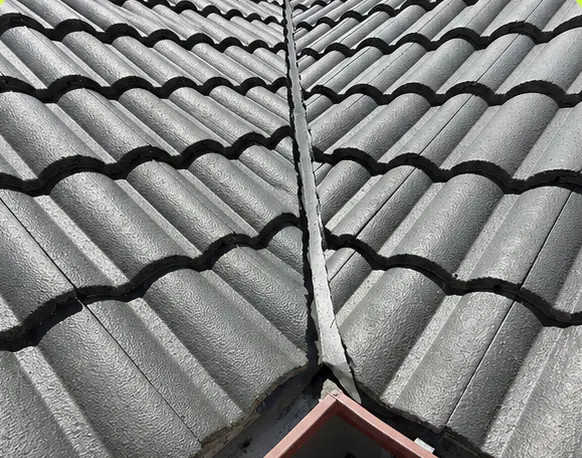
The second photo shows the same valley from the same end. The tiles are now complete on both sides. They run tight to the valley line all the way down to the gable. The netting, the timber and the debris are no longer exposed.
That is what a good tile roof leak repair looks like from the roof. The repair closes the gap, and it puts whole tiles back where broken ones were.
Why do flashings matter on a tile roof?
Flashings are the metal pieces that seal the joins in a roof: at valleys, walls, chimneys and pipes. Consumer NZ’s guide to general roof maintenance explains why they matter.
“Flashings protect vulnerable areas of the roof. If they fail they can affect the weathertightness of the roof allowing water to get into your home.”
Consumer NZ, General roof maintenance
The same guide notes that flashings “may not last as long as the roof so they will require more maintenance.” So a tile roof with sound tiles can still leak at a flashing. Our roof flashing repair guide covers that repair.
The rule behind all of this is the New Zealand Building Code. Its clause E2 External Moisture sets the weathertightness requirements that a roof must meet.
How do you find where a tile roof is leaking?
Good tile roof leak repair starts with finding the source. These steps use what you can check safely, and they narrow the search before a roofer arrives.
- Note when it leaks: in every shower, or only in heavy rain with wind.
- Mark the stain on the ceiling and take a photo of it.
- Look at the roof from the ground. Check for a tile out of line, and look at the valleys.
- If your roof space is safe to enter, look for damp timber above the stain.
- Stay off the tiles, and book an inspection.
The stain is a clue, not an address. Water can travel along the roof before it drips. Our guide on how to find a roof leak goes through the search in more detail.
Is the water already coming in? Then our guide on how to fix a roof leak covers the first hour.
Should you repair a tile roof leak yourself?
We recommend against do-it-yourself tile roof leak repair. Consumer NZ says that “clay and concrete tiles can be damaged when walked on”. It adds that on a roof over 15 degrees in pitch, “you generally have little or no chance of catching yourself before the edge if you slip.”
There is a second problem. Sealant spread over a crack hides the fault without fixing it. The next roofer then has to find the leak under the sealant. WorkSafe New Zealand’s working-at-height guidance explains the risks of roof work.
How much does tile roof leak repair cost in Auckland?
Our published prices put most roof repairs in Auckland at $150–$1,800 + GST. Within that range:
- A single tile or cracked cap replacement: $150–$350 + GST.
- Flashing repair or replacement: $300–$800 + GST.
- Valley repair: $400–$1,800 + GST.
We do not publish the price of the job in this post. The price for your tile roof leak repair depends on where the water gets in and what we find under the tiles. We confirm it in a written quote, after a free inspection.
Book a free roof inspection or call 022 501 9921, and tell us where you see the water.
What Questions Do Auckland Homeowners Ask?
Why is my tile roof leaking?
A tile roof usually lets water in at one of five places: a broken or slipped tile, the pointing along the ridge, a valley, a flashing, or the layer under the tiles. The stain on your ceiling may not sit under the fault, because water can run along the roof before it drips. An inspection on the roof finds the source.
Can a leaking tile roof be repaired without replacing the roof?
Often, yes. When the fault is local, such as a few broken tiles or one damaged valley, a roofer repairs that area and leaves the rest. On our Auckland job, the damage sat at the foot of one valley, and the repair stayed there. A roof with faults all over it is a different question.
How much does tile roof leak repair cost in Auckland?
Our published prices put most roof repairs in Auckland at $150–$1,800 + GST. A single tile or cracked cap replacement is $150–$350 + GST. Flashing repair or replacement is $300–$800 + GST, and valley repair is $400–$1,800 + GST. We confirm the price for your roof in a written quote after a free inspection.
Is a tile roof leak an emergency?
It is when water is coming through the ceiling, or when the ceiling has started to sag. Move what you can, catch the water and call a roofer. Our team answers emergency calls across Auckland on 022 501 9921. A small stain that only shows after heavy rain still needs an inspection soon.
Can I find a tile roof leak myself?
You can look from the ground and inside the roof space, and both help. We recommend against walking on the tiles. Consumer NZ warns that clay and concrete tiles can be damaged when walked on, and that a slip on a pitched roof gives you little chance of stopping before the edge.
Topics covered
- concrete tile roof leak repair
- tile roof leak repair Auckland
- why is my tile roof leaking
- tile roof valley repair
- leaking tile roof