
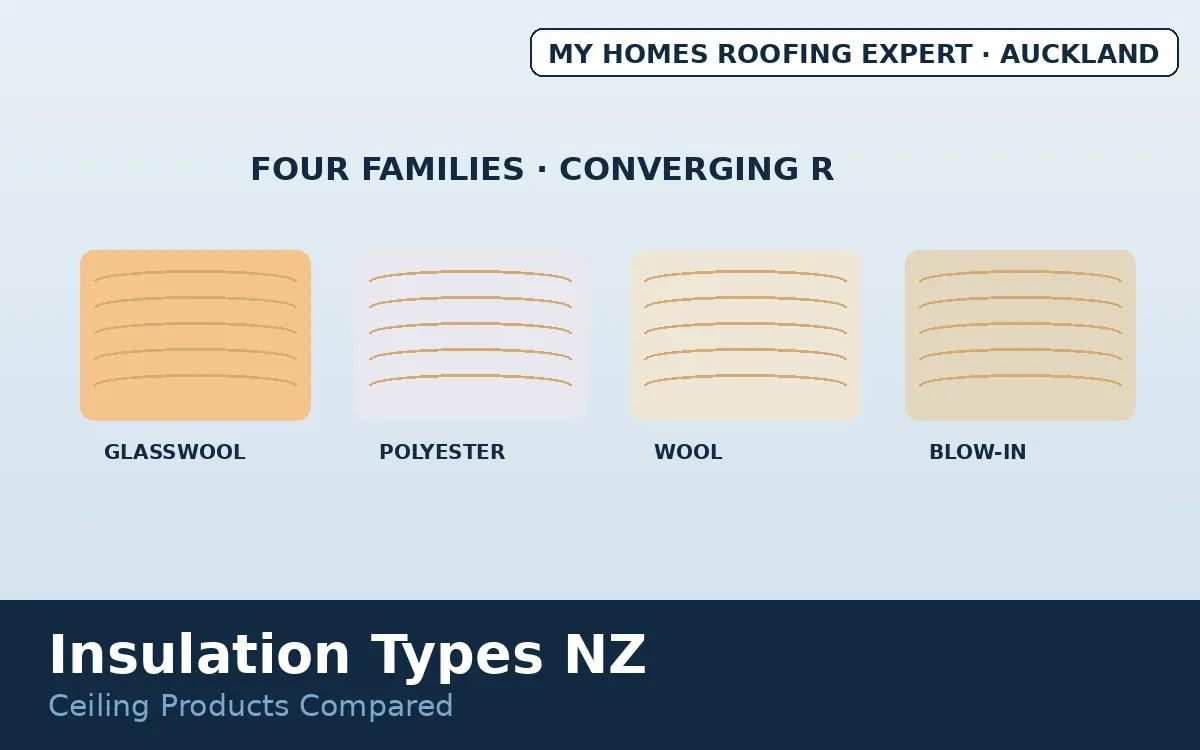
Ceiling insulation types in NZ fall into four families: glasswool, polyester, sheep wool and blow-in loose fill. All four deliver their rated R-values when installed to full coverage, and installation quality is what matters more than the label. Choose glasswool for value, polyester for handling and moisture tolerance, wool for natural-fibre values and blow-in where access is tight.
| Type | Best for | Notes |
|---|---|---|
| Glasswool | Value — the most R per dollar | Standard segment and blanket formats; the fibres demand protective handling |
| Polyester | Handling and moisture tolerance | Bonded fibre with no itch and no airborne fibres; a modest premium over glasswool |
| Sheep wool | Natural-fibre values | Buffers moisture cycles gracefully; a values purchase as much as a thermal one |
| Blow-in loose fill | Cavities hands cannot reach | Low-pitch spaces and retrofit top-ups; settled depth must be verified |
Ceiling insulation types NZ buyers compare sort into four working families — glasswool, polyester, sheep wool, and blow-in loose fill — and the comparison's honest headline is convergence: all four deliver their rated R-values when installed to coverage, and installation quality moves outcomes more than the product label does. The families differ where owners feel them: handling, moisture behaviour, access fit, and price per R.
The roof connection is direct: the cavity is insulation's home, the re-roof is its golden installation window for tight spaces, and roof moisture is its one mortal enemy — the intersections our insulation cost guide maps from the pricing side.
Which insulation type suits your ceiling?
Direct answer: glasswool for value, polyester for handling and moisture tolerance, wool for natural-fibre values, blow-in for access. The cases: Glasswool — the volume standard, delivering the most R per dollar, in segment and blanket formats every installer knows; its fibres demand protective handling, a trade concern more than an owner one. Polyester — bonded fibre with no itch and no airborne fibres, shrugging off the damp incidents that mat other products, and pleasant enough that top-up work often specifies it.
Modest premium over glasswool. Sheep wool — the natural choice, buffering moisture cycles gracefully and carrying the sustainability story, at a price that makes it a values purchase as much as a thermal one. Blow-in loose fill — machine-blown coverage for the cavities hands cannot serve: low-pitch spaces, awkward corners, retrofit top-ups; settled-depth verification is its quality discipline. Current R-value requirements have stepped up in recent years and can change — check current guidance rather than older articles, this one included.
What Is the Short Answer?
Any of the four insulates well installed well: choose glasswool by default, polyester for handling and damp-prone cavities, wool for the natural premium, blow-in where access rules. Then spend your scrutiny on coverage — continuous, uncompressed, edge-to-edge, photographed.
Formats and the cavity fit
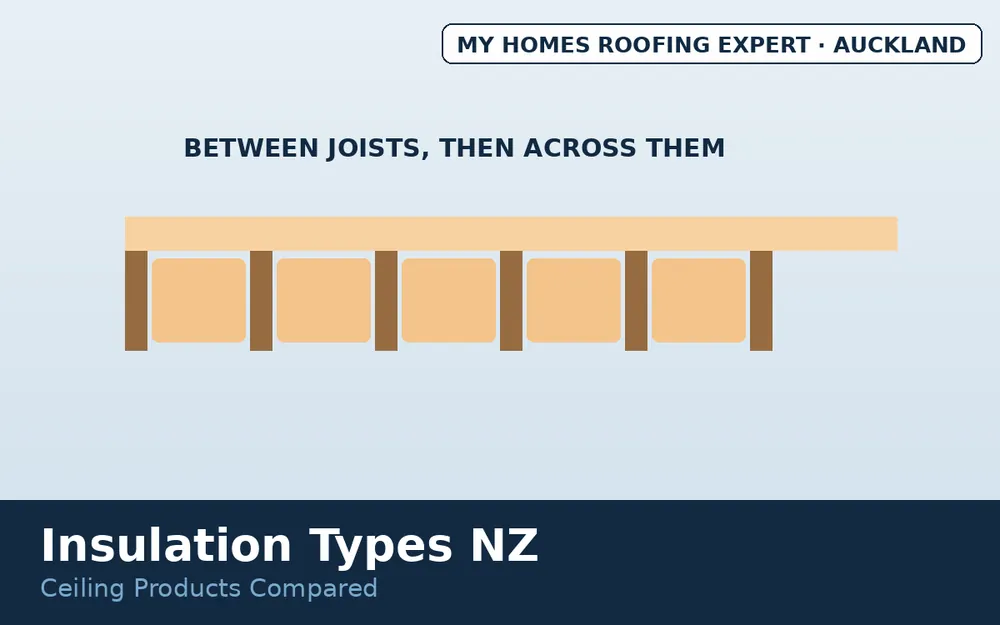
Products arrive in formats that match cavities: segments — pre-cut lengths laid between joists, the standard accessible-cavity install; blankets — continuous rolls crossing over joists as the second layer that lifts total R and blankets the thermal bridges joists create; loose fill — blown depth where neither fits. The layering logic: between-joist first, cross-layer second, the build-up modern targets generally assume. Cavity realities shape the choice: walk-space cavities take anything.
Low-pitch and skillion spaces narrow toward blow-in or the open-roof installs that make re-roofing the upgrade moment; and downlights, flues, and wiring impose clearance rules that are fire-safety specification, not preference — fitting-rated products and trained installers exist precisely for them.
Moisture — the enemy all four families share
Wet insulation barely insulates, and the cavity offers three water sources worth ruling out before any product goes in: roof leaks — the slow drips that saturate and compress whatever they find, which is why insulation projects begin with the roof inspection our moisture guides recommend; condensation — the cavity's nightly cycle, managed by the underlay and ventilation system our ventilation comparison covers; and household moisture misrouted — extractors venting into the cavity, the source error no product survives. Polyester and wool tolerate incidents better.
None tolerate causes. Dry cavity first, insulation second — the sequence that protects the spend.
What Cost, Risk and Verification Factors Apply?
Pricing stacks glasswool under polyester under wool, with blow-in priced by access more than material — inside the installed ranges our cost guide sets out, and with whole-home efficiency projects beyond the ceiling sitting naturally with the building expertise at our parent brand My Homes Construct. Verification is the owner's lever: coverage photos, stated R-values, clearance compliance at fittings. And the cavity-safety constant: joists that hold, ceilings that do not, wiring and dust between — professional territory, with the homeowner's contribution made at the hatch.
How Do You Get insulation matched to your cavity in Auckland?
My Homes Roofing Expert coordinates insulation with roof work across Auckland — cavities dried first, products matched to access, coverage photographed. Call 022 501 9921 or get in touch.
What Questions Do Auckland Homeowners Ask?
What types are available?
Glasswool, polyester, sheep wool, and blow-in loose fill — converging performance, different handling and fit.
Polyester or glasswool?
Polyester for handling and moisture tolerance; glasswool for R per dollar — both work installed well.
Is wool worth it?
As a natural-fibre values purchase, yes; on pure thermal economics, the synthetics win.
What is blow-in for?
Cavities hands cannot reach — low-pitch spaces and retrofit top-ups, verified by settled depth.
Type or installation?
Installation — continuous uncompressed coverage beats product labels every time.
What else should you know?
Does wet insulation still work?
No. Wet insulation barely insulates. Three water sources need ruling out before any product goes in: roof leaks, condensation, and household moisture misrouted into the cavity, such as extractors venting there. Polyester and wool tolerate incidents better, but none tolerate causes. Dry the cavity first and insulate second.
Topics covered
- glasswool vs polyester insulation
- wool insulation NZ
- blanket vs segments
- blow-in ceiling insulation
- insulation product comparison