
Massey's elevated, exposed, high-rainfall conditions plus its large concrete-tile stock make it genuinely moss-prone — so treatment is regular local work, killing at the root for a multi-year result the damp conditions then set the interval on. We cover the suburb from nearby West Harbour, and an inspection sorts treatment-alone from the broader work.
Roof moss treatment Massey homeowners need is driven by a clear combination: elevated, exposed, high-rainfall conditions meeting a large stock of concrete-tile roofs from the 1970s–90s subdivisions that built the suburb. Massey gets the weather, and its tile roofs give moss exactly the porous, damp-holding surfaces it thrives on — which makes the suburb one of the more moss-prone parts of West Auckland and moss treatment a regular, rather than occasional, part of local roof care.
This guide explains why Massey roofs grow moss so readily and what treating it properly involves — the moss picture for a suburb the conditions favour.
Who does roofing in Massey?
My Homes Roofing Expert covers Massey and the wider West Auckland area from our West Harbour base — moss treatment, repair, restoration, and re-roofing across the suburb's large concrete-tile stock. Because Massey's conditions grow moss readily, treatment is a core part of local work, run properly and on a sensible cycle rather than as a one-off.
A free inspection stages whether a Massey roof needs treatment alone or the broader age-related work the suburb's aging tile often calls for, and our number is 022 501 9921 for a no-obligation quote.
Why Massey grows moss — the conditions explained
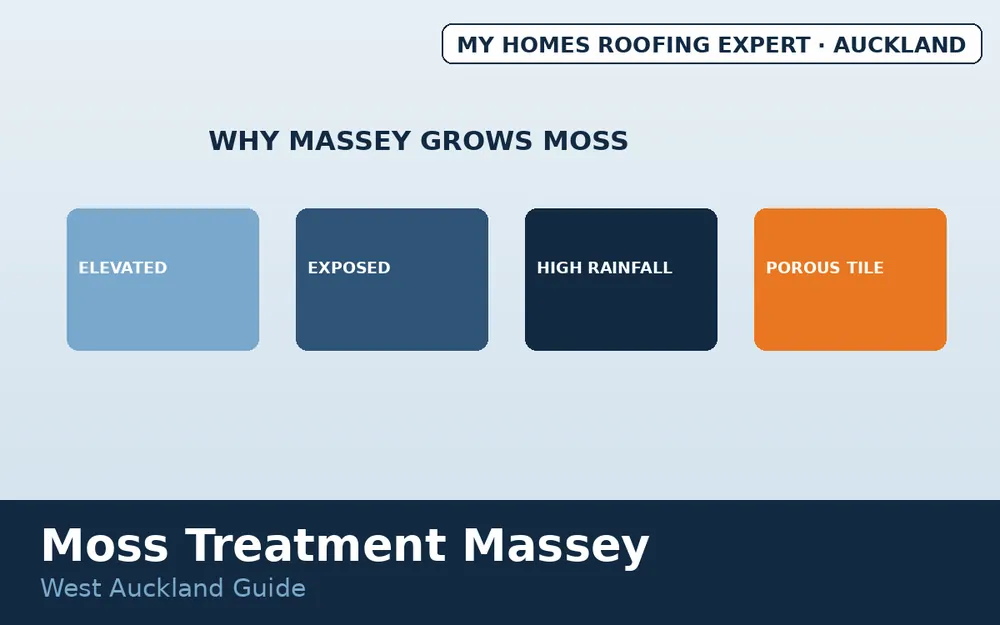
Three factors compound to make Massey moss-friendly: elevation and exposure — Massey's elevated, exposed position catches weather and stays damp, the moisture that moss, lichen, and algae need; high rainfall — the West Auckland rainfall the suburb receives keeps roofs wet, feeding growth that drier suburbs starve; and the concrete-tile stock.
The large population of 1970s–90s concrete-tile roofs gives moss its ideal home, because aging concrete tile is porous (the surface weathering our tile guide describes) and holds moisture in a way smooth steel does not, so moss establishes and thrives on it. The combination is why Massey roofs green up faster and more thoroughly than roofs in drier, sunnier, or steel-roofed suburbs — and why treatment here is maintenance rather than a rare event. The good news is that the moss is entirely manageable.
It just needs to be on the calendar, treated in the correct treat-then-clean sequence our sequencing guide sets out, and kept up on the cycle the regrowth guide maps.
Why treating moss matters — and what else Massey roofs need
Treating Massey's moss is about protection, not just appearance, because matured moss does real work on a concrete-tile roof: holds moisture against the tile, keeping it damp and accelerating surface weathering; lifts pointing — moss working into ridge mortar contributes to the failure our rebedding guide covers; blocks gutters — the shed-debris pulse (the aftercare harvest) filling spouting; and compounds aging on tiles already at the age where the suburb's stock is reaching its restore-or-replace decisions.
Which points to the broader picture: in Massey, moss treatment is often one part of a set — the aging concrete-tile roofs frequently also wanting rebedding, repointing, and eventually restoration, with the moss being the most visible symptom of roofs reaching their maintenance years. An inspection stages whether a given Massey roof needs treatment alone, treatment plus ridge work, or the fuller restoration the stock's age sometimes calls for — the honest read that puts the spend where the roof needs it.
What Cost, Risk and Local Factors Apply?
Massey moss treatment prices in the standard ranges our treatment cost guide maps, with the suburb's generally accessible single-and-two-storey stock keeping access moderate. The local risk is the deferral one: Massey's damp conditions grow moss back faster, so letting it mature between treatments lets it do the damage that treating on cycle prevents — making the regular-treatment discipline genuinely worthwhile here. Based nearby in West Harbour, we cover Massey regularly, and the honest staging of treatment-versus-broader-work is the conversation that serves the suburb's aging tile stock best.
How Do You Get a Massey roof treated and staged?
My Homes Roofing Expert treats moss and maintains roofs across Massey and West Auckland from our West Harbour base — root-kill treatment, honest staging, free no-obligation quotes. Call 022 501 9921 or book an inspection.
What Questions Do Auckland Homeowners Ask?
Who does roofing in Massey?
My Homes Roofing Expert, covering Massey and West Auckland from West Harbour — moss treatment, repair, restoration, re-roofing.
Why do Massey roofs grow so much moss?
Elevated, exposed, high-rainfall conditions plus a large porous concrete-tile stock — moss's ideal combination.
Does moss damage concrete tile?
Left to mature, yes — it holds moisture, lifts pointing, blocks gutters, and accelerates weathering.
How often should Massey roofs be treated?
On the multi-year cycle treatment buys, which the damp conditions may shorten.
Is treatment enough?
It is the foundation — aging Massey tile often also needs rebedding, repointing, and eventually restoration.
Topics covered
- Massey roofer
- roofing Massey Auckland
- roof repair Massey
- West Auckland roofing
- Massey roof moss