
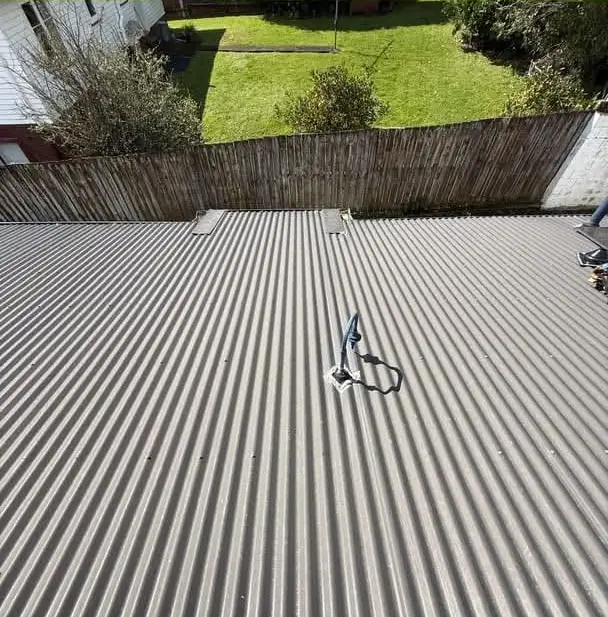
A back tray is a flat tray flashing built into a metal roof around a penetration. On this Auckland job, a pipe came through the middle of a corrugated sheet, sealed only with black sealant. We installed two flat trays running up the roof, and the pipe now passes through a square flashing in one of them.
Roof back tray flashing is a flat steel tray built into a corrugated or ribbed metal roof around a pipe or other penetration. The joint around the pipe then sits on a flat surface instead of across the curves of the sheet. This is one Auckland job where My Homes Roofing Expert replaced a sealant-only pipe joint with flat trays.
What is a roof back tray flashing?
A roof back tray flashing is a flat metal tray that replaces part of a profiled roof sheet around a penetration, such as a pipe. The pipe passes through its own flashing in the flat tray. Roofers often shorten the name to back tray.
Not every pipe needs one. MBIE’s Building CodeHub summary of the BRANZ Build article on roof pipes notes that small pipe penetrations in roofs are typically flashed using proprietary EPDM boot flashings. The right detail depends on the pipe, where it sits on the sheet and the roof profile. That is a judgement made on the roof, not from a photo.
What did we find on this Auckland roof?
The roof is dark grey corrugated metal. A pipe came up through the middle of one sheet, well away from the ridge and the edges. The visible weatherproofing at the joint was black sealant around the base of the pipe.
A pipe in the middle of a sheet is awkward to weatherproof. Rain runs down every trough of a corrugated roof, so a mid-sheet pipe sits directly in that flow. Its seal takes water from above on every wet day.
We do not know when the pipe was installed or who sealed it, and we will not guess. If you have a pipe sealed like this one, our roof repair team in Auckland can check it for you.
Why is sealant alone a weak detail around a roof pipe?
The NZ Metal Roof and Wall Cladding Code of Practice, published by NZ Metal Roofing Manufacturers, explains what sealant is for. It seals joints between cladding and flashings, and it works when it is sandwiched inside the joint. It is blunt about sealant added afterwards.
“In most cases, the post application of sealant to the outside of a joint is both futile and unacceptable.”
NZ Metal Roof and Wall Cladding Code of Practice, Flashings: Sealants
The same code says designs using sealant to seal sheet components “must always include a mechanical fastening such as a screw, rivet or a mechanical seam.” Its durability section adds that wires and conduits through the cladding need a gooseneck or proprietary cover “to prevent reliance on sealant for weatherproofness”.
The point for homeowners is simple. Sealant can be part of a good penetration detail. A bead of sealant on its own is not the detail, because a flashing has to turn the water.
What did we install on this roof?
We installed two flat trays running up the roof, with a strip of the corrugated sheet between them. The pipe now passes through a square flashing in one of the trays.
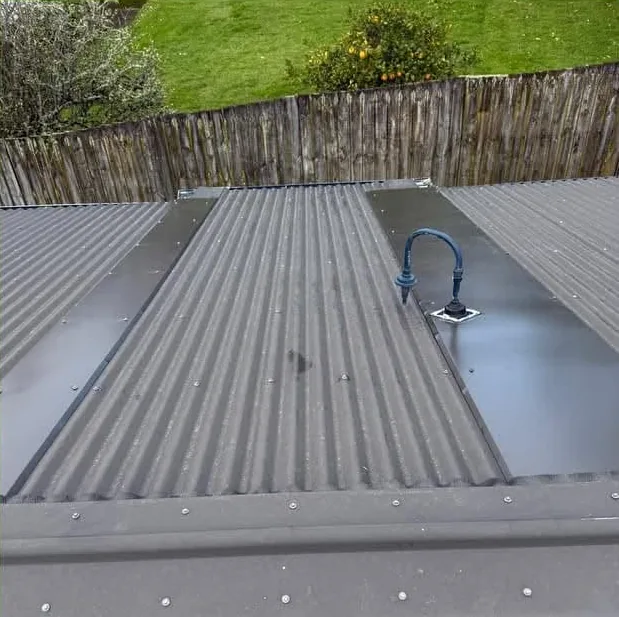
The photo does not say why there are two trays rather than one, so we will not invent a reason. It does show the change that matters. The pipe sits in a flat tray with its own flashing, instead of a sealant joint in the corrugations.
A flat tray gives a pipe flashing a flat surface to sit on. On a corrugated sheet, any flashing has to follow the curves of the profile. You can see this job’s before and after photos side by side in our back tray case study on the projects page.
How does a sealant-only joint compare with a tray flashing?
| Question | Sealant-only joint | Flat tray with a pipe flashing |
|---|---|---|
| Where the seal sits | Around the pipe, across the corrugations | On a flat tray surface |
| What keeps water out | The sealant bead alone | A flashing, with sealant only as part of the detail |
| What the Code of Practice says | Sealant added to the outside of a joint is, in most cases, “futile and unacceptable” | Sealant designs “must always include a mechanical fastening” |
| What you see from the ground | A dark bead or blob at the base of the pipe | A flat panel in the roof with a flashing around the pipe |
What should you check around pipes on your own roof?
You can check most of this from the ground or an upstairs window. Please do not climb onto the roof to look. WorkSafe New Zealand’s working-at-height guidance explains why roof work needs proper fall protection.
- Pipes, flues or cables that come through the middle of a sheet.
- Black or grey sealant around the base of a pipe, especially if it looks cracked or lifted.
- Rust staining running down the sheet below a penetration.
- Damp marks on the ceiling below where a pipe passes through.
- A pipe added after the roof was built, which may not have been flashed as part of the roof.
Our guide to roof penetration sealing in Auckland covers vents, flues and skylights as well. For the metals used, see our comparison of roof flashing materials.
How much does a flashing repair cost in Auckland?
Our published price for flashing repair or replacement in Auckland is $300–$800. Most roof repairs we quote fall between $150 and $1,800. A penetration that needs new trays is quoted after we have seen the roof.
The inspection is free and comes with a written quote. Book a free roof inspection or call 022 501 9921.
What Questions Do Auckland Homeowners Ask?
What is a back tray on a roof?
A back tray is a flat metal tray flashing built into a profiled roof around a penetration such as a pipe. The pipe passes through its own flashing in the flat tray, so the joint sits on a flat surface instead of across the corrugations. On our Auckland job, two flat trays now run up the roof around the pipe.
Is sealant enough around a pipe through a metal roof?
Not on its own. The NZ Metal Roof and Wall Cladding Code of Practice says sealant designs must always include a mechanical fastening, and that applying sealant to the outside of a joint afterwards is, in most cases, futile and unacceptable. Sealant can be part of a good penetration detail, but a flashing should do the work of turning water.
Does every roof pipe need a back tray?
No. MBIE’s Building CodeHub summary of the BRANZ Build article on pipe penetrations notes that small pipe penetrations in roofs are typically flashed with proprietary EPDM boot flashings. The right detail depends on the pipe, where it sits on the sheet and the roof profile, so a roofer decides it on site rather than from a photo.
Why is a pipe in the middle of a roof sheet harder to seal?
Water runs down every trough of a corrugated or ribbed roof. A pipe in the middle of a sheet sits directly in that flow, so the seal at its base takes water from above on every wet day. A flat tray gives the pipe flashing a flat surface to sit on, instead of the curves of the sheet.
Can I fix a leaking roof pipe flashing myself?
We advise against it. Roof work is work at height, and WorkSafe New Zealand expects proper fall protection for it. A new bead of sealant over an old joint also leaves the detail underneath unchanged. Check from the ground for sealant, rust stains and ceiling marks, then book a free inspection so a roofer can see the joint.
Topics covered
- back tray flashing
- pipe penetration through roof
- roof pipe flashing
- flat tray flashing corrugated roof
- sealant around roof pipe