
Torbay's established 70s stock needs age-related work (re-fixing, rust and moss treatment, recoating); Long Bay's newer builds need modern-roof monitoring. Both share the clifftop wind and salt of the East Coast Bays edge, making fixing and coating matter. We cover both from West Harbour.
Roofing Torbay and Long Bay means roofing two eras on one coast: Long Bay's newer master-planned builds beside Torbay's established 1970s stock, both perched on the exposed East Coast Bays edge where clifftop wind and salt are the shared conditions. It is a useful pairing to read together — the new homes needing modern-roof monitoring, the established ones needing age-related work, and both shaped by the same wind-and-salt exposure their coastal position brings.
This guide covers the two-era picture — what each stock needs, and the clifftop exposure that unites them.
Who does roofing in Torbay & Long Bay?
My Homes Roofing Expert covers Torbay, Long Bay, and the wider North Shore from our West Harbour base — repair, restoration, maintenance, and re-roofing across both the established and newer stock. Because the two suburbs span eras, the work spans modern-roof monitoring on the Long Bay builds and age-related restoration on the Torbay homes, both with the coastal-edge awareness the clifftop position demands. A free inspection reads the specific roof, and our number is 022 501 9921 for a no-obligation quote.
Two eras, two conversations
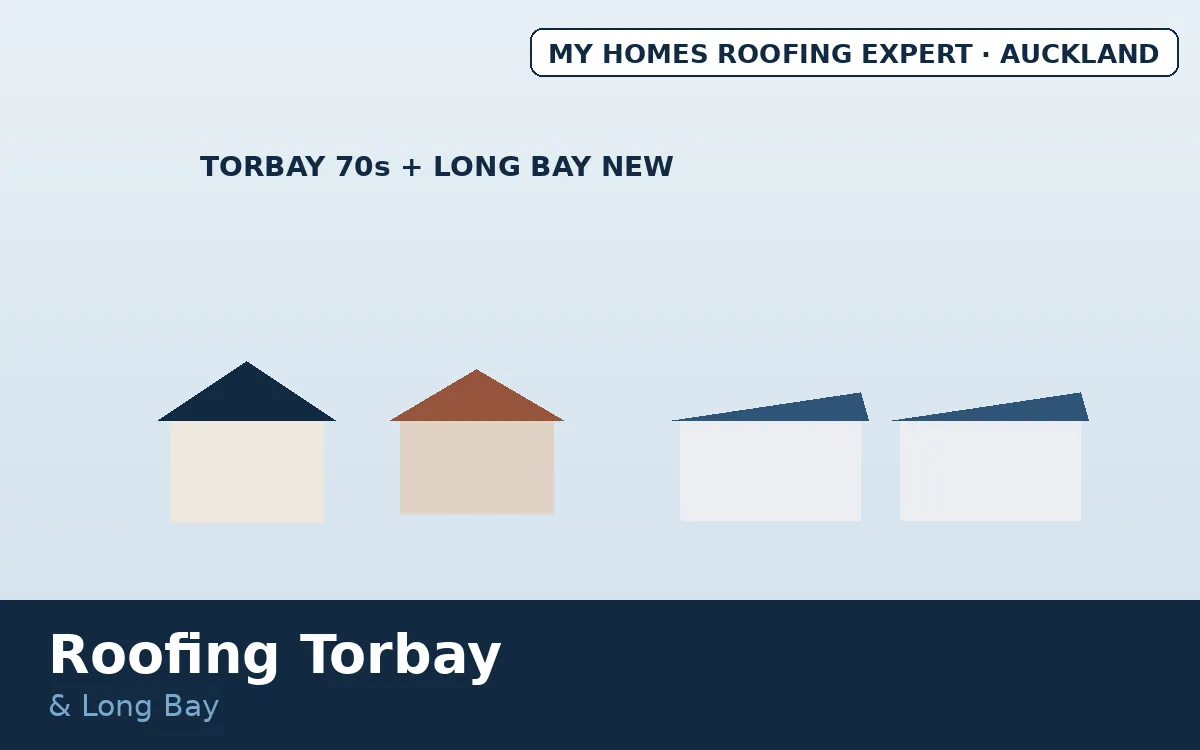
Reading the era points to the work: Torbay's established stock — the 1970s-era homes now at restore-and-maintain age, needing the lead-head conversion, rust treatment, moss treatment, recoating, and gutter work the era calls for, much of it restoring well on sound substrate (the restoration case); and Long Bay's newer builds — the master-planned development's younger roofs in maintenance, needing the drainage, fixing, and detail monitoring our modern-roof maintenance guide describes, with any low-pitch or parapet details on the watch list and the coastal salt monitored from the start. The pairing makes the point that roofing answers follow era and condition, not suburb name — and Torbay/Long Bay, with both eras visible side by side, illustrates it neatly. The inspection confirms which conversation a specific home is in.
The clifftop exposure — wind and salt together
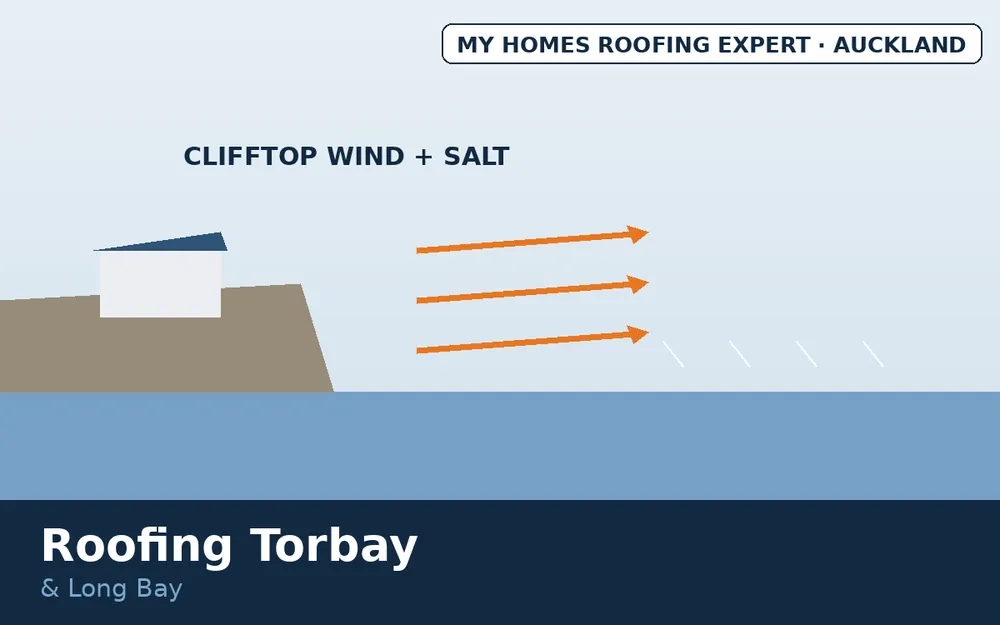
What unites the two eras is the exposed coastal edge: wind — the clifftop and open-coast positions catching more wind than sheltered streets, making wind-zone-appropriate fixing and the wind-zone patterns matter, denser at edges and ridges, with the wind-lift sequence more relevant on exposed roofs; salt — the East Coast Bays salt working on coatings, fixings, and flashings, the salt air picture applying to clifftop addresses, where grade and aluminium flashings earn their place; and the combination — wind and salt together making the established stock's fixing-and-coating condition genuinely worth maintaining, and the new stock's specification worth getting right from the start. Both eras reward treating Torbay and Long Bay as the exposed coast they are — fixings checked, coatings maintained, grade matched to the exposure.
What Cost, Risk and Local Factors Apply?
Torbay and Long Bay roofing costs span the two eras — established-stock restoration and maintenance in their ranges, modern-roof monitoring light while the Long Bay roofs are young — with the coastal-edge factors making the fixing and coating considerations worthwhile on both. The local risk is the exposure one: under-maintained fixings on the wind-exposed established stock, and under-specified or unmonitored coastal exposure on the new. Both are managed by treating the clifftop edge as the condition it is. Covering both suburbs and the North Shore from West Harbour — itself coastal — we bring the era-and-exposure read the pairing needs.
How Do You Get a Torbay or Long Bay roof assessed?
My Homes Roofing Expert roofs established and new homes across Torbay, Long Bay, and the North Shore from our West Harbour base — era read, clifftop exposure handled, free no-obligation quotes. Call 022 501 9921 or book an inspection.
What Questions Do Auckland Homeowners Ask?
Who does roofing in Torbay & Long Bay?
My Homes Roofing Expert, covering both and the North Shore from West Harbour — repair, restoration, maintenance, re-roofing.
How do the two differ?
Torbay is established 70s stock at restore-and-maintain age; Long Bay is newer builds in maintenance — two eras side by side.
Why does the clifftop position matter?
The exposed East Coast Bays edge brings both wind and salt, making fixing and coating matter on both stocks.
What do Long Bay roofs need?
Modern-roof monitoring — drainage, fixings, details, with the coastal salt watched from the start.
What do Torbay roofs need?
The age-related set — re-fixing, rust and moss treatment, recoating — with wind and salt making maintenance worthwhile.
Topics covered
- Torbay roofer
- roofing Torbay Auckland
- roof repair Torbay
- North Shore roofing
- Long Bay roofing